
-

-


Follow Us
-

 On Facebook
 On Flipboard
 On Twitter

The Montreal Canadiens have officially shed the basement dweller label. Coming out of the Olympic break, they find themselves in the thick of a playoff race, currently sitting third in a relentless Atlantic Division. The Bell Centre atmosphere has shifted from patient observation to postseason hunger, as the young core led by Nick Suzuki and Cole Caufield proves they can go toe-to-toe with the division’s heavyweights.
The upcoming influx of prospects represents the final structural pieces of the rebuilding puzzle. This isn’t just a collection of best-available-player talent; it is a calculated effort to erase foundational weaknesses. From Ivan Demidov’s game-breaking top-six scoring to David Reinbacher’s steadying presence on the right side of the defence to Jacob Fowler’s arrival as the presumptive answer in goal, this next wave of prospects is designed to turn a competitive roster into a complete one.
Canadiens’ X-Factor
The club has already added its game breaker. Ivan Demidov has already added the high-octane offensive “X-factor” that the roster lacked during the early years of the rebuild. Since joining the team from the Kontinental Hockey League (KHL) in April 2025, the 20-year-old winger has rapidly become a cornerstone of the top six, recording 47 points in 58 games (66-point pace) this season.
His skills, along with his ability to process the game at an elite speed, have been a perfect fit with Juraj Slafkovsky and have revitalized the second line, transforming the Canadiens into a multi-layered offensive threat. The good news is that they can look forward to a possible second game-breaker in a few years with Alexander Zharovsky, who has been named one of the top NHL prospects by RDS.
INSANE pass from Ivan Demidov to set up Oliver Kapanen
— Sportsnet (@Sportsnet) January 4, 2026pic.twitter.com/mmL6Zokrar
Despite this and the rapid progression of the core, the Canadiens’ roster still grapples with three critical structural deficiencies that prevent it from transitioning from a spoiler to a true contender.
First, while the club is fourth in the NHL for most goals scored, its top six still lacks balance and some size that could ensure consistent secondary scoring. Secondly, the defensive corps remains left-heavy, with a desperate need for a right-shot defenceman capable of playing heavy minutes against the opposition’s best.
Finally, the post-Carey Price era has lacked a definitive, long-term starting goaltender; while the Samuel Montembeault and Jakub Dobes tandem has been a valiant bridge, the team requires a true starter who can be a stabilizer to anchor a young group through the volatility of a playoff race.
Stabilize the Middle
The eventual graduation of Michael Hage and Owen Beck represents more than just depth; it is a calculated overhaul of the Canadiens’ spine, adding important skill sets to a centre core in need of their youth and skill.
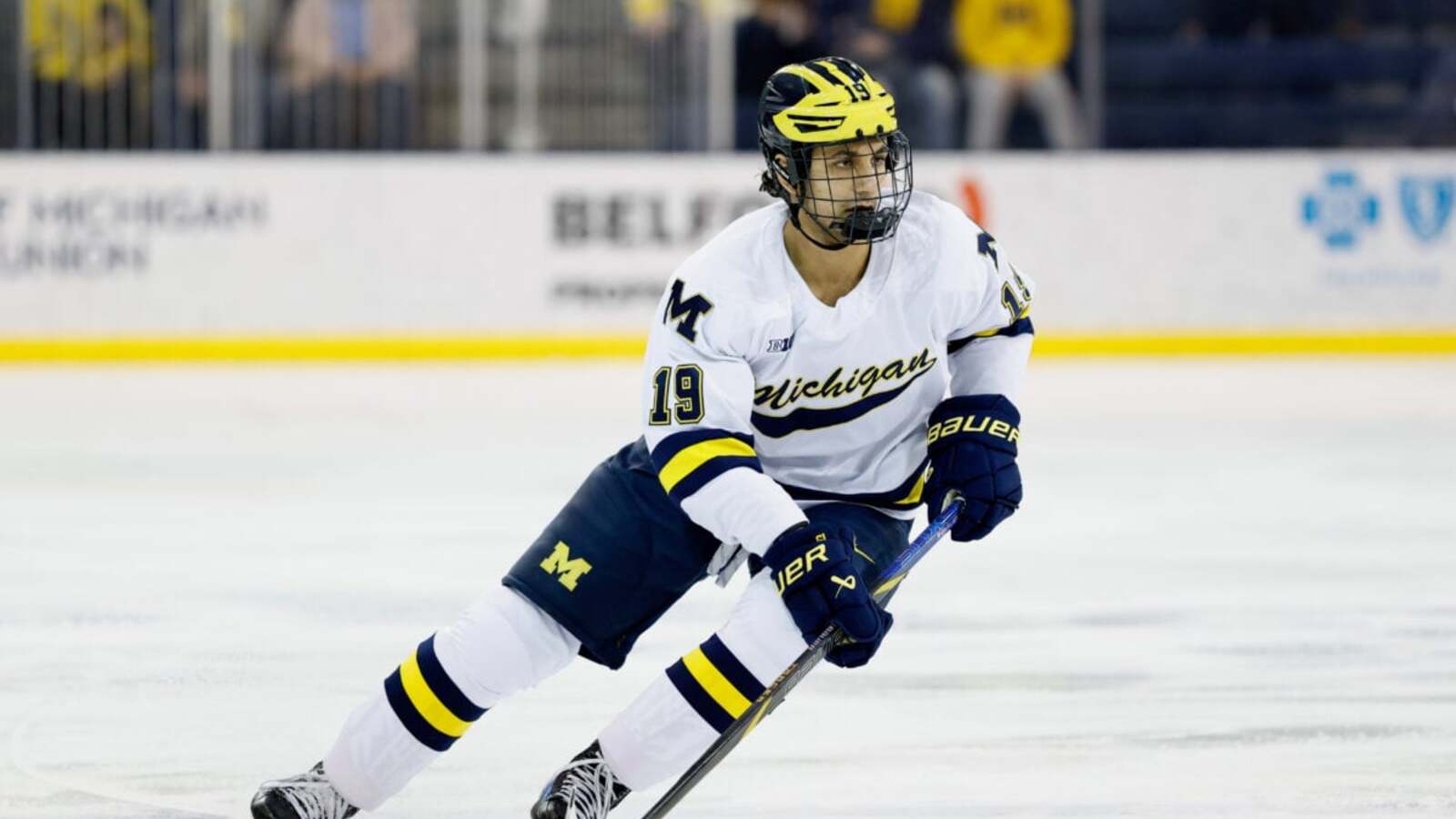
A safe bet, Beck has the highest NHL floor. He has spent 2025-26 refining a pro-style game that looks tailor-made for high-leverage situations. With an NHL faceoff percentage at 58.7% this season and elite defensive tracking, Beck projects as the quintessential third-line shutdown pivot. He could also be an immediate solution to the Canadiens’ penalty-killing (PK) woes, bringing details such as positional play, shot blocking, and an ability for aggressive puck pursuit.
Hage enters the conversation as a dynamic game-changer, currently enjoying a dominant sophomore season at Michigan (45 points in 34 games) and a record-setting 2026 World Junior Championship, where he led all players with 15 points. His play has earned him respect from coaches, but also from his peers, as Porter Martone mentioned in an interview with Marco D’Amico of RG.org.
“He’s got a really good hockey IQ and really knows how to make plays. You could arguably say he was our best player at the tournament.”
-Porter Martone
His elite vision and right-hand shot make him the perfect successor to run Montreal’s second power-play (PP) unit, providing a dual-threat scoring option that prevents opposing PKs from simply hyper-focusing on the top unit. The eventual integration of Hage and Beck could finally allow the coaching staff to force players into roles that don’t fit.
Specifically, it allows the Canadiens to move Alex Newhook to the wing permanently, where his elite speed can be weaponized in transition rather than spent on defensive zone responsibilities. It also provides internal competition with Oliver Kapanen, who has been a reliable two-way centre in a top-six role, where the team could move one of these players to the wing, adding significant depth to the top nine, or use any of them as trade bait to fill needs elsewhere.
The Blue Line Conundrum
General manager Kent Hughes has done the difficult part, adding the high-end mobility and skill every blue line needs when he drafted Lane Hutson and then traded for Noah Dobson. Now, the focus is to shift from flashy to functional, focusing on creating a balanced defensive ecosystem. The primary requirement now is a stabilizing counterweight to Hutson, who has been providing offence on par with the likes of Cale Makar.
While Hutson drives the attack, the roster has lacked a physical, right-shot puck-mover capable of logging heavy defensive minutes and anchoring a top-tier penalty kill. This structural gap often left the Canadiens vulnerable to heavy cycles and transition rushes, as the defensive corps struggled to find a reliable partner who could neutralize top-line opposition while possessing the skating ability to keep pace with a transition-heavy offensive system.
The answer to this is already in the system with David Reinbacher and the versatile Adam Engstrom; however, Reinbacher is the natural right-hander. Despite injuries, Reinbacher is emerging as a physically imposing force, now listed at a sturdy 209 pounds with significantly improved gap control and stick-checking efficiency.
His ability to kill plays before they reach the high-danger zone has been stellar. He is not flashy; he plays a safe, effective style. He clears the front of the net, he wins puck battles in his own zone to then move the puck quickly up the ice, or he can carry the puck under control in transition. Once in the offensive zone, he holds the zone and keeps the puck in play, but can also use his mobility to quickly cover for an error in coverage.
Dineen de Reinbacher et Tuch
— Rocket de Laval (@RocketLaval) February 28, 2026https://t.co/27AJVjVrlB pic.twitter.com/UCr0Q0TRd3
Reinbacher’s defensive intelligence and physical presence provide the safety net required for Hutson to take offensive risks, finally giving Montreal a modern, top-four rotation that can both produce and protect.
The Canadiens’ Heir Apparent
The final piece of the Canadiens’ rebuilding puzzle lies in the crease, where the organization has needed a definitive successor to Price. The current Montembeault/Dobes tandem has provided much-needed air cover during the rebuild, but for the team’s window of contention to open, the requirement has shifted from competent to elite. Montreal needs a goaltender who thrives under the unique pressure of the Bell Centre.
That goaltender seems to be Fowler, who has met every challenge with a level of composure that belies his 21 years. After an elite NCAA career at Boston College, where he set a freshman record for wins and took home the 2025 Mike Richter Award as top NCAA goaltender, Fowler’s transition to the professional ranks has been seamless.
In 26 games with the Laval Rocket this season, he has posted a stellar 2.23 goals-against average (GAA) and a .915 save percentage (SV%), numbers that earned him a celebrated NHL debut in December 2025 against the Pittsburgh Penguins. Making 36 saves in a 4-2 victory, Fowler joined the likes of Ken Dryden, Patrick Roy, and Price as Canadiens’ netminders to win their debut in Pittsburgh, proving his calm-under-pressure reputation is more than just scouting hyperbole.
Fowler’s arrival should solidify Montreal’s goaltending depth chart for the next decade. His technical precision and economical movement allow him to stay square to shooters, effectively killing plays by smothering rebounds and reducing defensive zone chaos. With Fowler in the fold, the Canadiens have a youth-filled goaltending backbone (with Dobes in tandem) required to transform their high-end prospect pool into a legitimate championship contender.
The Pesky Salary Cap
The staggered entry of high-end prospects like Demidov, Hage, and Fowler creates a strategic rolling window for Montreal’s salary cap management. By spreading these signings out, Montreal ensures that its entry-level contracts (ELCs) don’t all expire at once. This prevents a cap logjam where multiple stars require massive second contracts (bridge deals or long-term extensions) in the same summer.
Instead, as veterans like Brendan Gallagher ($6.5 million) and Josh Anderson ($5.5 million) see their expensive deals expire in 2026 and 2027, the savings are naturally reallocated to the next wave.
This transition is further bolstered by a projected NHL salary cap jump to approximately $113 million within the next three seasons, allowing management to absorb the performance bonuses of players like Demidov and Hage while keeping the core of Suzuki, Caufield, and Slafkovský locked in at team-friendly percentages of the total cap.
Montreal’s meticulous draft and development blueprint is nearing the moment it fully crystallizes into a formidable NHL reality. By staggering the arrivals of game-breaking talents like Demidov and adding skilled depth with Hage, defensive insulation with Reinbacher, and the steadying presence of Fowler, the Canadiens will have successfully built a roster where high-end skill is balanced by positional discipline.
Thus, ensuring the team is physically, strategically, and financially prepared to compete in the Atlantic Division’s elite tier for the next decade.
More must-reads:
- Kings HC Jim Hiller's once-promising tenure ends in disappointment
- Alexander Ovechkin inches closer to Wayne Gretzky for overall scoring record
- The 'Most NHL goals by an American' quiz
Breaking News
Trending News




Customize Your Newsletter
 +
+




Get the latest news and rumors, customized to your favorite sports and teams. Emailed daily. Always free!
PRIVACY POLICY COOKIE POLICY CONTACT US
ABOUT YARDBARKER TERMS OF SERVICE


By using this site, you agree to our Terms of Service and Privacy Policy.
This site is for entertainment purposes only.
There is no gambling offered on this site.
Gambling Problem? Call 1-800-Gambler.
