
-

-


Follow Us
-

 On Facebook
 On Flipboard
 On Twitter
June 9, 2010: Patrick Kane skates away from Flyers goaltender Michael Leighton, arms in the air, cheering. Kane is the only player on the ice celebrating. Leighton, the only player in silent shock. Kane skates towards the Chicago Blackhawks bench, gathering his teammates for a celebration. Where's the puck? Did Kaner just score? Did he just win the Stanley Cup?
The Chicago Blackhawks just beat the Philadelphia Flyers 4-3 in overtime, Game Six of the Stanley Cup Final. One of the NHL's oldest franchises finally ends a championship drought dating back to 1961.
The 2010 Stanley Cup Final was poetic. Chicago witnessed the start of one of the most dominant teams in the post-salary cap era of the NHL. A team that revived a dead franchise and reignited the love of hockey in Chicago.
The Hawks of the 2010s are a golden chapter in a saga that begins in 1926. A year in which only seven teams existed in the National Hockey League. The Montreal Maroons beat the Victoria Cougars of the Western Hockey League for the Stanley Cup. The NHL is entering its tenth season, and they are eyeing which cities are ripe for expansion.
Expansion in Chicago
In 1926, the NHL wanted to expand into the US following the successful Boston Bruins (1924) and the Pittsburgh Pirates (1925). The NHL had four teams in Canada ( the Toronto St. Patricks, the Maroons, the Montreal Canadiens, and the Ottawa Senators). The US only had three, the New York Americans being the third team. In addition to the success of the Boston and Pittsburgh teams, there was a major shift in the professional hockey world.
The WHL, the largest competitor of the NHL since 1921, folded in 1926. The NHL and WHL met every year to battle for the Stanley Cup. Now, the NHL had access to the world's best hockey players and control of the coveted Cup. With an influx of talent, the NHL had the flexibility to expand in multiple cities. But which ones?
The NHL's board of governors met twice in 1926 to determine the next teams. Four cities were at the top of the list, and each required a unanimous vote to be awarded an NHL team: New York City, Detroit, Philadelphia, and Chicago. In the April meeting, New York and Detroit received unanimous votes, but Chicago and Philadelphia did not.
New York was an easy city to award a new franchise. Tex Rickard, owner of the Rangers, built the third iteration of Madison Square Garden. Detroit was going to build a massive arena. But Chicago didn't have an arena. Tex proposed building a Chicago arena larger than Madison Square Garden, and another Chicago-based group was ready to build an arena for a professional hockey team.
Chicago was a city on the rise. Perfect for a hockey team, which business investors thought of as one of the more profitable sports at the time. Tex had a group of businessmen ready for ownership, led by former football star Huntington Hardwick. The competing group was led by Paddy Harmon, who partnered with the owner of the New York Americans, Thomas Duggan.
Duggan feared that Hardwick was merely a way for Tex to own a second franchise in the NHL, so he voted against the new franchise. Chicago needed a unanimous vote, and the NHL needed the Chicago team. Harmon was ready to build the new arena, and with it, a new hockey team. That team would either be in the NHL or another professional hockey league.
This division over the Chicago franchise was so severe that owners of the other franchises discussed leaving the NHL and forming a new league. To save the league, an amendment to the NHL's constitution was implemented: a majority vote was needed to award a city a new franchise. On May 1, the owners met again and voted in favor of Chicago. Hardwick became the owner of the new Chicago franchise.
On May 1, 1926, the NHL officially expanded to three teams in New York, Detroit, and Chicago. With Chicago approved for a new professional hockey team, all they needed were players. The answer was in Portland, Oregon.
The Portland Rosebuds
The NHL agreed that the new Detroit and Chicago franchises could purchase former WHL teams for $100,000 to fill their rosters. The rest of the WHL would be spread throughout the weaker teams of the NHL. Detroit purchased the team that lost in the Stanley Cup Final, the Victoria Cougars, and became the Detroit Cougars. Hardwick purchased the Portland Rosebuds for his Chicago team, which was listed as the Chicago National Hockey Team, Inc.
The Chicago franchise and the Detroit Cougars were officially accepted on May 15. They had until September 1 to build an NHL roster and November 10 to build an arena.
The Rosebuds had relative success in Portland. The first iteration of the team played from 1914-18 and won the Stanley Cup in 1916. The WHL team lasted only one season, 1925-26. The head coach, Pete Muldoon, stayed in Chicago and the roster provided Chicago with notable players, including franchise star Dick Irvin.
Huntington Hardwick had his new team in Chicago, but his ownership was short-lived. It's unclear if Hardwick faced pressure from Tex's rivals. On June 1, Hardwick notified the NHL that the Chicago team had a new owner: "a Chicago man will shortly be elected President, and the Board of Directors will be composed largely of Chicago men." The Chicago man referenced was Frederic McLaughlin, owner of McLaughlin's Manor House coffee in Chicago.
The Chicago Black Hawks
Frederic McLaughlin was an officer with the United States Army during World War I and served with the 86th Infantry Division, nicknamed the "Blackhawks." In 1917, when the unit was created, men from Illinois and Wisconsin filled its ranks. Officers were trained in Fort Sheridan, just outside of Chicago. The namesake of the 86th is derived from the Sauk leader Mahkatêwe-meshi-kêhkêhkwa, also known as "Black Hawk."
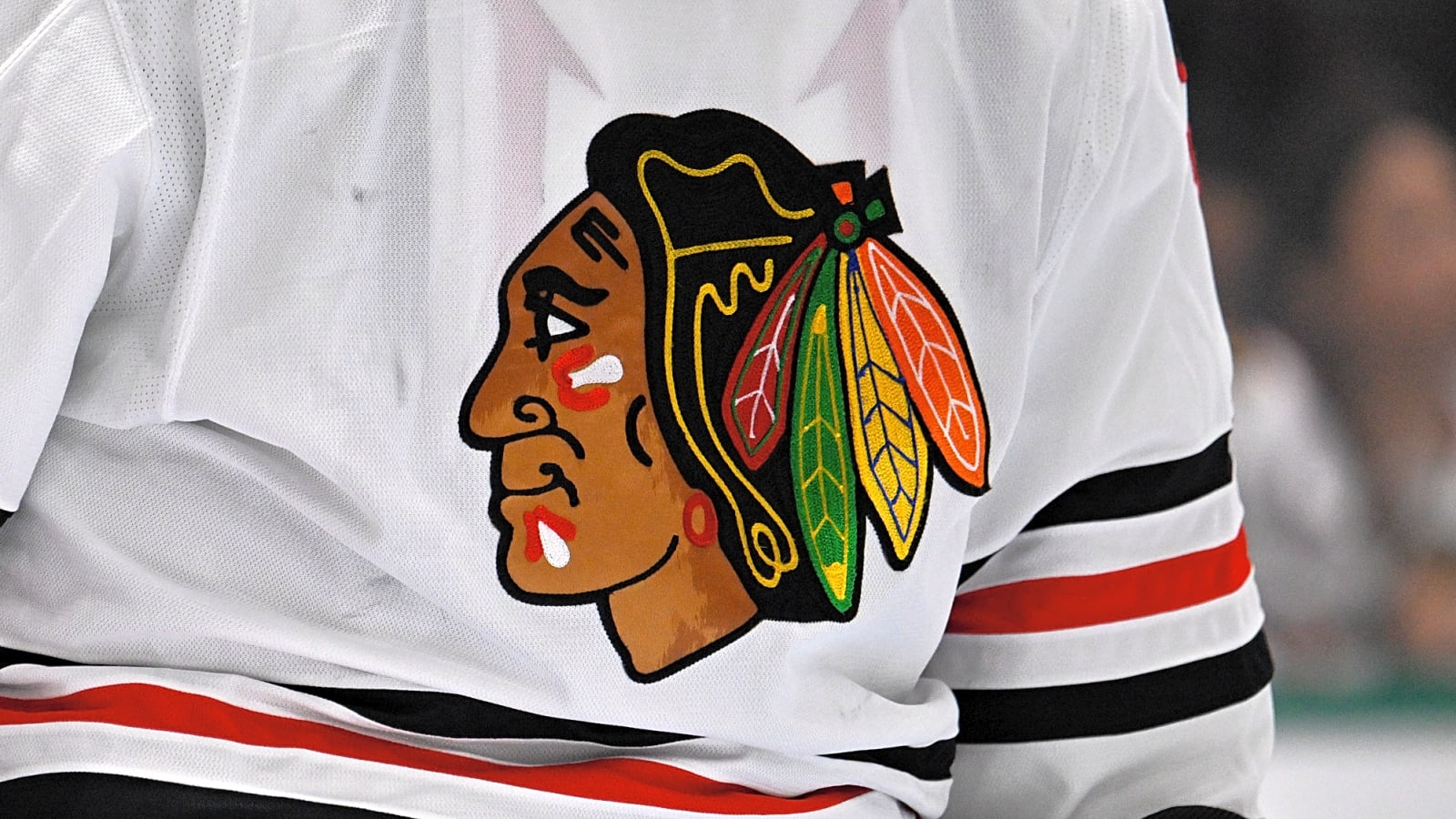
While the Chicago Black Hawks were named after McLaughlin's infantry unit, the team took on the identity of Black Hawk's legacy. In fact, the original documents naming the Chicago franchise list the team as the "Blackhawks," with no space, just as the 86th's nickname. McLaughlin's wife is credited with creating the first logo of the Chicago Black Hawks, representing the Sauk leader.
Black Hawk was an important leader in Sauk history, and an article will be written about him. Black Hawk filled a leadership void when required and led his men in battle without being an actual "war chief." Following the Black Hawk Wars, he was captured and taken on tour around the US.
The use of Black Hawk as a logo reflects the intersection between Native American and US history. The logo embodies what Black Hawk believed in and fought for. Black Hawk was quoted as saying that he hopes the people who took his land can work together as friends. He was a warrior for his people who ultimately wanted humans to work together in peace.
That's why this logo is important. It keeps the memory of an important person alive. It keeps the memory of what he stood for alive. It's one of the most important logos in sports because it's more than a logo.
What's On Tap Next?
In the next installment of Blackhawks history, we look at the first season of the Chicago Black Hawks in 1926.
Sources: Jenish, D'Arcy (2013). The NHL: 100 Years of On-Ice Action and Boardroom Battles. New York, NY: Random House
Antrobus, Augustine M. (1915). History of Des Moines County, Iowa: And Its People, Vol. 1, Chicago: S.J. Clarke
More must-reads:
- Former Maple Leafs player floated as GM candidate after Brad Treliving firing
- Capitals' Alex Ovechkin makes more NHL history with another 30-goal season
- The 'Active 30-point NBA games leaders' quiz
Breaking News
Trending News




Customize Your Newsletter
 +
+




Get the latest news and rumors, customized to your favorite sports and teams. Emailed daily. Always free!
PRIVACY POLICY COOKIE POLICY CONTACT US
ABOUT YARDBARKER TERMS OF SERVICE


By using this site, you agree to our Terms of Service and Privacy Policy.
This site is for entertainment purposes only.
There is no gambling offered on this site.
Gambling Problem? Call 1-800-Gambler.
