
-

-


Follow Us
-

 On Facebook
 On Flipboard
 On Twitter

The Olympics gave the Edmonton Oilers a rare three-week reset after a disappointing stretch of hockey. They limped into the break with an underwhelming 4-5 record despite playing eight of those nine games at home.
Coming out of the pause, they introduced major changes across both personnel and systems. They traded for Jason Dickinson, Connor Murphy and Colton Dach, adjusted their breakouts, and completely overhauled their penalty kill.
Despite the changes, Edmonton’s record over the last nine games is 4-4-1, nearly identical to the nine games before the Olympics. It’s a disappointing result, but make no mistake: the Oilers are playing very differently, and there are reasons to be optimistic. I’ll be looking under the hood to see what’s different about the team lately and where things are trending.
Team defence
In the past few weeks, the Oilers have been doing a much better job of controlling play at 5-on-5, and most of that improvement has come from their defence. Before the Olympics, Edmonton ranked 27th in expected goals against, but since then, they’re fourth-best in the NHL.
Back in early February, when the team was spiralling defensively, Kris Knoblauch commented on the number of quality looks they were giving up.
“The quality of the chances is something that has to be addressed,” he said. “Less breakaways or two-on-ones, odd man rushes, those kinds of things, where that is leading to goals. It has to get better. Like more perimeter shots.”
Knoblauch was right: it wasn’t so much the volume of chances the Oilers were giving up, but the ones they were conceding were often from the slot or off the rush.
Over the last nine games, Edmonton’s shots against per game have hardly changed, but there’s been a significant reduction in expected goals. That suggests the Oilers are giving up far more shots from the outside and fewer from the high-danger areas.
There are a few key differences that have led to the improved defensive play, starting with the breakouts. For most of the season, the Oilers’ forwards were blowing the zone without any support down low for the defence. There was too much distance between the forwards and the defence, and opposing teams could read the stretch passes.
The poor breakouts often led to turnovers, odd-man rushes, and lethal counterattacks. Lately, the Oilers have been much more disciplined in supporting the forwards down low on breakouts, and these types of chances have become fewer and farther between.
Another change Edmonton has made is to its personnel. Dickinson and Murphy are both top-15 defensive players at their positions. While neither produces much offence, they provide the coaching staff with a reliable option for defensive-zone draws and matchups against the other teams’ best players.
Per PuckIQ, Dickinson and Murphy have played 65 per cent and 60 per cent of their time on ice against elite competition, respectively, since joining the Oilers. It’s a small sample, but those numbers are sky-high. For reference, Shane Pinto currently leads the league this season with 50 per cent of his minutes coming against elites.
The Oilers have thrown Dickinson and Murphy to the wolves, with a heavy dose of defensive zone draws and tough matchups. While they are unsurprisingly being outplayed, both have performed admirably defensively, with Dickinson even ranked third best on the team at suppressing expected goals over the past few weeks.
Depth players like Dach, Josh Samanski, and Trent Frederic have stepped up defensively too, helping stabilize minutes that were previously spiralling out of control. Before the Olympic break, the Oilers were outscored 60-32 with a 44 percent expected goal share without McDavid and Draisaitl on the ice—absolutely catastrophic numbers. Since then, they’ve only been outscored 8-7 while breaking even in expected goals.
Edmonton has found a defensive identity, collapsing to the slot and allowing more perimeter shots. The depth players settling into their roles and sticking to the structure is creating more balance to the lineup than before.

Penalty Killing
Over the last few seasons, the Oilers have played a wedge +1 penalty kill structure, which led to one of the greatest shorthanded runs of all time in the 2024 playoffs. After regressing last season, the coaching staff changed the system to a 2-2 box. That change turned out to be a costly mistake.
Their penalty kill fell to 26th in the NHL by early February, and in the final nine games before the pause, Edmonton was only killing off 61.5 per cent of penalties.
I went into detail in an earlier piece, breaking down why the new penalty kill system failed, so that I won’t spend too much time on it. Essentially, the Oilers weren’t defending the slot or the net front nearly as well as they did with the old system.
The coaches used the break to reintroduce the wedge + 1, which has yielded better results. Their PK percentage has improved to 76 per cent over the last nine games, good for 18th in the league over that stretch.
They also received a boost from Dickinson and Murphy, who formed part of the Chicago Blackhawks’ league-best penalty kill unit this season. It’s still not where the Oilers want to be, but considering the spotty goaltending they’ve received from Tristan Jarry, a 76 per cent penalty kill is a big step in the right direction.
Offence
The Oilers have focused heavily on tightening their defensive structure, but the offence hasn’t disappeared. They’re still scoring at an exceptional clip over the past nine games, ranking second in the NHL in 5-on-5 scoring and first on the power play.
While the goals are still coming, the volume of chances has decreased recently. Edmonton is averaging roughly three fewer shots per game at 5-on-5 post-Olympics, and the expected goals have slightly dipped from 2.76 per hour to 2.64.
Some of the scoring recently appears to be inflated by their shooting percentage of 13.1, which leads the Western Conference over that timeframe. They appear to have sacrificed some offence in their pursuit of better defence, and while it hasn’t bitten them yet, eventually the goals will likely come down a bit if they don’t generate more chances.
One encouraging revelation for the offence, however, is Matt Savoie’s recent breakout. Savoie has eight points in the last nine games and leads all Oiler forwards in points per hour in that time, besides McDavid, Draisaitl, and Dach, who have only played 16 minutes.
Recently, Savoie was elevated to the top line, replacing the injured Ryan Nugent-Hopkins, and his chemistry with McDavid was evident. They generated numerous rush chances and posted dominant play driving metrics. The two connected for a beautiful McDavid goal late in the second period against the Blues.
The Nugent-Hopkins-McDavid-Hyman line had become stale recently and clearly needed a reset. Savoie gives them another option that might be worth sticking with even when Nugent-Hopkins returns. The offensive upside is there for Savoie.
Goaltending
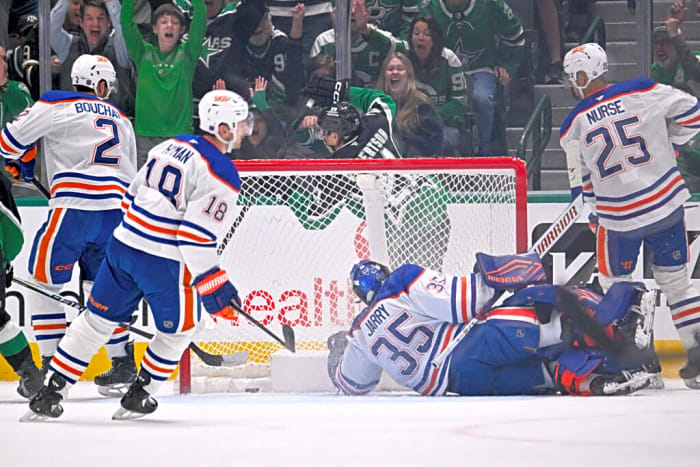
So far, in this piece, I’ve been quite positive, and why wouldn’t I be? The Oilers are controlling play much better, improving from a 50.7 percent expected goal share to 54.2 percent over the past three weeks. Their team defence has gone from the bottom five to the top five. Their penalty kill is improving. Unfortunately, that’s where the positives end, because there’s an elephant in the room: the goalies can’t stop the puck.
Even with recent progress on defence, Edmonton ranks last in the NHL over the past nine games with an .849 save percentage.
A 7-2 drubbing at the hands of the Dallas Stars was the latest meltdown for Jarry, who has quickly approached unplayable territory. Over his last four starts, Jarry has an .811 save percentage, and his .855 mark as an Oiler is the worst in franchise history for a goalie with at least 15 games played.
Keeping pucks to the outside and protecting the slot isn’t enough right now. Jarry has a .937 save percentage on long-range shots according to NHL Edge, when the league average is .967. It’s not the high-danger chances that he is struggling with. It’s the medium and low-danger ones.
Could the Oilers do a better job boxing out forwards in front of the net and making it easier for him to fight through screens? Absolutely. But the defence cannot be blamed for this level of ineptitude. It’s not acceptable at the NHL level.
For all his faults, and he had several, Stuart Skinner never reached a floor quite this low, and Stan Bowman and the Oilers are surely feeling buyer’s remorse. Much like the Jack Campbell situation a few years ago, Edmonton has no choice but to turn to a goalie they never planned to be their starter.
Connor Ingram’s performance hasn’t been lights out by any means, but it’s been passable. He has an .878 save percentage and -2.39 goals saved above expected in his last seven starts. On the season, Ingram’s underlying numbers are eerily similar to Calvin Pickard’s, which isn’t ideal, but it’s certainly better than the alternative.
Jarry isn’t eligible to be sent down to the minors for the rest of the regular season because he was still on the roster at the trade deadline, but it wouldn’t surprise me at all if, come playoff time, we see an Ingram-Pickard tandem with Jarry in the press box.
Outlook
The Oilers have plenty of reasons to be optimistic based on their recent performance. The penalty kill system is slowly bringing them back toward league average, and the team defence has done a 180.
They’re doing precisely what they said they wanted to accomplish the rest of the season, by reducing the quality looks against and forcing more perimeter shots. The ultimate question is whether they can start to get some saves. If they don’t, none of the structural improvements will matter. It’s become increasingly unlikely that Jarry will find his game in time for the playoffs, but if Ingram can, there may still be a path for a deep run this spring.
More must-reads:
- Devastating injury update emerges on Maple Leafs' Auston Matthews after 'dirty' hit from Radko Gudas
- Lakers' LeBron James credits enthusiastic young fan for overtime win over Nuggets
- The 'Most men's NCAA Tournaments' quiz


Customize Your Newsletter
 +
+




Get the latest news and rumors, customized to your favorite sports and teams. Emailed daily. Always free!
PRIVACY POLICY COOKIE POLICY CONTACT US
ABOUT YARDBARKER TERMS OF SERVICE


By using this site, you agree to our Terms of Service and Privacy Policy.
This site is for entertainment purposes only.
There is no gambling offered on this site.
Gambling Problem? Call 1-800-Gambler.
