
-

-


Follow Us
-

 On Facebook
 On Flipboard

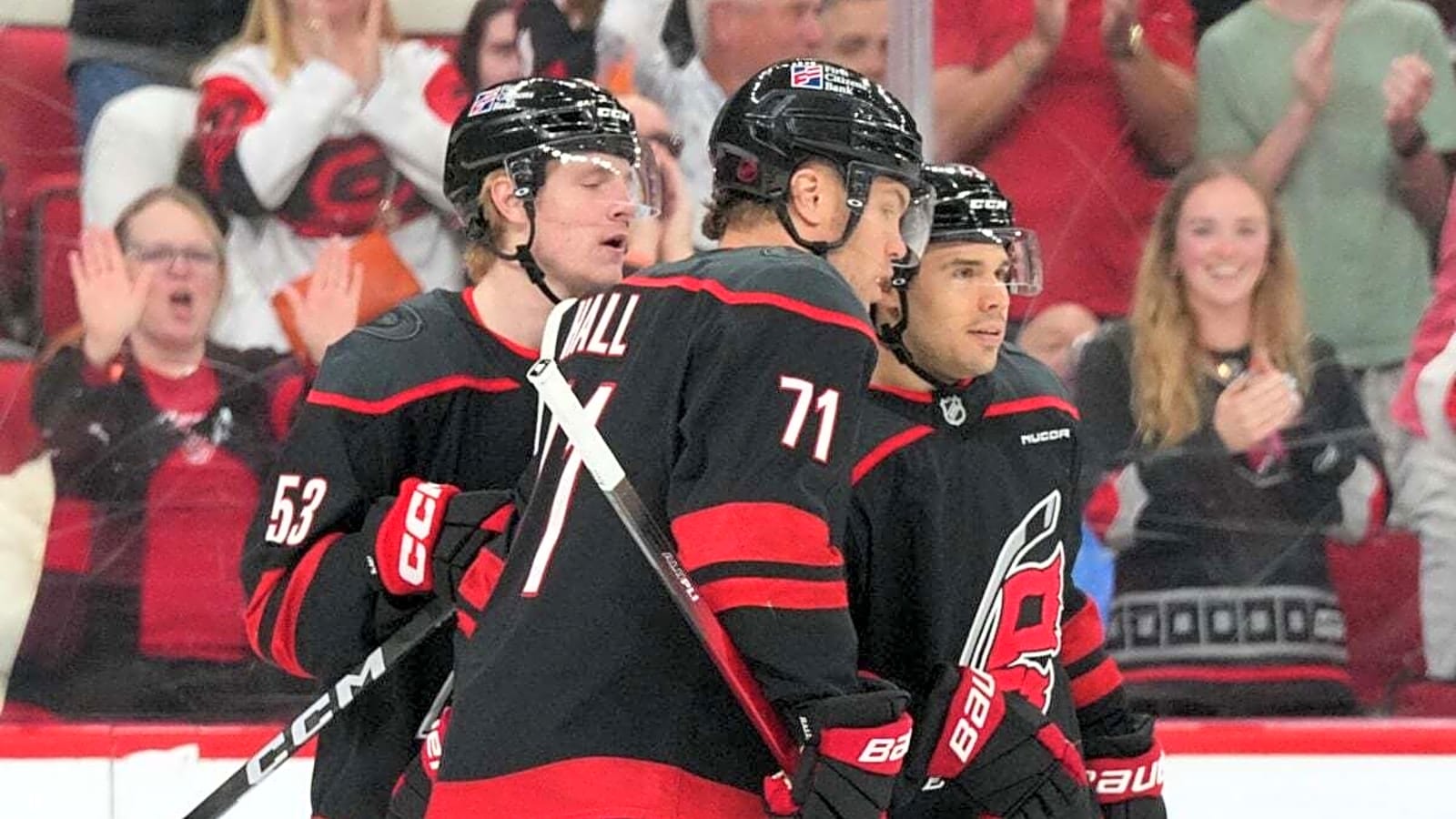
The Carolina Hurricanes won the 2026 Stanley Cup on the back of one line. Logan Stankoven, Jackson Blake, and Taylor Hall propelled the Hurricanes to the most dominant championship run, in terms of record, of the salary cap era. The 16-3 Hurricanes were led by this trio to break down the door they had been knocking on for a decade. But there is one lingering question. Is it sustainable?
That question is worth more than money. Postseason success does not necessarily equate to regular-season success, and the Hurricanes need to understand whether they caught lightning in a bottle with Stankoven, Blake and Hall or if they are just a building block toward the next wave of support to join the roster’s established core. General manager Eric Tulsky already knows what he wants to do and what he believes with this trio, but what about the fans?
Brind’Amour Finds Right Combination
Last season, Carolina’s forward combinations remained essentially unchanged. The line juggling early on was due to Stankoven playing at center for the first time at the NHL level. Because he is undersized, head coach Rod Brind’Amour wanted bigger players, like Andrei Svechnikov, around him for protection. That didn’t work.
Carolina tried Nikolaj Ehlers on this line; they tried Seth Jarvis, too. Eventually, they settled with Blake on the right, leaving a hole on the left. When Svechnikov had his early-season issues and was sliding down the lineup, the Hurricanes promoted Hall and landed on the trio that almost single-handedly won them the Stanley Cup.
Why settle on this combination? Blake led the line with 53 points, Hall had 48, and Stankoven only had 44 – not stats that suggested they were special, right? However, according to MoneyPuck, that trio had 3.7 expected goals for per 60 (xGF/60). For reference, the Hurricanes’ ground-breaking top line, where all 30 members broke either 30 goals or 70 points, had a 3.15 xGF/60. If Svechnikov-Aho-Jarvis couldn’t match that, this line was doing something right. The offense was there for the Stankoven line. However, it wasn’t all rosy.
Despite having a proportionally high xGF/60, their expected goals percentage was just 58% (xG% is a share of the expected goals when you’re on the ice), which highlighted their defensive issues. The Stankoven line could create, but they also had a 2.65 expected goals against per 60 (xGA/60), by far the highest of any line on the Hurricanes that played 300 minutes or more. That, combined with the struggle to convert dominant chances into goals, was why they were not played more frequently.
What Caused the Second Line’s Offensive Outburst?
In the playoffs, that second line became a monster. Stankoven’s 11 goals in 19 games led the team, Hall reverted to Hart Trophy form, and Blake delivered an iconic moment in Game 4 against the Philadelphia Flyers in Round 2 with the “HeartBlaker” in overtime to send the Hurricanes through to the Eastern Conference Final.
Blake’s 20 points led the team, as he became just the third Hurricane to ever reach the 20-point plateau in a postseason, joining Cory Stillman and Eric Staal from 2005-06. So, why did they burst into life?
Well, let’s turn to the analytics. MoneyPuck says the Hurricanes’ second line had an xGF/60 in the playoffs of 4.29. When the number starts with a three, it’s good. When it starts with a four, it’s ridiculous. They got slightly better defensively, with an xGA/60 of 2.17, which was still the second-worst of all the team’s lines. They began to generate for fun. It got to a point where the other three lines just had to shut the game down, and the Hall-Stankoven-Blake trio would break the game open.
What changed? Luck. In the regular season, this line was slightly unlucky. Stankoven had a PDO (or puck luck, a metric that combines on-ice save percentage with shooting percentage) of .993, Blake had a PDO of .991, and Hall had a PDO of .988, according to Natural Stat Trick. Above one, you’re benefiting from luck. Below one, you’re unlucky. The further from one, the luckier or unluckier you are. That’s the logic, though there is no “perfect” way to define luck. In the playoffs, Hall’s PDO jumped to 1.035, Blake’s to 1.021, and Stankoven’s to 1.001.
This shouldn’t be interpreted as “oh, they were only good because they got lucky”. Mark Jankowski had a PDO of 1.038, and he was good, but no one is talking about him in the same way. You have to be good to be lucky, and you have to be lucky to be good.
Hall, Stankoven and Blake benefited from both, as every Stanley Cup champion does. One complements the other, and, again, it’s not a perfect measurement. They also had a shot conversion percentage of 14.29% in the playoffs and 11.33% in the regular season. They became more clinical.
Is Hall-Stankoven-Blake Success Sustainable?
That is the question. The answer is complicated. Their playoff dominance is probably a bit better than what we can realistically expect during the regular season, meaning their playoff performance isn’t sustainable. They outperformed their expected goals, and few Hurricanes lines under Brind’Amour can say that.
However, they’re likely better overall than what we saw in the regular season. Does this mean they can be pillars of the Hurricanes roster moving forward? Analytically, this should be the case, but analytics are not perfect and not an accurate measure of the future. They’re analytically closer to the line that torched the postseason than the ho-hum regular season they endured. This trio had a 70.6% goals share in the playoffs, meaning 70.6% of the goals that were scored with them on the ice belonged to this line; that does not happen, especially in the playoffs. They will learn from this, and maybe find another gear to become even better than they were.
The other thing to consider here is age. While Hall, 34, was considered the driving force, and he was excellent, Stankoven and Blake are just 23 years old. They’re still maturing. If those two can pick up the slack as Father Time begins to catch up with Hall on their line, they could repeat their success.
With everything these three have achieved, they’re always going to be thought of as a trio. They won and will walk together forever, to paraphrase the great Fred Shero. They’ve earned their legacy, sustainable or not. Nothing will change that.
More must-reads:
- Four NHL teams under most pressure to win the Stanley Cup this season
- Blue Jackets' Adam Fantilli is latest young player to cash in thanks to rising cap
- The 'Active NFL catch leaders' quiz
Breaking News
Trending News







Customize Your Newsletter
 +
+




Get the latest news and rumors, customized to your favorite sports and teams. Emailed daily. Always free!
PRIVACY POLICY COOKIE POLICY CONTACT US
ABOUT YARDBARKER TERMS OF SERVICE


By using this site, you agree to our Terms of Service and Privacy Policy.
This site is for entertainment purposes only.
There is no gambling offered on this site.
Gambling Problem? Call 1-800-Gambler.
