-

-


Follow Us
-

 On Facebook
 On Flipboard



The Toronto Maple Leafs are struggling to find answers right now, and the pressure on head coach Jim Hiller is mounting. After a winless six-game homestand, fans are understandably frustrated. Losing at home is never easy to accept in Toronto, but what’s becoming more concerning is the growing number of questions about how this team is being coached. It’s no longer just about the results. Fans want to see some direction, better decisions, and evidence that the people behind the bench know how to get this group moving again.
Another part of the situation is worth watching, too. While the experienced players struggle to find consistency, rookie Gavin McKenna is trying to adjust to the NHL in a role that doesn’t seem to give him many chances to use his best skills. These two stories are connected because Hiller is responsible for getting the most out of the roster he’s been given, both now and down the road. The Maple Leafs need better results, but they also need to develop the young talent that is supposed to be part of their future.
The Maple Leafs’ Jim Hiller Problem Goes Beyond Losing
There’s no question Hiller is under pressure in Toronto. Fan complaints go beyond the six-straight home losses. They’re questioning his lineup decisions, his constant line juggling, his handling of young players, and even how he communicates with his team. Those concerns are adding up, and they’re making it harder for supporters to believe he’s the right person to lead this group.
One thing that stands out is that Hiller hasn’t given fans much evidence that he has a clear answer for what’s happening. Questions have come up about his use of the fourth line against top opposition, his goaltender decisions, and where he’s putting McKenna. Then there’s Auston Matthews‘ revelation that Hiller generally doesn’t address the players after games. None of these things, on their own, necessarily makes someone a bad coach. Put them together, however, and it’s understandable why supporters are beginning to question his approach. As Adam Martin argues at Lindy’s Sports, the coaching experiment may not be working.
I think there’s another side to this conversation, though. The coach can’t score goals, prevent every defensive mistake, or make experienced players execute properly. Toronto’s problems won’t disappear simply by changing the person behind the bench. Still, a coach has to give his players direction, confidence, and a reason to believe things will improve. That’s where Hiller is facing his biggest test. The question isn’t simply whether he deserves to be fired after a difficult start. It’s whether he’s showing enough to convince anyone he can get this team out of trouble.
Are the Maple Leafs Making Gavin McKenna Work Too Hard to Fit In?
McKenna is learning that playing in the NHL is different from being the player everyone expects to make things happen. At 18, he’s adjusting to a new level of competition, fewer minutes, and a role that doesn’t necessarily suit his greatest strengths. He’s recorded six goals and 13 points in 22 games, which is respectable for a rookie. However, his recent production has slowed, and he’s acknowledged that limited ice time makes it harder to stay involved. That’s an interesting admission from a young player who is used to having the puck on his stick and creating offence.
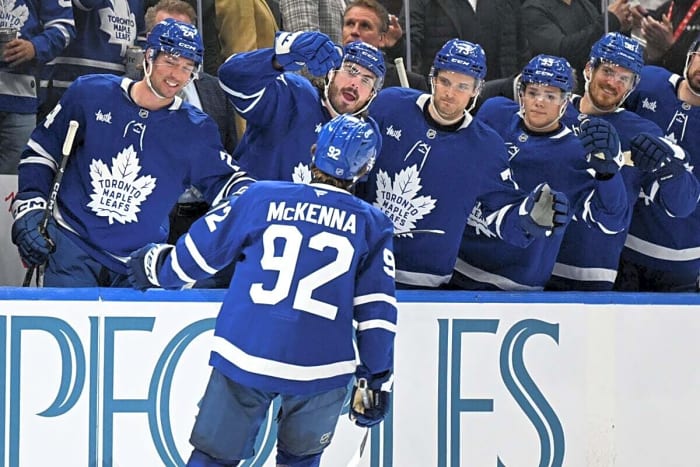
Hiller has McKenna playing on the third line, averaging just under 14 minutes a game. He’s also lost his spot on the first power-play unit since John Tavares returned from injury. There’s a development argument for asking a young offensive player to learn the less glamorous parts of the game. McKenna will eventually have to become more responsible away from the puck and learn to contribute when the offence isn’t running through him. Still, there’s a difference between teaching a young player to become more complete and taking away too many opportunities to use what he already does exceptionally well. As Thomas Williams writes at Editor In Leaf, McKenna is finding it difficult to stay involved when his opportunities are limited.
The Maple Leafs have to be careful about how they handle this. They don’t need to hand an 18-year-old unlimited minutes or guarantee him a place on the top power-play unit. He has plenty to learn, and it will take patience. But development should also build confidence and let young players succeed at what they do best. McKenna’s offensive instincts, creativity, and ability to make something happen with the puck are valuable assets. The challenge for Hiller is developing the rest of his game without taking too much of that away.
What’s Next for the Maple Leafs?
These are two different problems, but they lead to a similar question about the team’s direction. Hiller needs to show that he can get more out of his players, make adjustments that work, and give supporters something to believe in. He doesn’t have to win every game to earn patience, but he does need to show that the team is making progress. Right now, that’s becoming increasingly difficult to see.
McKenna’s development is a longer-term concern, but it deserves attention just the same. Toronto needs to find a way to let him learn the NHL game without taking away the creativity that makes him special. The Maple Leafs have enough immediate problems to worry about. They shouldn’t make their future harder to build in the process. Whether Hiller is the coach who can solve both challenges is becoming a question management may soon have to answer.
More must-reads:
- Connor McDavid's historic start continues by tying Wayne Gretzky record
- Tipping off: The unstoppable Spurs; Lakers on pace to rack up even more wins
- The 'National League MVPs' quiz
Breaking News
Trending News







Customize Your Newsletter
 +




Get the latest news and rumors, customized to your favorite sports and teams. Emailed daily. Always free!
PRIVACY POLICY COOKIE POLICY CONTACT US
ABOUT YARDBARKER TERMS OF SERVICE


By using this site, you agree to our Terms of Service and Privacy Policy.
This site is for entertainment purposes only.
There is no gambling offered on this site.
Gambling Problem? Call 1-800-Gambler.