-

-


Follow Us
-

 On Facebook
 On Flipboard


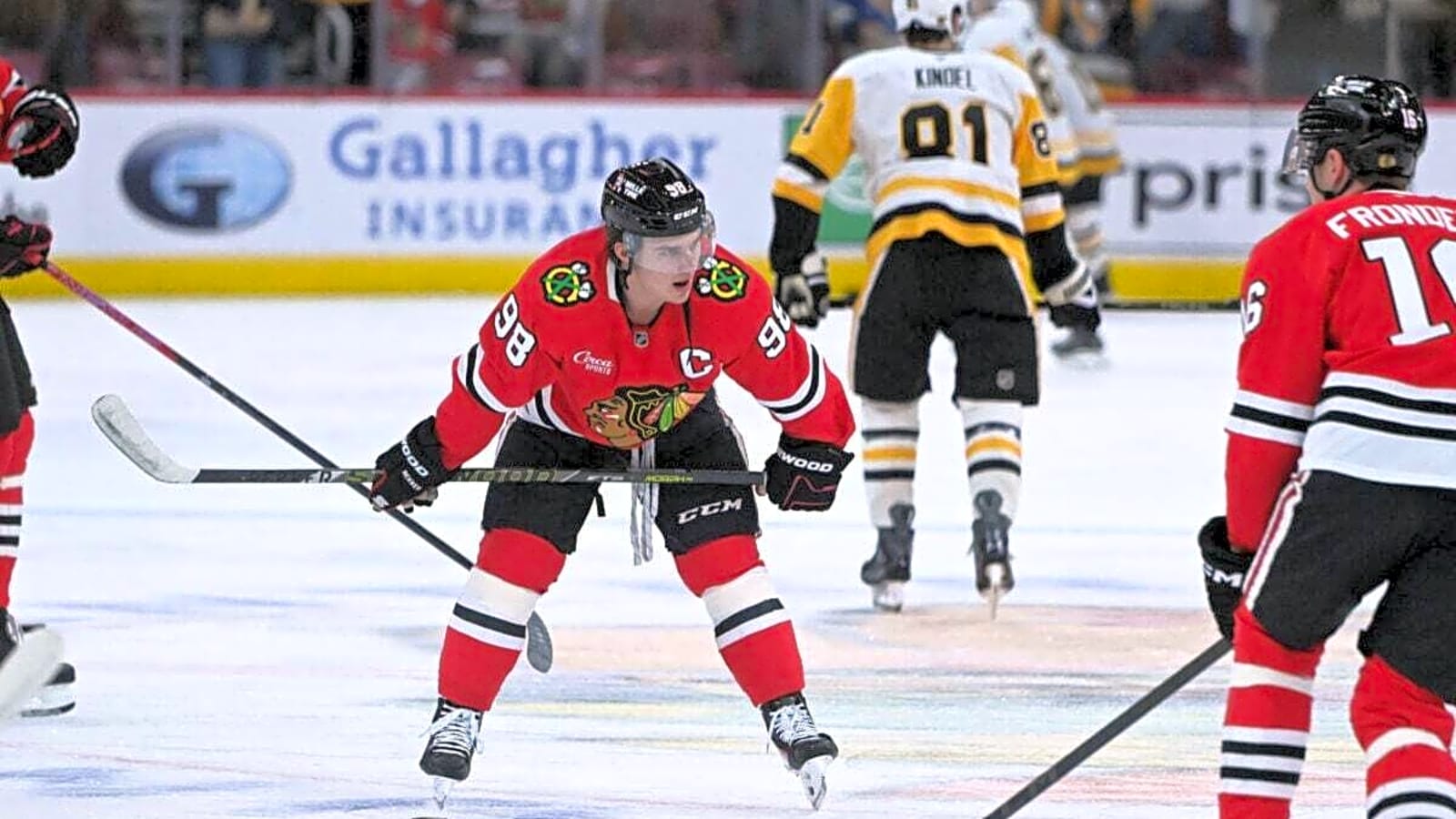
At one point or another, the Chicago Blackhawks, Philadelphia Flyers, and San Jose Sharks’ rebuilds were praised. But with each club finding itself near the bottom of the NHL standings in what was supposed to be a season of progress, I have some concerns about their futures. On a scale ranging from 1-10, where does each team place on my rebuild panic meter?
Chicago Blackhawks: 9 Out of 10
The optimistic outlook here is that racking up a ton of top draft picks is a positive thing for Chicago—anyone can make that work. But the fact that this keeps happening brings into question how good their future core really is.
Let’s look at the big picture. If you exclude Anton Frondell and Roman Kantserov, the prospect pool worries me. All of the best players are playing in the NHL now, so there’s not a ton to write home about with the pipeline. Václav Nestrašil and Xavier Villeneuve could end up carving out middle-of-the-lineup roles in Chicago (and that’s not guaranteed), but aside from them, I don’t see a lot.
Then, you have the NHL team. Maybe I’m lower on the young guys than I should be, but this core isn’t all that great to me. Oliver Moore has the vibe of a depth contributor, Frank Nazar has had questionable production at both ends of the ice despite second-line minutes, and the defense includes several of general manager Kyle Davidson’s top draft picks, yet there’s little redeeming about it. Even Connor Bedard has had ugly regularized adjusted plus/minus (RAPM) metrics in his career, per Evolving-Hockey.
With no changes, I feel like the best-case scenario for this group is mediocrity in its prime. Depth and defense are big concerns, and it’s not like those are built overnight. There’s still time to figure this out, since Bedard is only 21, but there’s a lot of work to be done. They’re not far off from how much work the Vancouver Canucks have to do, and they just started a rebuild last season. Chicago had a four-year head start.
To make matters worse, I have less than zero confidence in this management group. Davidson’s coaching hires—Luke Richardson and Jeff Blashill—have been so bad that you can argue they stunted the development of the roster. His drafting has been even worse. Taking Artyom Levshunov over Ivan Demidov could be an all-time miss, Sacha Boisvert and Marek Vanacker could be outright busts, Kevin Korchinski, Moore, and Sam Rinzel might just be depth players, and Nazar might not become a star.
The Bowen Byram trade, too, needs no introduction. He hasn’t played much, so the jury is technically still out, but that also looks like an all-time bad trade, given how Daxon Rudolph is playing in college (he became the No. 4 pick that Chicago traded for Byram).
It’s not a full panic yet, since the rebuild is still young, but it’s getting there. The roster, the pipeline, and the people in charge do not instill much confidence.
Philadelphia Flyers: 9 Out of 10
A few months ago, Flyers fans were spending thousands of dollars on second-round playoff tickets. Today, they’re spending thousands of dollars on a plane flyover above Xfinity Mobile Arena and a billboard to read “Fire Rick Tocchet” (no, that is not a joke).
Winning a postseason series with fans in the building for the first time since 2012 was great and all, but the team’s conference-worst 4-10-4 record has many seeing the bigger picture: as constructed, Philadelphia probably won’t be good enough to contend for a title, even when its young guys reach their primes. Perhaps even worse, the front office has proven to have questionable, if not detrimental, judgment.
The long-term core here consists of Jamie Drysdale, Tyson Foerster, Porter Martone, Matvei Michkov, and Trevor Zegras, with Denver Barkey, Oliver Bonk, Alex Bump, and Egor Zavragin being other young players of note. To put it bluntly, though, that’s not an intimidating enough group to win a championship. If it were, the Flyers wouldn’t have the worst record in the conference.
Now, to be fair to the Flyers, they have more to work with than the Blackhawks do, in my eyes. They made the playoffs last season and have a 4-4-1 record since their nine-game losing streak to open the campaign—this roster is a lot further along. But I’m just as concerned, if not more so, with this management group.
Hiring Tocchet was a disaster waiting to happen. I said as much before he was brought in. The underperforming stars, the drama in the locker room, the clashes with top prospects—all of it happened at the veteran coach’s previous stops and has happened repeatedly in Philadelphia. The front office’s lack of judgment here is unforgivable on its own, but it’s far from the first time management has made a short-sighted decision.
In fact, one of the major topics of discussion right now is trying to get 29-year-old forward Travis Konecny to waive his no-movement clause. A report from Daily Faceoff‘s Anthony Di Marco gave this idea some staying power, and it’s still being talked about by the team’s top beat reporters.
God help us if the Flyers front office actually believes this about asking TK to waive his NTC. pic.twitter.com/x79XKr15MB
— broadburnt (@broadburnt) November 7, 2026
If the Flyers are serious about trying to trade Konecny, I have to give them some props. But they merely came to the same conclusion I, as well as many others, did two and a half years ago. Extending a valuable veteran player through his age-35 season during the “accumulate assets” stage of a rebuild never made sense—especially when that player’s style is on the more physical side.
Then, you have the team’s drafting, which hardly needs an introduction. Five of the team’s first-round picks between 2023 and 2026 turned into the following: Bonk, Jett Luchanko, Jack Nesbitt, and Maksim Sokolovskii. The other two were Martone and Michkov, who liked posts slamming his head coach on Instagram (whoever is managing his account did, anyway). The last two have star upside, but that projection is far from guaranteed.
What puts the Flyers on the same level as Chicago is that the whole front office instability thing isn’t new in Philadelphia. There was the Chuck Fletcher regime and the Ron Hextall regime before it, spanning nearly a decade in total. Even Paul Holmgren’s time as general manager, though it saw a Stanley Cup Final appearance, had mixed results. There was the Sergei Bobrovsky trade, and only twice did his teams record 100 regular-season standings points. It’s been a cycle of mediocrity for two decades.
San Jose Sharks: 4 Out of 10
Believe it or not, I have some qualms with the Sharks’ vision. It goes without saying that the front office has done a respectable job in accumulating quality players via the draft, with Macklin Celebrini being the face of this operation. That’s the part you have to get right, and to this point, things have gone well.
But I haven’t agreed with everything. In a weak Pacific Division, many people felt that a playoff spot was San Jose’s for the taking. After all, this team was in the hunt until the very end last season and added some veterans on defense (as opposed to minor-league talent beforehand). But with the league’s fifth-worst points percentage and worst expected goal share at 5-on-5, according to Natural Stat Trick, the Sharks are approaching Chicago territory.
So, what gives? Well, I wasn’t a huge fan of San Jose trading William Eklund. The 24-year-old winger was, to me, the second-best player on the roster last season, and third place wasn’t particularly close. Sure, he didn’t have the point-scoring breakout some thought he would, and his 8.5% shooting clip was dangerously low, but he has established himself as a dependable two-way top-six forward. He was traded for the No. 9 pick in the 2026 NHL Draft, which was used to select Keaton Verhoeff.
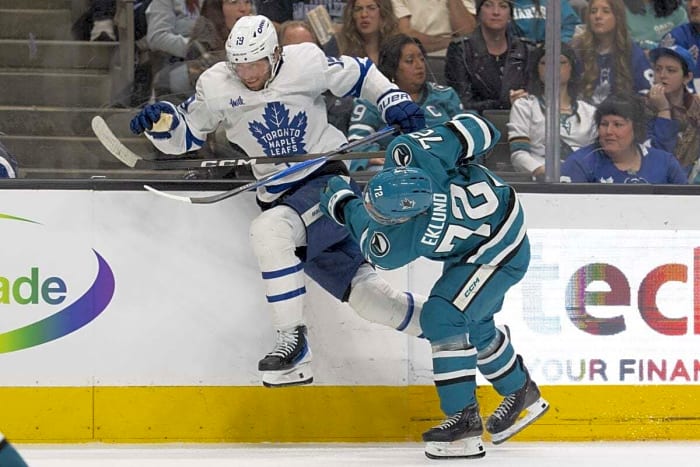
That helps segue into another point: the defense needs a lot of work. I was not a Verhoeff fan entering the draft, given his struggles at the college level. I’ll admit that I haven’t watched any of his sophomore campaign, but I think there are a range of outcomes with this player. I’m more on the pessimistic side right now, and the same could be said for many of the other top young defensive players in San Jose, including Luca Cagnoni and Sam Dickinson.
A young defenseman has yet to truly play well with the Sharks, so there’s work to be done there. Also, similar to Chicago, acquiring better depth will need to be a priority. If the Sharks had playoff-caliber depth, they would not consistently be this bad in the expected goals department.
I’m not necessarily panicking about the Sharks, to be clear. But I’m not ready to put them on dynasty watch, either. They have work to do if they want to cement themselves as a contender down the line—bold moves will have to be made.
The Sharks are still in my good graces, since their rebuild plan has mostly gone well so far—this season has been their first step in the wrong direction, which isn’t the end of the world. I am, however, worried about Chicago and Philadelphia. Unless their front offices can dig themselves out of the hole they created, mediocrity may be in their future.
More must-reads:
- Predators' Juuse Saros introducing new goalie mask that pays tribute to Dolly Parton
- Top 5 most likely trade candidates during MLB offseason
- The 'Most CFP Top-25 appearances' quiz
Breaking News
Trending News




Customize Your Newsletter
 +


Get the latest news and rumors, customized to your favorite sports and teams. Emailed daily. Always free!
PRIVACY POLICY COOKIE POLICY CONTACT US
ABOUT YARDBARKER TERMS OF SERVICE


By using this site, you agree to our Terms of Service and Privacy Policy.
This site is for entertainment purposes only.
There is no gambling offered on this site.
Gambling Problem? Call 1-800-Gambler.