
-

-


Follow Us
-

 On Facebook
 On Flipboard

Zach Hyman remains one of the Edmonton Oilers’ most important forwards, but the organization cannot ignore the need to begin planning for life without him.
Hyman will be 34 years old during the 2026-27 season and is entering the sixth year of a seven-year contract. His $5.5 million cap hit runs through 2027-28, when he will be eligible to become an unrestricted free agent at age 36.
That does not mean Hyman is finished. Despite appearing in only 58 games last season, he recorded 31 goals and 52 points. That translates to a 44-goal pace over 82 games, illustrating that he can still be highly productive alongside Connor McDavid.
However, Hyman’s age, physical playing style and recent injuries make succession planning increasingly important. Edmonton must identify younger players who can eventually replace his scoring, forechecking and net-front presence.
Hyman’s Role Is Difficult to Replace
Replacing Hyman involves much more than finding another 30-goal winger.
His greatest value comes from his willingness to perform the difficult work around the offensive zone. Hyman retrieves loose pucks, battles along the boards, drives toward the crease and absorbs contact in front of the net. His ability to establish positioning around the blue paint creates passing lanes for McDavid and Leon Draisaitl.
Hyman is also one of Edmonton’s most effective power-play finishers. While McDavid, Draisaitl and Evan Bouchard control possession, Hyman screens goaltenders, deflects shots and converts rebounds. Those goals may appear simple, but consistently reaching those areas requires strength, timing and a willingness to take punishment.
That style has also contributed to physical wear. Hyman required season-ending surgery after suffering an upper-body injury during the 2025 playoffs. He then missed more than a month at the beginning of 2025-26 and sat out the final five regular-season games while dealing with another injury.
Physical wingers can decline quickly once injuries begin limiting their speed or ability to win battles. The Oilers should not assume Hyman will remain a 30-goal top-line winger through the end of his contract.
Matthew Savoie Can Replace Some of Hyman’s Scoring
Matthew Savoie is Edmonton’s strongest internal candidate to eventually assume a permanent top-six position. Savoie recorded 18 goals and 37 points while playing all 82 games during his rookie season. His performance improved considerably over the second half, suggesting he was beginning to adjust to the speed and physical demands of the NHL.
At 22 years old, Savoie provides the speed, skill and right-handed shot Edmonton needs. His ability to attack in transition could complement either McDavid or Draisaitl, while his finishing should improve as he receives more top-six minutes. Savoie will not replace Hyman’s physical presence. At 5-foot-10 and approximately 180 pounds, he is unlikely to become a dominant net-front player. His value will come from creating offence in different ways, including controlled entries, quick releases and movement through open space.
The Oilers should begin giving Savoie more opportunities alongside McDavid. If he develops into a consistent 25-goal scorer, he could replace a significant portion of Hyman’s offensive production even without replicating his exact style.
Podkolzin Could Handle the Forechecking Responsibilities
Vasily Podkolzin represents another part of the potential solution. Podkolzin recorded career highs with 19 goals and 37 points last season. He also played all 82 games and finished with a plus-16 rating. His production was identical to Savoie’s, but he generated offence through a more physical, forecheck-oriented approach.
During the previous season, Podkolzin ranked in the 92nd percentile among NHL forwards in forechecking pressures per hour. His puck pursuit and willingness to engage physically made him a useful linemate for Draisaitl. Podkolzin is already signed through 2028-29 at $2.95 million annually, giving Edmonton an affordable opportunity to determine whether he can become more than a complementary winger.
He may never match Hyman’s goal production, but his forechecking, puck retrieval and physicality could replace some of the work that makes Hyman valuable. If Podkolzin can establish himself as a consistent 20-goal player, he could become part of Edmonton’s long-term top six.
Colton Dach Has the Physical Tools
Colton Dach is the most natural internal candidate to eventually inherit Hyman’s net-front responsibilities. The 23-year-old stands 6-foot-4 and weighs approximately 218 pounds. He recorded 219 hits across 61 games between Chicago and Edmonton last season, placing him among the NHL’s most physical forwards despite missing 21 games.
Dach also showed some offensive potential after joining the Oilers, producing two goals and four points in eight regular-season games. That sample is far too small to project him as a top-six player, but his size and physicality give Edmonton something its other young forwards lack. The Oilers should begin developing Dach as a net-front option on the second power-play unit. He needs to improve his positioning, hand-eye coordination and ability to finish rebounds, but those skills can be developed through repetition.
Dach does not need to become a 30-goal scorer to provide value. If he develops into a 15-goal, physically disruptive winger who can screen goaltenders and recover pucks, Edmonton could pair his strengths with Savoie’s scoring ability to collectively replace Hyman.
Howard Provides Another Scoring Option
Isaac Howard should also be part of Edmonton’s succession plan. Howard recorded 24 goals and 50 points in 47 AHL games last season, but managed only two goals and five points in 29 games with Edmonton. His limited NHL production came while averaging approximately 10 minutes per game, often without skilled linemates. Howard’s shot is his greatest weapon. He scored 26 goals in 37 games during his final season at Michigan State and immediately translated that ability to professional hockey in Bakersfield.
Like Savoie, Howard is not a natural replacement for Hyman’s net-front physicality. However, he could eventually replace some of Hyman’s finishing if given a legitimate opportunity beside McDavid or Draisaitl. Edmonton must determine what it has in both young scorers before spending major assets on an external replacement.
Oilers Could Pursue an External Successor
If none of Edmonton’s internal candidates develops into a complete top-six solution, general manager Stan Bowman may need to pursue a younger established winger.
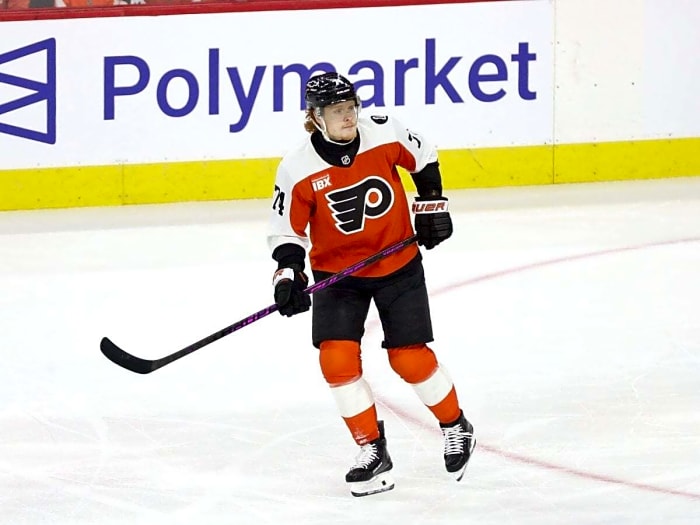
Owen Tippett would be an intriguing target. The 27-year-old recorded 28 goals and 51 points for the Philadelphia Flyers last season and is signed through 2031-32 at $6.2 million annually. Tippett combines size, speed and shooting ability, although Philadelphia would demand a substantial return.
Kirill Marchenko could be another option if he becomes available. The 25-year-old produced 27 goals and 67 points in 76 games for the Columbus Blue Jackets last season. At 6-foot-3, he offers the size and finishing ability to become a long-term fixture in Edmonton’s top six. Marchenko will become a restricted free agent after 2026-27, meaning acquiring him would require both a significant trade package and an expensive new contract. Edmonton would likely need to surrender a premium prospect and its 2028 first-round pick.
The Oilers should only pay that price if they are confident the acquired winger can remain part of the core beyond Hyman’s contract.
Edmonton Should Begin the Transition Now
The Oilers do not need to remove Hyman from the top line immediately. His production remains strong, and his chemistry with McDavid continues to make him an important part of their championship pursuit. The objective should be a gradual transition.
Savoie and Howard should receive opportunities in the top six. Podkolzin should continue developing his forechecking and scoring, while Dach should be tested in net-front situations. Reducing Hyman’s workload could also help keep him healthy and effective through the end of his contract. No single internal candidate currently replaces everything Hyman provides. Savoie and Howard offer scoring, Podkolzin provides forechecking, and Dach supplies size and physicality. Edmonton may eventually need multiple players to collectively fill the void.
Hyman has been one of the best free-agent signings in Oilers history, but his career is approaching its final stage. Developing his successor before his production declines would allow Edmonton to manage the transition instead of reacting after it becomes a problem.
More must-reads:
- Flyers one loss away from joining infamous club — and it's familiar territory for Rick Tocchet
- Cardinals suffer backfield blow as Jeremiyah Love is ruled out
- The '2nd-most TD-passes by NFL team' quiz
Breaking News
Trending News


Customize Your Newsletter
 +
+




Get the latest news and rumors, customized to your favorite sports and teams. Emailed daily. Always free!
PRIVACY POLICY COOKIE POLICY CONTACT US
ABOUT YARDBARKER TERMS OF SERVICE


By using this site, you agree to our Terms of Service and Privacy Policy.
This site is for entertainment purposes only.
There is no gambling offered on this site.
Gambling Problem? Call 1-800-Gambler.
