
-

-


Follow Us
-

 On Facebook
 On Flipboard


The Pittsburgh Penguins do not have to give up on Ville Koivunen. That would be too easy, too reactionary and probably too soon.
But they do have to make a decision on him.
That is where this gets interesting. Koivunen is no longer just an exciting name from the Jake Guentzel trade. He is no longer only a productive American Hockey League (AHL) forward waiting for his chance. He is now a young player caught between two realities. The first is that he has already shown enough skill to remain one of the more intriguing forwards in the organization. The second is that the Penguins’ NHL roster is getting crowded, and his path is not nearly as clean as it looked a year ago.
When Pittsburgh acquired Koivunen from the Carolina Hurricanes in the Guentzel trade, he became one of the main pieces attached to a painful franchise pivot. Guentzel was not just another productive winger. He was part of the Penguins’ championship identity, a longtime Sidney Crosby running mate and one of the organization’s best playoff performers of the modern era. Any player coming back in that deal was going to carry extra attention.
Koivunen did enough early to earn it. He played in Wilkes-Barre/Scranton, looked comfortable during his first NHL look and entered the 2025-26 season with real momentum. THW’s preseason prospect ranking had him as Pittsburgh’s No. 1 prospect, ahead of other important young pieces in the system.
Now, after a season that brought more questions than answers, the Penguins need to stop treating Koivunen like a vague future piece and start treating him like a player who needs a specific plan.
Penguins Still Have Something in Koivunen
Koivunen’s case is not simple because the talent has not disappeared.
At his best, he is a smart, skilled forward who can think the game at a high level. He is not a burner who overwhelms defenders with speed, and he is not a heavy forechecker who changes games with physicality. His game is built more around reads, timing, spacing and puck movement. That kind of player can look subtle when things are working and invisible when they are not.
That is part of the challenge.
Koivunen’s AHL production still matters. According to a Pensburgh season review, he has been a point-per-game player across 97 regular-season games with Wilkes-Barre/Scranton. That is not nothing. Players do not accidentally produce at that rate over that sample. It shows he can handle professional hockey, create offense and be more than just a passenger when he is playing with confidence.
The problem is that the NHL has not given him the same room to breathe. That same review noted that Koivunen had just two goals and five assists in 39 NHL games during the 2025-26 season. That is the part Pittsburgh cannot ignore. The Penguins do not need him to be a star right away, but they do need him to show that his game can survive when the pace rises, the space closes, and the decisions have to come faster.
The strange part is that Koivunen’s underlying game has not always looked as bad as the scoring line. He has had moments where the puck moves in the right direction when he is on the ice. He can find soft areas, keep plays alive and make the next pass. But there is a difference between helping the play move and forcing the play to matter.
That is the gap he has to close.
Koivunen Has to Turn Possession Into Production
There are players who drive coaches crazy because they produce despite messy details. Koivunen has the opposite issue. There are times when the details look fine, but the production does not follow.
For a young forward trying to win a job, that can be dangerous.
The Penguins can be patient with a prospect who is learning how to play without the puck. They can be patient with a player who needs to add strength. They can be patient with someone whose defensive habits need work. What becomes harder is carrying a forward who needs offensive usage but does not produce enough offense to justify it.
That is the line Koivunen is walking.
He is not built like a fourth-line energy player. If Pittsburgh wants him at his best, it probably has to give him skilled linemates, offensive-zone touches and power-play opportunities. But those are not development gifts. Those are NHL minutes, and they have to be earned.
That is why the Penguins need a real plan, not just a roster spot if one happens to open.
Koivunen should not be thrown onto a fourth line for eight minutes a night and then judged for not producing. That would be a poor use of his skill set. But he also cannot be penciled into the top six just because he was once the organization’s top-ranked prospect. The Penguins have to decide what role they actually believe he can grow into, then put him in situations that test that role.
If the belief is that he can become a middle-six winger, then training camp should be about seeing whether he can play with pace, win enough battles and create chances against NHL defenders. If the belief is that he is more of a sheltered offensive winger, then the Penguins need to be honest about whether their current roster has room for that.
Because right now, room is the issue.
Penguins’ Forward Additions Squeeze Koivunen
The Penguins have made the forward picture more complicated.
They acquired Nick Robertson from the Toronto Maple Leafs for a 2028 fourth-round pick, according to the team’s official announcement. Robertson is not an aging placeholder. He is 24, a restricted free agent and coming off a 16-goal, 32-point season in Toronto. He is exactly the type of player who can take the kind of opportunity Koivunen needs.
They also added Andrei Kuzmenko, who signed a one-year, $5 million contract with Pittsburgh, according to NHL.com. Kuzmenko is older, but he is a proven scorer. If he is on the roster, he is not there to sit around and wait. He is there to play offensive minutes, help the power play and give the Penguins another finishing option.
Then there is Hendrix Lapierre, whom the Penguins acquired from the Washington Capitals before signing him to a two-year deal. Pittsburgh’s official release listed his average annual value at $1.3 million. Lapierre gives the Penguins another young forward with NHL experience, AHL success and a reason to push for lineup time.
That does not even get into Rutger McGroarty, Ben Kindel, Egor Chinakhov, Tommy Novak, Blake Lizotte, Bryan Rust, Rickard Rakell and the veterans still around the core. The point is not that all of those players directly block Koivunen. The point is that the Penguins are no longer short on forwards who need opportunity.
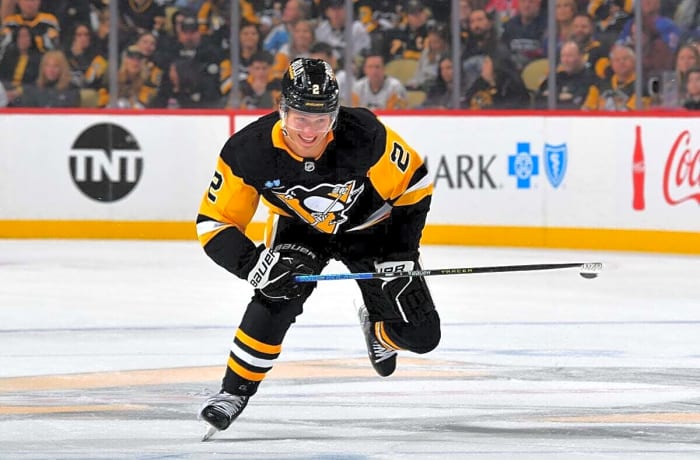
A recent Pensburgh depth chart made that crowding clear. Pittsburgh has added enough bodies that some players are going to be squeezed before opening night.
Koivunen cannot afford to be one of them by default.
Penguins Cannot Let Koivunen Drift
This is where Pittsburgh’s development approach has to be sharper.
Koivunen is 23. That is still young, but it is not young in the same way an 18-year-old draft pick is young. He has played professional hockey in Finland, produced in the AHL and already had NHL games to show what he can do. The Penguins do not have to decide his entire career this summer, but they should know what they are trying to find out.
There are three realistic paths.
The first is that Koivunen wins an NHL job outright. That is the cleanest outcome. If he has a strong camp, creates offense and looks faster in his decisions, Pittsburgh can give him a real role and see whether the production follows. That would be ideal because it would turn one of the Guentzel trade pieces into something tangible.
The second is that he starts in the AHL but with a clear purpose. That should not mean sending him down just because he is waiver-exempt or easy to move. If he goes back to Wilkes-Barre/Scranton, the Penguins need to give him specific targets: shoot quicker, attack inside more, play at NHL pace, become harder to knock off pucks and force a recall. Another productive AHL season only matters if it fixes the reasons he has not stuck in Pittsburgh.
The third is that he becomes part of a trade conversation. That is not the outcome fans want to hear, but it has to be considered. If the Penguins do not see a clear NHL fit and other teams still value Koivunen’s skill, then letting him sit in limbo would be poor asset management.
Pittsburgh has already shown it is willing to reshape the roster around younger, more controllable pieces. I recently wrote about that kind of thinking in the Penguins’ move for Kaedan Korczak’s upside. Koivunen belongs in that same larger conversation. The Penguins are not only building for next season. They are sorting through who can matter after the Crosby-Malkin-Letang era finally changes shape.
That means Koivunen needs clarity, not just patience.
Koivunen’s Path Depends on Winning a Specific Role
The biggest question is not whether Koivunen has skill. He does. The question is whether he has a role that makes sense on this Penguins team.
That is where the comparison to other young forwards matters. Chinakhov has given Pittsburgh a clearer answer because his shot and scoring profile are easy to identify. THW’s Jordan Orth previously wrote about why Yegor Chinakhov is proving he can be part of the Penguins’ future. Robertson has a similar advantage because his value is tied to goal scoring. Lapierre can sell himself as a versatile center with playoff success in the AHL. McGroarty has a more physical, two-way identity.
Koivunen’s identity is more delicate. He has to be skilled enough to help offensively and responsible enough not to disappear when he is not scoring. That is a harder needle to thread.
For him, the next step is probably not about becoming a completely different player. It is about making his current game more direct. He needs to get pucks off his stick quicker. He needs to turn good positioning into actual scoring chances. He needs to make defenders react instead of simply moving the puck around the outside.
If he can do that, there is still a path.
The Penguins are not overflowing with young forwards who have proven they can become long-term top-nine pieces. They have options, but not all of them are sure things. Koivunen does not have to beat out every young player in the organization. He just has to show that his offensive brain can translate against NHL competition.
That is why training camp matters so much. A strong camp would make this conversation feel different. A quiet one would make the squeeze feel real.
Penguins Need an Answer Soon
The Penguins can still be careful with Koivunen. They should be. Giving up too early on skilled young forwards is how teams lose value.
But there is a difference between patience and uncertainty.
Koivunen has already shown he can produce below the NHL level. He has already shown flashes in Pittsburgh. He has already done enough to remain interesting. Now the Penguins need to decide what comes next, because the roster around him is not waiting.
Robertson needs minutes. Kuzmenko needs touches. Lapierre needs a look. McGroarty still matters. Chinakhov is pushing into a bigger role. Kindel and other young players are part of the larger future. Every one of those names makes Koivunen’s path a little more crowded.
That does not mean the door is closed. It means he has to push it open.
For Pittsburgh, the plan should be simple. Give Koivunen a real chance in camp, define the role they want him to win, and then act based on what he shows. If he earns NHL minutes, use him properly. If he needs more AHL time, make it targeted. If he does not fit the future, do not let the asset fade.
Koivunen does not need to become the face of the Penguins’ next era. He does not even need to become the best young forward in the system. But he does need to become something more specific than a former top prospect waiting for another chance.
The Penguins need a real plan for him.
And very soon, Koivunen has to give them a reason to keep that plan alive.
More must-reads:
- NFL teams preach family, then remind players it's a business
- MLB releases spring training schedule as dark cloud looms over 2027
- The 'Most points in a game by NBA team' quiz
Breaking News
Trending News




Customize Your Newsletter
 +
+




Get the latest news and rumors, customized to your favorite sports and teams. Emailed daily. Always free!
PRIVACY POLICY COOKIE POLICY CONTACT US
ABOUT YARDBARKER TERMS OF SERVICE


By using this site, you agree to our Terms of Service and Privacy Policy.
This site is for entertainment purposes only.
There is no gambling offered on this site.
Gambling Problem? Call 1-800-Gambler.
