
-

-


Follow Us
-

 On Facebook
 On Flipboard


It’s hard to believe two years have already passed since the infamous “Summer of Jeff” in Edmonton. A time when the hockey world collectively praised Jeff Jackson for his work as interim GM of the Edmonton Oilers. Jackson’s moves that offseason were universally celebrated. But it wasn’t long before the fans and analysts were proven universally wrong.
On July 1, Jackson’s short GM tenure officially began. He re-signed veteran forwards Connor Brown, Corey Perry, Adam Henrique, Calvin Pickard, and Mattias Janmark. He also acquired a pair of veteran top-six forwards in Jeff Skinner and Viktor Arvidsson at reasonable cap hits. A few days later, he traded Ryan McLeod to the Buffalo Sabres for prospect Matt Savoie.
Thanks to Jackson’s explosive summer, Edmonton opened the 2024-25 season as Stanley Cup favourites. The Athletic’s analytics model gave them a 19 per cent chance of winning the Cup, which was 9 per cent higher than the next-closest team.
They nearly accomplished that goal, coming just two wins short of a championship in 2025. Shockingly, though, they did it despite limited contributions from Jackson’s additions.
Arvidsson and Skinner were a disappointment, and several of the team’s veterans experienced age-related decline and injuries. How did the result look so different from the expectations set during the summer of Jeff?
Why did Jeff Skinner and Viktor Arvidsson struggle in Edmonton?
In 2023-24, the Oilers’ second line, centred by Leon Draisaitl, was in constant flux.
Whether it was Warren Foegele, Dylan Holloway, McLeod or Perry, the coaching staff didn’t seem entirely comfortable with their options on the wing. Nor did they want to pull Zach Hyman or Ryan Nugent-Hopkins away from Connor McDavid, as the top line had become a well-oiled machine.
On July 1, Jackson found what he considered upgrades in free agency: Jeff Skinner and Viktor Arvidsson.
Arvidsson had missed 64 games the prior season with injuries, but he spent most of his career on the top two lines and had a lengthy track record of superb even-strength production. For two years at a $4 million AAV, he seemed like a steal.
Skinner was coming off a 46-point campaign with the Buffalo Sabres, and although his defensive play was never a strength, his production more than justified a one-year $3 million contract.
Both players were proven scorers, but it didn’t translate in Edmonton. Take a look at their five-on-five numbers over the past five seasons:

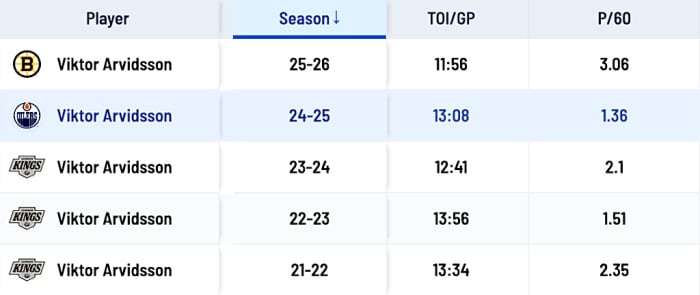
Skinner’s five-on-five production dropped from 2 points per hour to 1.7 with the Oilers, and Arvidsson’s dropped from 2.1 to 1.4. To make matters worse, neither player possessed the same defensive ability or penalty-killing prowess as the team’s former wingers, Foegele and McLeod. If they weren’t producing points, they weren’t contributing.
Several factors contributed to their disappointing seasons, including a lack of opportunity.
After averaging well over 16 minutes per game in LA, Arvidsson’s time on ice dropped to 14:36 per game with the Oilers. Skinner experienced an even sharper drop, falling from 16 minutes per game in Buffalo to 13 in Edmonton.
It wasn’t just the total time on ice that declined, either — so did the quality of their linemates. Both players had spent most of their careers alongside top-six talent, but in Edmonton, Kris Knoblauch abandoned the original plan to pair them with Draisaitl. Instead, they each played significant minutes with the bottom six forwards.
By the end of the season, Skinner had spent less than 30 per cent of his minutes with McDavid or Draisaitl, while Arvidsson spent roughly 53 per cent of his minutes in the top six.
Clearly, there was a disconnect between what Jackson envisioned for Arvidsson and Skinner and how the coach felt about the two players. Both eventually fell into Knoblauch’s doghouse and were healthy scratched for stretches of the playoffs.
Knoblauch received plenty of criticism during his Oilers tenure for failing to find roles for prominent free-agent acquisitions after they arrived in Edmonton. Andrew Mangiapane, Trent Frederic, and Adam Henrique all experienced a similar decline under Knoblauch. While injuries and age can partially explain most of these cases, Arvidsson’s struggles did reflect somewhat poorly on Knoblauch, as he immediately returned to form with the Boston Bruins last year, producing one of the best seasons of his career.
To be fair to Knoblauch, though, there were valid reasons to keep Arvidsson and Skinner out of the top six.
A couple of months ago, OilersNation’s NHL_Sid created a comprehensive chart of Draisaitl’s linemates, revealing several common characteristics among those who thrived alongside him.
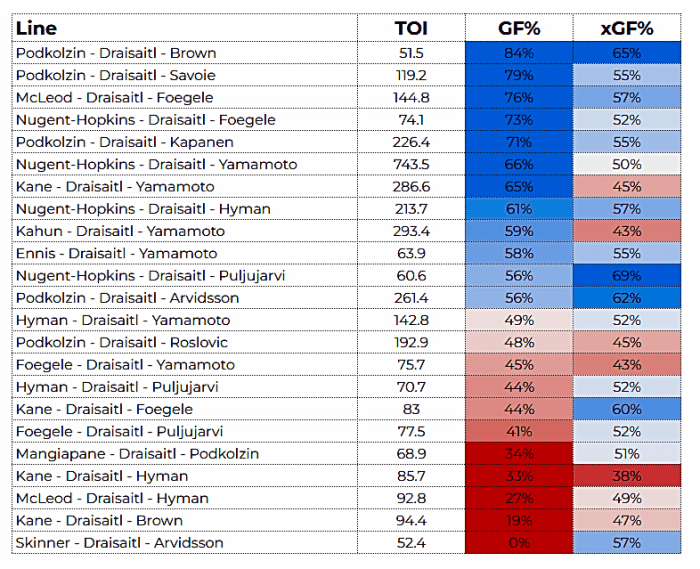
Most of the players near the top of the chart (Podkolzin, Foegele, Kapanen, McLeod and Yamamoto) have a couple of common traits: they’re all defensively sound, and they all forecheck. That explains a lot about the lack of a fit for Arvidsson and Skinner.
Arvidsson only ranked in the 26th percentile in forecheck involvement last season, while ranking in the 96th percentile in rush offence. He preferred to attack in transition rather than dump the puck in and grind down opponents off the cycle, which had historically been the ideal formula for Draisaitl’s lines. His style of play simply wasn’t a match. Rather than jam a square peg into a round hole, Knoblauch tried to find a different role for him, but it didn’t pan out.
Skinner is similarly uninvolved in the forecheck, and his defensive struggles cost him opportunities to play with the big guns. He was never going to be a good fit with Draisaitl, but his 53 percent goal share and 61 per cent expected goal share with McDavid suggested there might’ve been potential there had Knoblauch given it a longer look. Ultimately, though, Skinner failed to earn his coach’s trust and was frequently banished to the press box.
There are a couple of lessons we can take away from the failed Arvidsson and Skinner experiments. The first is that chemistry matters. Sure, players like Foegele or Podkolzin may not be as prolific scorers as Arvidsson or Skinner. They may not be as talented. They may not have anywhere close to the same ceiling. But their style is such a great fit that they got better results in the Oilers’ top six anyway.
The second lesson in all of this is that the grass isn’t always greener on the other side. Is Arvidsson a better player than Foegele? Perhaps. But Foegele and Draisaitl had a dominant 61 per cent goal share together from 2022-23 to 2023-24. They consistently outscored and outchanced the opposition.
Just because you have a chance to make a slight upgrade on paper doesn’t mean that you should. Not when there’s ample evidence that the mix of players you have is already working.
Did Jeff Jackson prioritize aging veterans over the Oilers’ youth movement?
Trading futures for immediate roster upgrades is part of being a Cup contender. But depleted draft capital means that the few young players who do crack the roster become even more critical. Without them, the championship window will be short.
Arvidsson and Skinner may have been unexpected flops, but the problem wasn’t just them. Their struggles exposed a flaw in Jackson’s overall approach to team building that summer: The prioritization of aging veterans over young players on the rise. Instead of bringing back Foegele (28), McLeod (24), and Holloway (22) to play in the top nine, he favoured Arvidsson (31), Skinner (32), and Henrique (34).
Young players who are still developing their games can be a huge source of improvement for championship teams, not just trading for players at the deadline. Having a veteran group can certainly help in the short term, but there’s such a thing as taking it too far. There needs to be a future wave of players in place to replace veterans over time.
While the Holloway and Broberg offer sheets happened under Bowman’s watch, Jackson dragged his feet with the two RFAs, leaving them still unsigned over halfway through the summer. And the Skinner signing suggested he was skeptical that Holloway could fill a top-six role.
Aside from abandoning the youth movement, Jackson’s moves were also misaligned with the team’s identity, which revolved around speed and territorial dominance. McLeod, Foegele, Holloway, and Broberg fit right in, being some of the best skaters on the team.
Without them, Edmonton’s supporting cast was older, slower and less efficient.
How did the Oilers’ front office reverse the off-season damage?
The summer of Jeff did serious harm to the long-term health of the organization, but the Oilers front office has since done its best to reverse the damage.
The trades for Podkolzin and Savoie eventually softened the blow suffered with the offer sheets, as both young wingers have become top-six forwards. The team also moved on from numerous veterans over the past year and brought younger replacements into the fold, like Isaac Howard, Colton Dach, and Josh Samanski. The additions of Kasperi Kapanen and Jake Walman also injected more speed into the veteran group.
There seems to be a much greater emphasis on balancing the present and the future in Edmonton’s recent roster building. The summer of Jeff provided the organization with a few hard lessons. The question is whether it was already too late by the time they learned them.
More must-reads:
- Five most intriguing NHL home openers
- Three-time Stanley Cup champion Steve Yzerman stepping down as GM marks needed leadership change for Red Wings
- The 'MLB Home Run Derby winners' quiz
Breaking News
Trending News


Customize Your Newsletter
 +
+




Get the latest news and rumors, customized to your favorite sports and teams. Emailed daily. Always free!
PRIVACY POLICY COOKIE POLICY CONTACT US
ABOUT YARDBARKER TERMS OF SERVICE


By using this site, you agree to our Terms of Service and Privacy Policy.
This site is for entertainment purposes only.
There is no gambling offered on this site.
Gambling Problem? Call 1-800-Gambler.
