-

-


Follow Us
-

 On Facebook
 On Flipboard


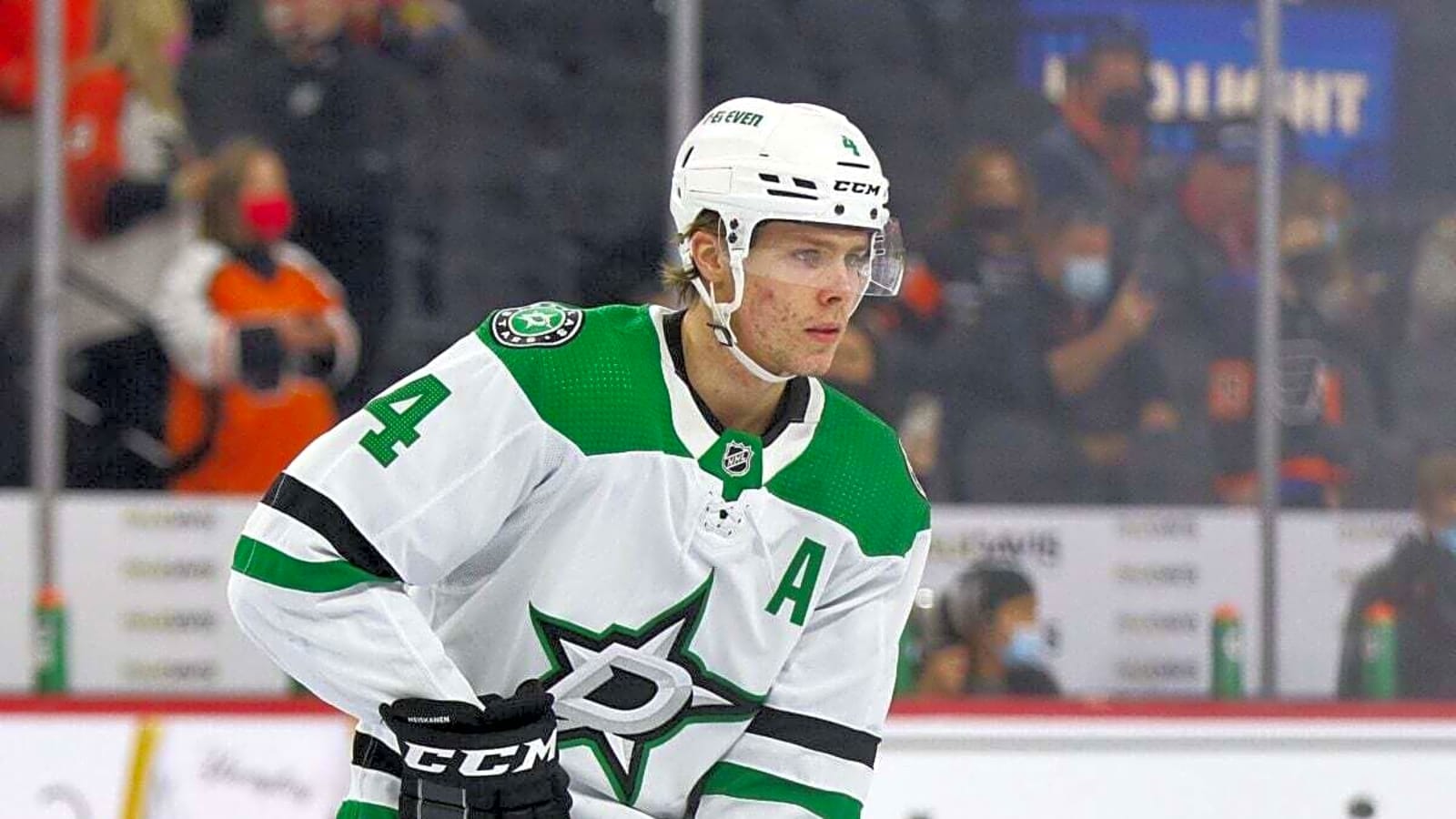
Miro Heiskanen closes in on the puck carrier a little at a time when he’s the last man back on a 2-on-1. The Dallas Stars defenseman walked Julia Valtanen and Aki-Petteri Pulkkinen of Iltalehti, a Finnish news source, through his approach in an interview published Nov. 25. “I try to take away time and space,” he said. He wants the carrier deciding fast, because a rushed decision ends in a bad pass or one he can cut off himself.
Dallas needs that kind of defending more than most teams. The Stars are 15-8-2 and fourth in the Central Division, and only two NHL teams allow fewer goals a game than their 2.48. Only one allows fewer shots. The offense ranks 26th at 2.68 goals a game, and Dallas’s Finns scored more than half of the team’s goals through late October.
The defense breaks down late in shifts. MoneyPuck’s shot data tracks how long a team’s defensemen have been on the ice when each shot comes. Half of the 44 goals Dallas has allowed at five-on-five came with its two defensemen averaging 45 seconds or more into the shift. No team has a higher share, and the league-wide rate is one in three.
Dallas’s top three defensemen play the longest shifts of any team’s top three, and those extra seconds are costing goals. The fix is a fourth defenseman the Stars can trust with some of that time.
Heiskanen Defends a 2-on-1 by Taking Away Time
Iltalehti’s story makes a bigger claim: Heiskanen might be the NHL’s best at defending a 2-on-1 as the last man back. He has a template for those plays, he told the paper, and leaves himself room to react. The speed of the rush matters, and so do the side the attackers come from and which way they shoot. If the handedness sets up a one-timer, he works harder to take away the pass. Often the play comes too fast to think about handedness, so he just plays.
Miro Heiskanen with an oustanding defensive play*
— Robert Tiffin (@RobertTiffin) March 28, 2026
*on the power play pic.twitter.com/2K7P2Ntnsr
For the current season, we cannot rely on the microstats, because a 2-on-1 has to be tracked by hand, and All Three Zones does that manual tracking for previous seasons. But for this season, there’s no clean count for this one, so keep that in mind.
What the numbers can show is how little gets through when he’s out there. MoneyPuck has him on the ice for about 42 shot attempts against per 60 five-on-five minutes, second-fewest among 167 defensemen with at least 250 minutes. Only the Carolina Hurricanes’ Shayne Gostisbehere is lower, and the median defenseman is at 55. Dallas holds 54 percent of the expected goals (xG, an estimate of how likely each shot is to score) with him on the ice and 46 percent without him. He’s doing it on longer shifts than almost any defenseman in the league.
Dallas Asks Its Top Three for the NHL’s Longest Shifts
Heiskanen averages about 64 seconds a shift, 14 more than the typical defenseman with 15 or more games, according to the NHL’s time-on-ice report. Only the Minnesota Wild’s Quinn Hughes stays out longer. Thomas Harley is third at 61 and Esa Lindell sixth at 59.
The shifts have grown since Lian Bichsel went down with a lower-body injury against the Winnipeg Jets on Nov. 12. Heiskanen’s average has gone from about 62 seconds to 67 since he came back from his own injury on Nov. 17. Harley’s and Lindell’s have each added two to four seconds, and Nils Lundkvist is playing three more minutes a night. Dallas dresses six defensemen and leans on four.
Long shifts push more of the defending into the late seconds. Dallas faces 32 percent of its five-on-five unblocked shot attempts (shots on goal plus misses) late in shifts, the sixth-highest share in the NHL. Its goalies have an .843 save percentage on the ones that reach the net, sixth-worst in the league, against .927 the rest of the time. League-wide, the drop is only from .908 to .880. Dallas’s drop is three times as steep.
Some of that is luck. Expected goals put Dallas’s late-shift share of the danger it allows at 36 percent, fifth-highest in the league but well short of half. That model can’t see passes, though. My read is that the cross-ice feed to a one-timer, the play Heiskanen tries to take away, is what a tired defenseman gives up.
The second period makes it worse. The defensive zone sits farthest from the bench in the second (the long change), and 13 of the 22 late-shift goals against have come in that period. Dallas allows the second-fewest first-period goals a game in the NHL and ranks 19th in second periods.
Jake Oettinger has covered for a lot of it. He’s at almost 14 goals saved above expected (GSAx) in 19 starts, second among 62 goalies with at least 300 minutes, according to MoneyPuck’s goalie numbers. Casey DeSmith is about one goal below expected and 2-3-1 with an .892 save percentage, so the margin shrinks when he starts.
Harley Is on the Ice for Most of the Late Goals
By my count from the NHL’s shift charts and play-by-play reports, Harley was on the ice for 15 of the 22 late-shift goals against, Heiskanen for six and Lindell for three. Harley has played about 43 percent of Dallas’s five-on-five minutes, the most of any Stars defenseman, so he’d be on for plenty of goals regardless. But his goals still outrun his time on-ice minutes; he’s been on the ice for 25 of the 44 at five-on-five.
This pattern also holds with his two main partners. Harley and Lundkvist, Dallas’s most-used pair, hold 55 percent of the expected goals in 252 minutes together, according to MoneyPuck, and have been on for five of the late goals. Harley and Heiskanen have been the best pair on the team at 68 percent in 127 minutes, and four of the six goals scored against them came late in shifts. Even the best pair leaks late.
Lindell’s pairing with Heiskanen reads the other way. The two have been out-chanced together, with 44 percent of the expected goals in 161 minutes. Dallas has still outscored opponents 4-2 with them on the ice, and none of the 22 late goals came against them. Lindell also leads Dallas in shorthanded ice time at about four and a half minutes a game, for the NHL’s second-best penalty kill (88 percent).
The most direct answer is shorter shifts for Harley. That takes a defenseman head coach Glen Gulutzan seems to trust enough to send out in his place.
A Fourth Trusted Defenseman Is the Fix
Dallas hasn’t dressed its top six defensemen together since Heiskanen got hurt against the Washington Capitals on Nov. 3. THW’s preseason look at the blue line named Kyle Capobianco as the only real replacement behind those six, and he’s been out since Oct. 27 with a lower-body injury. Gulutzan said on Nov. 13 that Bichsel would miss about two weeks, per Daily Faceoff, and Dallas moved him to injured reserve the next day.
That leaves the call-ups. Kyle Burroughs is averaging 11:25 in seven games, and Trey Taylor 10:47 in nine, and Gulutzan seems to keep their shifts short, at about 45 seconds. The minutes they don’t play go to the top four.
I’d make a fourth 20-minute defenseman Dallas’s first deadline target. One player at that level would move Lundkvist back toward the 17 or 18 minutes he played before the injuries. It would also give Gulutzan a reason to get Harley and the other two off the ice sooner. Bichsel helps when he returns, but he averaged about 16 minutes a game before he got hurt.
Bichsel’s return is the first chance to bring those shifts down. The March 1 trade deadline is the last.
More must-reads:
- Matvei Michkov, Flyers relationship reaches possible point of no return after former first-rounder ruled out over 'internal' matter
- Devils defenseman Brenden Dillon suspended four games
- The 'Completion %-record by NFL team' quiz
Breaking News
Trending News


Customize Your Newsletter
 +




Get the latest news and rumors, customized to your favorite sports and teams. Emailed daily. Always free!
PRIVACY POLICY COOKIE POLICY CONTACT US
ABOUT YARDBARKER TERMS OF SERVICE


By using this site, you agree to our Terms of Service and Privacy Policy.
This site is for entertainment purposes only.
There is no gambling offered on this site.
Gambling Problem? Call 1-800-Gambler.