-

-


Follow Us
-

 On Facebook
 On Flipboard


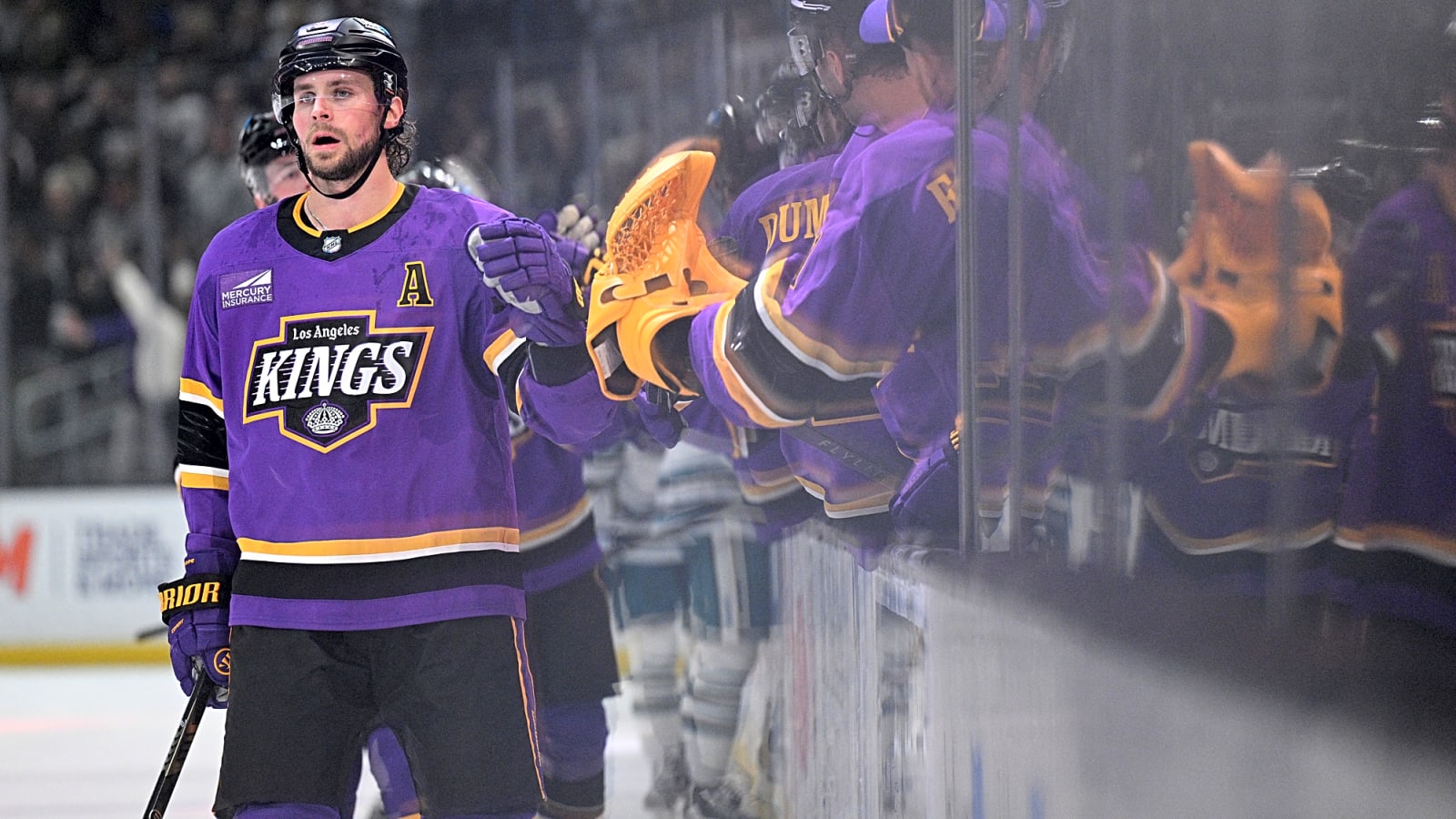
The Los Angeles Kings spent the last 2010s and early 2020s pivoting from the most successful era in franchise history to what was supposed to be their next great era of hockey, and for a while, it looked like success was just a matter of time. The Kings assembled the best prospect system in the entire NHL by 2021 (according to Scott Wheeler of The Athletic), led by Quinton Byfield, Alex Turcotte, and Arthur Kaliyev, but have since squandered their potential and are now one of the worst teams in the NHL. Even worse, their roster is an aging, expensive disaster.
It’s almost inexplicable that, just five years later, the Kings have the oldest team in the NHL, with an average age of 31. No single issue caused this downfall; it was a series of bad trades, poor development, and aggressive management decisions. The amazing thing for Los Angeles is that they were primed to build a sustainable contender around Byfield and Brandt Clarke, but now find themselves in a position where the playoffs feel like a long shot and their contention window is nearly closed.
There was obviously an opportunity for the Kings to be great, but for whatever reason, management’s mandate shifted to aggressively pursuing veterans and trading away much of their future to do so. In a vacuum, many of the Kings’ moves were fine, but when you sacrifice the future for the present, you need deals to work out better than just okay. A good example is the Kevin Fiala deal with the Minnesota Wild. In that trade, Los Angeles sent defenseman Brock Faber and a 2022 first-round pick back East, a return that felt reasonable given that Fiala was coming off an 85-point season in Minnesota. The idea with the move was to accelerate the Kings’ rebuild, but in hindsight it proved ill-fated, as Faber developed into one of the NHL’s best young defensemen and a foundational piece for the Wild. Now, Fiala remains a solid NHLer, and again, in a vacuum, the trade isn’t awful, but it was a sign of things to come for Los Angeles as they tried to accelerate into a contention window that never came.
A more glaring example of the Kings rushing things is the Pierre-Luc Dubois trade with the Winnipeg Jets. The move was probably former general manager Rob Blake’s biggest mistake. In June 2023, the Kings shipped Gabe Vilardi, Alex Iafallo, Rasmus Kupari, and a 2024 second-round pick. The trade was horrific for the Kings, but perhaps even worse was the eight-year, $68MM contract extension they gave him. The trade was supposed to solidify the center position for the Kings, but instead Dubois failed to fit into Los Angeles’ lineup, tallying just 40 points in 82 games. Things got so bad for Dubois in LA that by the playoffs he was taking regular shifts on the fourth line. Eventually, the Kings moved on from Dubois, sending him to the Washington Capitals for goaltender Darcy Kuemper, officially closing the door on one of the worst trades in franchise history.
The bigger issue for Los Angeles in the Dubois trade is not how poorly he played, but what they gave up to acquire him. The Kings traded three forwards, a good draft pick, and a lot of financial flexibility for Dubois, and it turned out to be a very costly mistake that is a microcosm of what went wrong with the Kings’ rebuild.
There are other examples of poor asset management that simply didn’t work out for the Kings. The Tanner Jeannot trade with Tampa Bay cost the Kings a 2024 fourth-round pick and a 2025 second-round pick, which on the surface doesn’t seem like a big deal. However, all the Kings got out of Jeannot was a 67-game season in which he posted seven goals and six assists and was largely a drag on his teammates from a possession perspective. Again, the cost wasn’t massively prohibitive, but it was another example of the Kings spending capital on marginal short-term improvements that ultimately don’t fit in with the team.
While the trades were part of the problem, there was also concern about what happened to the young talent the Kings didn’t trade away. The Kings spent years building the farm system that Scott Wheeler rated as number one in 2021, but somehow that group never developed into a young NHL core ready to compete for a cup, nor did it have a chance to do so. Vilardi was moved before he’d even scratched the surface; Kupari was moved as well and never became the impact forward many felt he’d become; Kaliyev struggled to establish an NHL role and had off-ice issues; Turcotte took longer than expected to become an NHL regular. Beyond that, Tobias Bjornfot wasn’t the NHL defenseman many thought he was, and Byfield still hasn’t become the force that so many scouts thought he was destined to be. All of it- the entire failure of their prospects to develop raises major questions about the Kings as an organization. Why did their can’t-miss prospect pool miss so badly? Was it a prospect development problem? Or did management’s obsession with immediate contention undermine their young players? After all, Los Angeles was constantly dipping into free agency to bring in older veterans who blocked younger players, which limited their NHL opportunities or led the Kings to deal the young players because they felt the veteran was an adequate replacement.
The signing of older free agents was certainly a choice the Kings consistently prioritized, with pedestrian results. Los Angeles brought in Phillip Danault, Viktor Arvidsson, Alex Edler, Trevor Lewis, and Joel Edmundson over the years. This focus on veterans is a major reason the Kings are the oldest team in the league, and it’s fair to wonder how much of their downfall can be attributed to their free agency shopping sprees. At a time when the league is going young, the Kings have chosen, time and again, to go old.
They even did it this past summer, signing 38-year-old Mats Zuccarello and 41-year-old Corey Perry to one-year deals. They also brought in 35-year-old Erik Haula and 34-year-old Erik Gustafsson.
Adding veterans isn’t a problem in and of itself, but when your team lacks speed and mobility and keeps losing to first-round opponents such as the Edmonton Oilers (who are built on speed and mobility), it does raise alarm bells.
Ultimately, the Kings had an opportunity five years ago to show patience and build a team that could compete for a decade or more, but they didn’t. Instead, they chose to repeatedly trade young players and draft picks for veterans, sacrificing cap space for immediate help. Some of it worked; most of it didn’t. Somewhere along the line, the Kings became obsessed with the short term and forgot about the bigger picture. Now the team is left with an old roster, limited flexibility, and a major question of what if.
The track record is indefensible, and the results speak for themselves. All of it makes you wonder what the point of rebuilding was in the first place. Did Rob Blake and company confuse the ultimate goal? Did they make short-term moves to save their jobs? Or did they simply lack direction? All of these questions are fair, and they will be asked by Kings fans for a long time if the current season continues to go off the rails.
More must-reads:
- Jets fans mercilessly boo 'coward' Connor Hellebuyck in return to Winnipeg
- Matvei Michkov reportedly wants trade from Flyers for two reasons
- The '150-Rec.-Yard NFL teammates' quiz
Breaking News
Trending News







Customize Your Newsletter
 +




Get the latest news and rumors, customized to your favorite sports and teams. Emailed daily. Always free!
PRIVACY POLICY COOKIE POLICY CONTACT US
ABOUT YARDBARKER TERMS OF SERVICE


By using this site, you agree to our Terms of Service and Privacy Policy.
This site is for entertainment purposes only.
There is no gambling offered on this site.
Gambling Problem? Call 1-800-Gambler.