-

-


Follow Us
-

 On Facebook
 On Flipboard


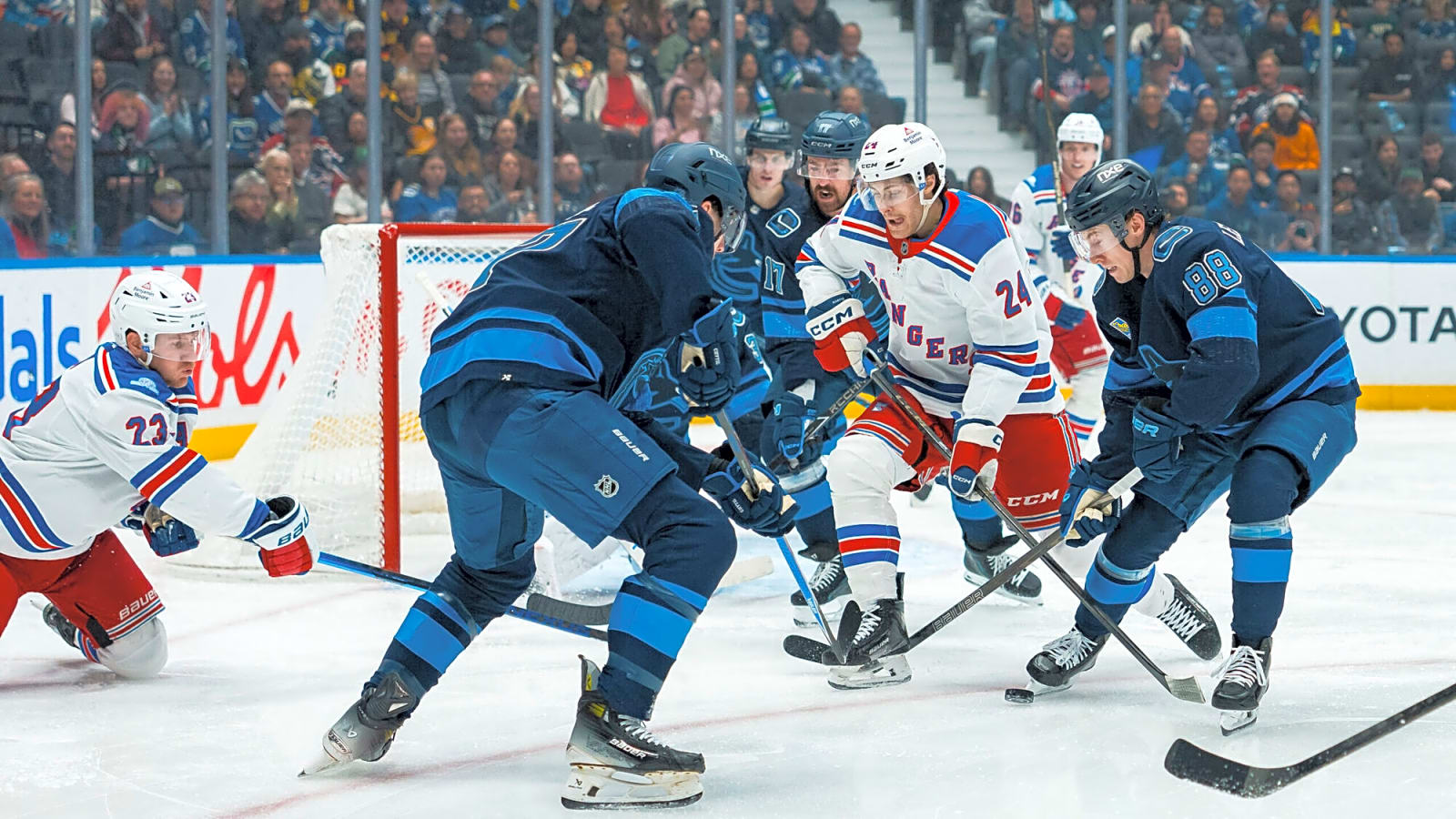
After three days off, a promising opening period was about all the Vancouver Canucks could muster against the New York Rangers on Friday night, with the wheels coming off over the final 40 minutes.
The 5-1 defeat extended the Canucks’ losing streak to seven games and established a franchise record with eight consecutive home losses. However, Elias Pettersson ended a lengthy five-on-five scoring drought, and Tom Willander reminded everyone what he brings to Vancouver’s lineup.
Here’s the game, by the numbers. As always, our glossary of advanced statistics is available here.
Game Flow
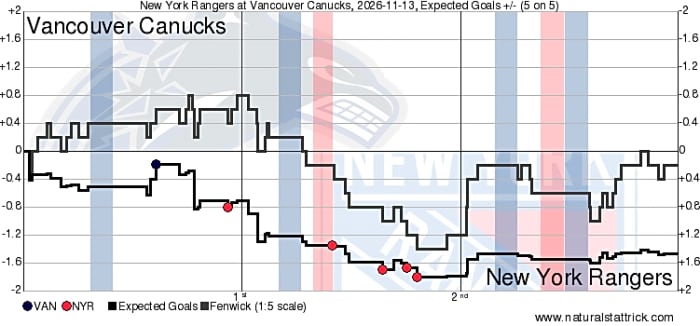
Vancouver outmatted New York 24-14 at five-on-five for a 63.16 CF% in the opening frame, but the visitors generated considerably better opportunities, recording 1.59 expected goals against the Canucks’ 0.87.
As things rapidly deteriorated in the second, the Canucks managed just seven shot attempts against 17, finishing with a 29.17 CF% and 16.28 xGF%. Their scoring-chance share fell to 18.75%, while New York generated eight of the period’s nine high-danger opportunities.
By the third, Vancouver had regained the territorial advantage, producing a 57.14 CF% and 67.87 xGF%. The Canucks controlled all four high-danger chances at five-on-five, although the Rangers were coasting with a four-goal lead.
Heat Map
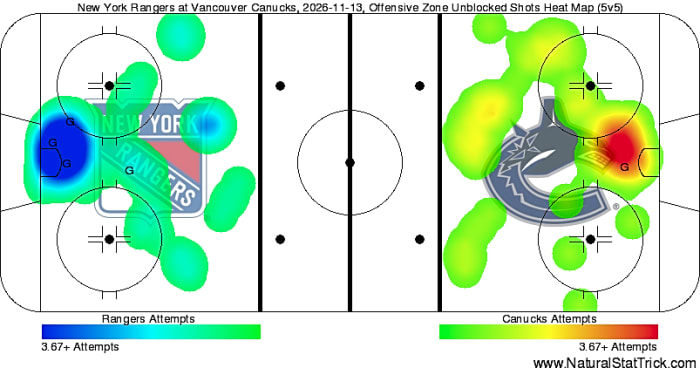
New York’s offensive pressure was concentrated around the crease and through the slot, particularly in the areas immediately surrounding Vancouver’s blue paint. The Rangers repeatedly found openings in dangerous positions, while the Canucks struggled to prevent second opportunities.
At five-on-five, the visitors controlled 16 high-danger chances against Vancouver’s 10 despite losing the overall shot-attempt battle 47-43. The Rangers finished with 3.21 expected goals at five-on-five compared to Vancouver’s 1.73, showing just how much better their scoring opportunities were.
Vancouver’s attempts were more scattered, with activity around the faceoff circles and some openings closer to the crease. However, the Canucks rarely established the same sustained presence in the middle of the ice.
Across eight minutes on the power play, Vancouver produced 12 scoring chances, three high-danger opportunities and 0.92 expected goals without converting. New York needed only 3:45 with the man advantage to generate 0.76 xGF and score once.
Individual Advanced Stats
Corsi Champ: Drew O’Connor led Vancouver with a 71.43 CF% at five-on-five, as the Canucks outattempted New York 10-4 during his 8:47. The winger helped generate four scoring chances against two and held a 3-1 advantage in high-danger looks; however, three of his shifts began in the offensive zone compared to none in the defensive end. Tom Willander recorded a 66.67 CF%, with Vancouver controlling 24 shot attempts against 12 during his five-on-five minutes.
Corsi Chump: Filip Chytil had an exceptionally difficult return to the lineup, finishing with a team-worst 32.14 CF% during 12:32 at five-on-five. New York outattempted Vancouver 19-9 with the former Ranger on the ice, while scoring chances favoured the visitors 14-3. Having returned from injured reserve before Friday’s game, the Czech centre was understandably working through some rust.
xGF: O’Connor’s 65.62% led the lineup, followed by Max Sasson at 63.67% and EP40 at 59.04%. Willander topped Vancouver’s defencemen at 56.14%, generating 0.65 expected goals against 0.51. On the flip side, Jonathan Lekkerimäki struggled, posting a 7.48 xGF%, below Paul Cotter, who finished at 10.25%.
GSAx: Leevi Meriläinen stopped 26 of 31 shots for an .839 save percentage, allowing five goals against 3.97 expected, working out to minus-1.03 goals saved above expected. That suggests Vancouver’s goaltender could have possibly provided another stop despite the poor defensive performance in front of him. Dylan Garand was considerably better in the opposite crease, turning aside 27 of 28 shots for a .964 save percentage and plus-1.80 GSAx.
Statistical Musings
The Cotter-Chytil-Lekkerimäki experiment didn’t go well: Vancouver’s second line produced an almost unbelievable 6.86 xGF% over 9:23 together, generating just 0.11 expected goals against 1.54. The unit was outattempted 14-7 and lost the scoring-chance battle 11-2. Worse still, seven of New York’s opportunities qualified as high danger, compared with just one for Vancouver. For Lekkerimäki, it was an unwelcome reversal after scoring Vancouver’s only goal against Philadelphia, when he enjoyed much stronger results in a different role. The young Swede managed only one individual shot attempt at five-on-five Friday.
Rossi’s line was stable: Across 10:41 at five-on-five, Liam Öhgren, Marco Rossi and Linus Karlsson outattempted New York 13-9 for a 59.09 CF%, while controlling scoring chances 5-3. They held a narrow 3-2 advantage in high-danger opportunities, but their 48.49 xGF% was less impressive, so it wasn’t a completely one-sided performance.
Crotty made the most of his minutes: Cameron Crotty was one of the few Vancouver defencemen who came away with favourable underlying numbers, despite playing just 11:12 at five-on-five. The Canucks outattempted New York 9-7 with the blueliner on the ice, giving him a 56.25 CF%. More impressively, Vancouver held a 4-2 advantage in high-danger chances during those minutes, contributing to a 51.33 xGF%. Only Tom Willander finished with a better expected-goals share among Vancouver’s defencemen.
Buium and Hronek had another difficult assignment: During Buium’s 21:12 at five-on-five, the Canucks surrendered 11 high-danger chances while generating two, producing a 23.22 xGF%. Hronek wasn’t much better, recording a 26.76 xGF% with 10 dangerous opportunities against during his own shifts. But both players were tasked with twice as many defensive-zone shift starts as offensive-zone starts.
J.T. Miller’s line did just about everything except score: The former Canuck returned to Rogers Arena alongside Tye Kartye and Pavel Dorofeyev, and through 10:14, the trio generated 1.52 expected goals against just 0.29 for Vancouver, producing an 84.00 xGF%. Their 9-2 advantage in scoring chances and 7-1 margin in high-danger opportunities underscore how thoroughly they controlled play. Dorofeyev was particularly threatening, recording four high-danger chances and 0.96 expected goals at five-on-five without scoring.
As a team
CF% – 52.22% | HDCF% – 38.46% | xGF% – 35.05%
Vancouver technically won the five-on-five shot-attempt battle, but that advantage disappeared after accounting for score and venue effects. Its adjusted CF% fell to 48.13%, while xGF% declined to 31.73% and high-danger share dropped to 34.49%. In other words, the final possession totals were kinder than the actual performance probably deserves.
Still, there were individual successes. O’Connor and Sasson continue to be bright spots, alongside Brendan Gallagher; the trio helped the Canucks out-attempt New York 9-4 over 7:12, finishing with a 69.23 CF% and a 3-1 advantage in high-danger chances.
Yet the larger concern is how quickly the Canucks fall apart once an opponent begins to dictate play. There is an understandable temptation to embrace defeats for their potential draft implications. However, as we’ve seen in Chicago, collecting prospects is only one part of constructing a competitive roster. Developing them properly matters just as much.
All statistics courtesy of naturalstattrick.com.
More must-reads:
- Quinn Hughes' spectacular play putting Wild in difficult position
- Canucks' start to season is one of worst in modern NHL era
- The 'NL Cy Young-winners' quiz
Breaking News
Trending News








Customize Your Newsletter
 +




Get the latest news and rumors, customized to your favorite sports and teams. Emailed daily. Always free!
PRIVACY POLICY COOKIE POLICY CONTACT US
ABOUT YARDBARKER TERMS OF SERVICE


By using this site, you agree to our Terms of Service and Privacy Policy.
This site is for entertainment purposes only.
There is no gambling offered on this site.
Gambling Problem? Call 1-800-Gambler.