
-


Follow Us

 On Facebook
 On Flipboard
 On Twitter

On Tuesday, St. Louis Blues’ general manager Doug Armstrong discussed the trade rumors (from “Doug Armstrong on Blues trade talk: Untouchables? Core players? Jordan Binnington’s future?, The Athletic, 12/16/2025) that have surrounded the struggling team. Armstrong acknowledged that while he wants the team to go on a run, he would listen to calls and offers from interested teams.
This has created talk among many about who could be traded should Armstrong decide to pull the trigger. A name that has come up frequently is Jordan Kyrou. Kyrou trade talks have been a hot topic, but the debate needs to be examined from both sides. However, once that is done, the answer is clear. The Blues should not trade Kyrou.
The Case for Trading Kyrou
While trading Kyrou is not the answer, there is a valid case to be made as to why they should.
Maximizing Value at the Right Time
Kyrou is a premium asset. He is in the prime of his career. He has elite speed, proven scoring ability, and a track record of producing at a top-six level. Around the NHL, those players are both scarce and expensive. If the Blues believe their window to contend does not align with Kyrou’s peak, they could sell high and get a significant return.
A contender looking to add a dynamic offensive threat would likely need to part with a substantial return, but it would be worth it, as Kyrou may not be any more valuable than he is right now.
Cap Flexibility and Roster Construction
Kyrou’s long-term contract reflects his offensive upside, but it also commits significant cap space to a winger whose impact is heavily weighted toward scoring.
Moving Kyrou could open flexibility to address more structural weaknesses. Money moved in a trade could be used to extend someone like Philip Broberg, who is becoming a prominent member of the defensive core. In addition, the extra money could help the front office by funding a player who could address an identified need. This could range from bringing in playmakers to bringing in depth players to help split time with younger players as they acclimate themselves to the NHL.
The cap is rising, so the Blues are by no means handcuffed by Kyrou’s $8.125 million cap hit, but it would be additional money available to spend.
Identity and Playoff Fit
The most-successful Blues teams have historically been defined by structure, physicality, and two-reliability. A prime example of a player who exemplified that was Ryan O’Reilly, who could play offense and defense at an elite level, winning the Conn Smythe Trophy and Selke Trophy in 2019 as a result. Kyrou’s game is electric, and he scores at an elite level, but it’s one-dimensional. In the 2022 playoffs, Kyrou scored seven goals in 12 games, outperforming his defensive struggles. However, last season, Kyrou only scored three goals and looked lost at times on the ice.
Jordan Kyrou kicks off game 7 with an early goal for the Blues
— Daily Faceoff (@DailyFaceoff) May 4, 2025: Sportsnet pic.twitter.com/YNRRu89ujP

If the Blues believe they need to recommit to a heavier, more defensively accountable identity (as in 2019), trading Kyrou could help accelerate that shift. A return focused on two-way players or defenders would reinforce a more apparent organizational identity.
Clarifying the Franchise’s Direction
The Blues entered a retool during the 2022-23 season. Last season, they made the playoffs, leading many, even those within the organization, to believe that the retool was already over. The struggles this season suggest otherwise.
The time is now to decide whether the team has finished the retool or is still in the middle of it. Trading a player of Kyrou’s caliber would send a clear message that the team is seeking to improve in the long term rather than compete in the short term.
What a Kyrou Trade Would Need to Include
If the Blues decide to move Kyrou, the return cannot be futures-heavy alone. Yes, a first-round pick is a must, but it is not all. The returning package must include at least one high-end, NHL-ready player who fills a clear need. For the Blues, this could be a legitimate two-way center.
Armstrong’s trade with the Buffalo Sabres in 2018 was a prime example of this. The Blues acquired O’Reilly, but gave the Sabres Tage Thompson, a high-end, NHL-ready player who fit the need of a scorer for the Sabres. Both teams got what they needed, though many would say the Sabres did not get enough in return.
The Case Against Trading Kyrou
This is the best option. In short, trading Kyrou does not advance the team’s retool.
Elite Offense Is Hard to Replace
The second the Blues trade Kyrou, they would be looking for someone to replace his production. Players with his speed, puck-handling, and scoring are rare commodities in the NHL. The Blues have players who they hope will bloom into elite scorers, like Jimmy Snuggerud, but as of right now, Kyrou is the only one who can be counted on for 30-plus goals per season.
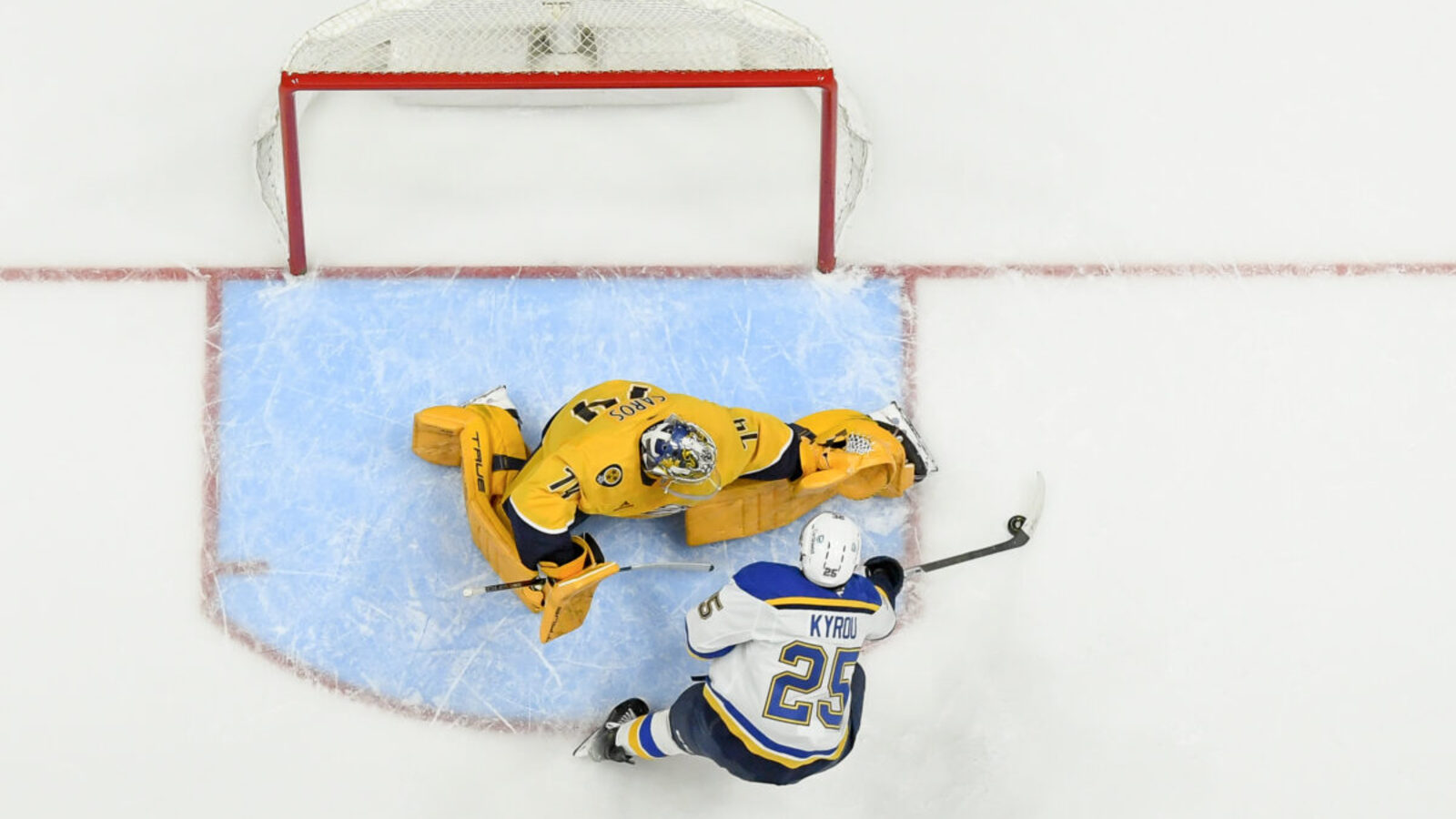
Trading him creates an immediate offensive void. While there is hope for players in the system to take that role, there is no guarantee it will happen. Giving up what has been offensive certainty in exchange for a hypothetical future is a gamble that can backfire.
Age, Prime Years, and Development Curve
At 27 years old, Kyrou is still firmly in his prime, rather than a declining veteran whose best hockey is behind him. An argument could be made that there is still room for growth; can he hit the 40-goal mark?
If the Blues believe the answer is a retool rather than a rebuild, holding on to prime-age talent is essential. Kyrou has been a core member of the Blues and could continue to have that role. He is to the Blues now what Vladimir Tarasenko was in the 2010s: An elite scorer on a team still needing pieces.
Trading Kyrou Does Not Help the Retool
Many, myself included, thought the retool was over after last season. This season is showing that the retool may still be active, and that is okay. However, trading Kyrou does not help the retool.
The Blues, even at their worst, can be considered a “mid” team. They will always float around .500 at the worst. Even during the 2022-23 season, in which players like Tarasenko and O’Reilly were traded, the team still finished just one game under .500.
If there were even an outside chance the Blues could be bad enough to earn a top-five pick in the NHL Draft Lottery, trading Kyrou would make sense. If someone like Kyrou’s talent was not going to make the team much better, then yes, trade him. Even without Kyrou, the Blues still have enough talent to finish around the middle of the pack.
This goal last night from Jordan Kyrou
— St. Louis Blues (@StLouisBlues) May 9, 2022pic.twitter.com/LmzjRuyWuI
The Blues are closer to being a playoff team than they are a bottom-feeder in the league. Kyrou is part of the core that can help the team keep making the playoffs. You do not trade someone when the team is that close to being a regular contender.
What Is This Season’s Team Capable of?
No one will argue the Blues have failed to meet expectations this season. Second periods have been awful, and goaltending has been inconsistent. However, another factor has not helped matters: The Blues cannot stay healthy.
Are some of the team’s problems beyond getting healthy? Yes. However, it would be nice to see what this roster is capable of when at full strength. Since we have not seen that yet, is it fair to start selling off core pieces?
The Bigger Question
Both sides present compelling arguments. I believe it makes too much sense to keep Kyrou. However, at the end of the day, the Blues will make their decision based on what the organization believes is best for the team and its future.
Yet, the most essential part of this decision is not the decision itself, but whether the organization commits to the direction they choose. Trading Kyrou without committing to a retool/rebuild or keeping him while failing to address other holes are equally damaging to the team’s future. At the same time, trading Kyrou without getting a sufficient return is also detrimental.
Keep Kyrou and build the rest of the team around him. He is part of the team’s core. Keep him wearing the Blue Note.
More must-reads:
- Oilers' Tristan Jarry leaves with injury
- 'Heartbroken beyond words': Remembering Greg Biffle, NASCAR's underappreciated star
- The 'NFL's active TD-catch leaders' quiz
Breaking News
Trending News





Customize Your Newsletter
 +
+




Get the latest news and rumors, customized to your favorite sports and teams. Emailed daily. Always free!
PRIVACY POLICY EDITORIAL POLICY CONTACT US
ABOUT YARDBARKER TERMS OF SERVICE


Use of this website (including any and all parts and
components) constitutes your acceptance of these
Terms of Service and Privacy Policy.
This site is for entertainment purposes only.
There is no gambling offered on this site.
Gambling Problem? Call 1-800-Gambler.
