
-

-


Follow Us
-

 On Facebook
 On Flipboard


The Utah Mammoth’s 2025-26 season is officially over. The team finished with a 43-33-6 record, good enough to clinch the first wild card spot in the Western Conference. Despite a strong series, the Mammoth lost to the Vegas Golden Knights in Round 1 in six games. Meanwhile, their American Hockey League (AHL) affiliate, the Tucson Roadrunners, finished with a 34-28-10 record, placing seventh in the Pacific Division, outside of a playoff spot.
With the season in the books, it’s time to look at the 49 players under an NHL contract and grade their 2025-26 season. Over the course of this summer, we’ll take a look at their season, their future, and give them an overall grade. We’re going alphabetically by first name. Next up is MacKenzie Weegar.
Player Info
Age: 32
2025-26 NHL Stats: Three goals, 18 assists, 21 points in 60 games (CGY). One goal, six assists, seven points in 19 games (UTA)
2025-26 Postseason Stats: Two goals, three assists, five points in six games
Originally Acquired: Acquired in a trade with the Calgary Flames for Jonathan Castanga, Olli Määttä, and three 2026 second-round picks on March 4, 2026
Contract Status: Entering the fourth year of an eight-year deal with a $6.25 million annual average value (AAV). Unrestricted free agent (UFA) in 2031
Season Overview
Weegar started the 2025-26 season on the Flames, entering his fourth year with the team. Despite being labeled as a rebuilding team, the Flames were coming off a season where they missed the playoffs as a result of a tiebreaker. While it wasn’t expected the young squad would be a playoff contender entering the new year, it was something to build off of.
Weegar himself was coming off the second-best season of his career. He had 47 points, and even though he wasn’t even close to the 20-goal plateau that he had hit for the first time in his career in 2023-24, it was a really good third year in Calgary for him.
In the team’s first game of the new season, it seemed like this Flames team was going to be scrappy. They beat the defending Western Conference champions, the Edmonton Oilers, 4-3 in a shootout. Weegar was a plus-one in the game. However, everything fell apart from there. The Flames lost their next eight games. Weegar was a minus-11 and only produced two assists in those games.
Weegar produced only one more assist in October as the Flames lost two of their final three games of the month. November wasn’t much better for the defenseman offensively as he only produced two points across the month. The second point was his first goal of the season, which he scored against his former team, the Florida Panthers.
December wound up being one of the best months for both the Flames and Weegar. The team went 9-4-0 after a horrible October and middling November. Weegar started to refind his production. He recorded back-to-back games with points for the first time this season, with his second point being his second goal of the year. The defenseman also recorded his first multi-point game with three assists against the Golden Knights late in the month. One of those assists ended up being his 200th career assist.
Across the 13 games in December, Weegar had nine points. Two of those points were goals. His two assists in the final game of the month against the Philadelphia Flyers started a three-game point streak as the defenseman started January with two straight games with points. However, Weegar failed to produce another point until the final game of the month against the San Jose Sharks. The Flames went 4-8-2 across January as they continued to dwell near the bottom of the standings.
A blast from the blueline has us within one! pic.twitter.com/1c8zGFeBao
— Calgary Flames (@NHLFlames) December 11, 2025
January was rough for Weegar defensively as well. He was never a plus player in the plus-minus category and was a minus-17 across the 14 games. While plus-minus isn’t the greatest stat to judge a player on, it is a remarkably poor number, granted almost everyone on the Flames struggled during the month.
Weegar produced four points across the four games in the Olympic-shortened February before going pointless in the first two games in March. In 60 games with the Flames, it was a rough go for the defenseman. It was his worst season offensively and defensively with the team. Even though he only played 60 games, he had the worst plus-minus on the Flames as a minus-35.
A lot of that has to be attributed to how bad the Flames were. Rasmus Andersson, who ended up leading the Flames in time on ice per game, was traded in January. Weegar took over as the number one defenseman from that month onward, a role he had never played before. Around him, Wolf couldn’t save everything like he did last season. Jonathan Huberdeau was knocked out with an injury in February amidst a personally horrible season. A lot of other players like Yegor Sharangovich and Morgan Frost also didn’t play particularly well.
Not to mention that once Andersson left, Weegar didn’t have a lot of high-caliber players on the blueline beside him. Kevin Bahl is not a top defenseman, Zayne Parekh didn’t have an outstanding rookie season, and Zach Whitecloud only played 12 games with Weegar.
With the trade deadline approaching and the Flames obviously in rebuilding mode, Weegar was one of the popular names on the block. The Mammoth approached with a trade offer, and after careful consideration, the defenseman decided to waive his no-movement clause to be shipped off to Utah for three 2026 second-round picks, Jonathan Castanga, and Olli Määttä.
It took some time due to visa issues, but Weegar made his Mammoth debut on March 7 in a game against the Columbus Blue Jackets, paired up with Sean Durzi on the top pairing. The defenseman got his first point as a Mammoth in the same game with an assist off of Alex Kerfoot’s goal. He also had the highest ice time out of any player, playing 23:21 against the Blue Jackets.
Weegar struggled a bit in his first couple of games as a Mammoth. It was a reset in play for him as he went from a team with a rebuilding mindset to a playoff-bound team with a whole competitive blueline around him. However, he continued to improve. He had his first fight as a Mammoth against Ryan Hartman in his third game with the team. A couple of games later, he had his best defensive statistic game of the season as a plus-four against the Dallas Stars.
The defenseman produced his second assist in a game against the Oilers at the end of March and scored his first goal as a Mammoth against the Washington Capitals a game later. To start April, Weegar produced an assist against the Seattle Kraken before missing a game due to an upper-body injury.
In the final six games of the season, Weegar produced three more assists, including a two-point outing against the St. Louis Blues to finish his first campaign with the Mammoth. Despite playing fewer minutes, the defenseman’s stats improved from his time with the Flames. Weegar had seven points in 19 games and also finished as a plus-two.
One thing that hasn’t been mentioned yet is Weegar’s excellent shot blocking. He blocked 175 shots throughout the season, which was the seventh most in the entire NHL. The defenseman was also top 30 in penalty minutes as he brought his physicality to the Mammoth.
For Weegar, the move to Utah was one that had a lot of question marks surrounding it. The Mammoth had only been around for a year and a half, and not a lot of players had filtered through the organization. However, in his first month and a half with the team, the defenseman was absolutely thrilled to be part of the Mammoth and is ecstatic to spend more time around the team.
“Everything exceeded expectations,” Weegar said. “The players, ownership, the staff, everything was great. It’s been an absolute pleasure, and it’s been a lot of fun in the two and a half months that I’ve been here. I’m excited for next season already. I just want to be part of the full journey.”
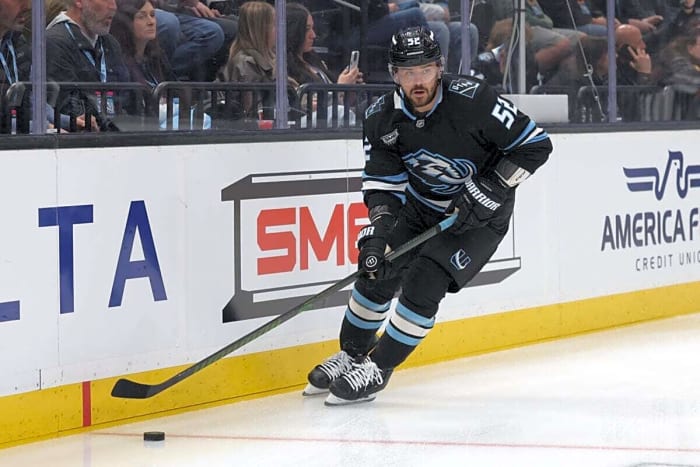
In the postseason, Weegar had the best playoffs of his career to date. Though he had a disappointing Game 1, he scored in Game 2, helping the Mammoth win their first-ever playoff game. In Game 3, Weegar scored the first-ever postseason goal at the Delta Center, which eventually led to the Mammoth winning the game and taking a 2-1 lead in the series. He also produced an assist in that game.
WEE got ourselves a goal!!
— Utah Mammoth (@utahmammoth) April 25, 2026
Weegar makes it 1-0, Utah! pic.twitter.com/P1O0932Zar
Weegar produced assists in Games 5 and 6, but it wasn’t enough to keep the Mammoth from being eliminated. The defenseman finished with five points in six games, tied for the team lead. He also finished as a plus-two, tied for the team lead in that category as well.
The Future
Now that he’s on a team that is expected to be a playoff contender for at least the remainder of his contract, Weegar’s future isn’t one of uncertainty. Next season, he will likely play on the top pair with Mikhail Sergachev.
The goal for next season is to get Weegar 100% acclimated to the Mammoth’s systems and play while getting his stats back to where they were before this season. You can knock the plus-minus stat all you want, but ultimately, it is something players pay attention to. Being the third-worst player in the league in that category isn’t a good thing, and it’s something Weegar really harped on in his exit interview.
“I was minus-33, so I definitely want to get better at keeping the puck out of my net and get back to being a plus player,” Weegar said. “I’ve always taken pride in being a plus player. I’ve got to get back to playing hard in the D zone, spending less time in the D zone and moving the puck up to the forwards, and playing a little bit more offense. I’ll go into the summer fixing that, then it’ll get better for this team. Playing with Sergey, it’ll be a lot easier for him as well.”
As mentioned, it was an adjustment for Weegar to fit into his role on the Mammoth, but down the stretch and especially in the postseason, he really became one of the top defensemen for the team. Interestingly enough, it was Sergachev who had the more disappointing postseason. Perhaps it was because it took time for him to adjust as well. The chemistry between the two needs to improve and be at its best in this upcoming season.
Weegar’s play does fit in well with the Mammoth’s systems. Usually, he’s able to make excellent passes with the puck while providing good play in his own zone that often comes with physicality. It’s not something that worked well with the Flames this season, a first half of the year that he’s still not happy with. With a full summer under his belt along with a full training camp in Utah, Weegar should be able to have a strong 2026-27 season.
“To be quite honest, I wasn’t really happy with my game coming from Calgary,” Weegar said. “It was a bit of a tough season. Next season, I’ll be super motivated to get back to being myself and moving the puck up to the young skill, the young forwards, and providing a little bit more stability on the back end. I think my game fits well with this team as a defenseman who can play both sides. I’m a bit of a hybrid back there. I like to do it all.”
Besides the needed redemption from a poor season on a horrible Flames team, the one thing that Weegar needs next season is a full year playing with the Mammoth. The more games he plays, the better he’ll get. That was proven in the playoffs. Otherwise, Weegar is a great addition to this team. He’s a solid defenseman and a great leader. He’s been on the Mammoth for less than half a year, yet he already believes that this team has the potential to do something great.
“This group is going to get better,” Weegar said. “We’re not going to go away. That’s why I moved my trade clause, because I believe in this team. I think we’re going to be in the playoffs for years to come here, and there’s a lot of good things to come for this group.”
Final Grade
It’s hard to grade Weegar’s season. His first half of the season was horrendous. Yes, he was on a bad Flames team, but even he’ll tell you it wasn’t a good first 60 games. However, after the trade to the Mammoth, Weegar improved with a better team around him, which culminated in a fantastic postseason performance where he was arguably the best defenseman all playoffs for Utah.
There are things to like and dislike from Weegar’s 2025-26 season. He was excellent at blocking shots and being a physical presence, but he was on the ice for a lot of goals against. His offense never really even came close to where he was in the past two seasons with the Flames, yet he was a big leader on and off the ice in both Calgary and Utah, no matter the situation he was in.
Overall, Weegar is getting a C-plus for this season. The defenseman’s 25 games with the Mammoth certainly improved his overall season, but the poor 60 games with the Flames certainly played a big role in driving down his grade. While not a lot of players on the Flames had a good season, Weegar’s defensive game was very poor, which drew a lot of criticism when the Mammoth traded for him.
With his first full season with the Mammoth a couple of months away, it should drastically help Weegar’s stats have a chance to be the best they’ve ever been. He’ll be given more of an opportunity to thrive with a good team around him, along with not being relied on as the number one guy. It won’t be surprising if Weegar’s grade significantly improves a year from now after wearing the Mammoth crest for a full 84-game season.
More must-reads:
- Why Maple Leafs fans should be excited about Gavin McKenna's first season
- Update on contract situation involving Penguins' Sidney Crosby emerges
- The 'NFL Playoffs rushing record' quiz
Breaking News
Trending News





Customize Your Newsletter
 +
+




Get the latest news and rumors, customized to your favorite sports and teams. Emailed daily. Always free!
PRIVACY POLICY COOKIE POLICY CONTACT US
ABOUT YARDBARKER TERMS OF SERVICE


By using this site, you agree to our Terms of Service and Privacy Policy.
This site is for entertainment purposes only.
There is no gambling offered on this site.
Gambling Problem? Call 1-800-Gambler.
