-

-


Follow Us
-

 On Facebook
 On Flipboard


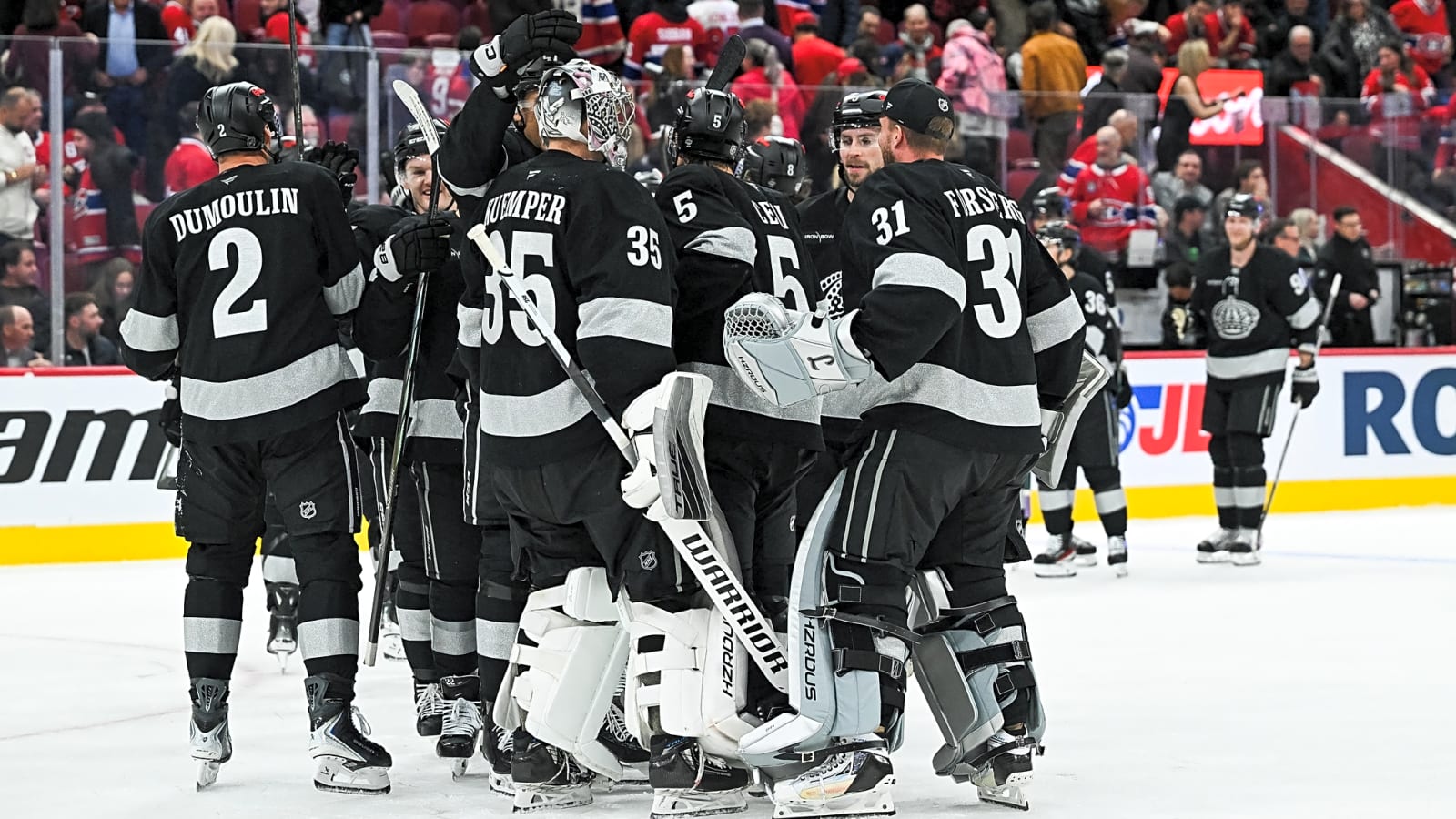
The Los Angeles Kings wrap up their five-game road trip this afternoon against the Anaheim Ducks before beginning a five-game homestand Saturday night. Given how the Kings have performed at Crypto.com Arena this season, returning home isn’t necessarily something to celebrate.
Los Angeles enters Friday’s game with a 2-8-0 home record compared to a 6-4-2 mark on the road. The Kings have collected just four of their 18 points at home, despite playing ten of their first 22 games there.
Interestingly, Los Angeles has generated more shots and controlled a greater share of expected goals at five-on-five at home. So why haven’t those performances translated into wins?
Purchase tickets via Ticketmaster
A Tale of Two Records
Los Angeles had the NHL’s second-worst home record following its November 23 victory over Montreal. The Kings had also lost four consecutive games at Crypto.com Arena, getting outscored 16-6 by Pittsburgh, Nashville, the New York Islanders and Calgary.
The lack of scoring extends beyond that stretch. Los Angeles scored 13 of its 24 home goals in two games, defeating Ottawa 6-5 in overtime and San Jose 7-2. That leaves just 11 goals across its eight home losses, an average of 1.38 per game.
However, the Kings have averaged 29.6 shots per game at home compared to 25.25 on the road. Their road scoring average of three goals per game is considerably better than the 2.40 they have managed at home.
It’s a significant departure from what the Kings accomplished just two seasons ago. Los Angeles had the NHL’s best home record in 2024-25, going 31-6-4 while averaging 3.46 goals per game. That dropped to 2.59 last season as the Kings finished 15-17-9 at home.
Opponent strength offers little explanation for the disparity. Using opponents’ records through November 25, the average points percentage was approximately .565 for home opponents and .571 for road opponents. That is an unweighted comparison across games, not a measure of how strong each lineup was on the night.
The decline in home scoring, therefore, isn’t entirely new. The difference this season is that Los Angeles has continued losing games without picking up the overtime points that helped offset some of its home struggles last year.
Where the Kings Are Struggling
According to Primitive Stats, Los Angeles has controlled 55.9 percent of expected goals at five-on-five at home compared to 44.4 percent on the road. Expected goals assign a value to scoring opportunities based on their estimated likelihood of resulting in a goal. A share above 50 percent indicates the Kings have generated more expected offense than they have allowed.
Consider the November 12 loss to the Islanders. Primitive Stats’ regulation-only, all-situations model, excluding empty-net situations, credited Los Angeles with 3.25 expected goals compared to 1.56 for New York. Yet the Kings lost 5-2. That was one of several home defeats in which the score wasn’t particularly representative of the chances the Kings generated.
Goaltending is another area where the difference stands out. Darcy Kuemper has a .845 save percentage in six home starts and a .915 save percentage in eight road starts. His goals-against average increases from 2.59 on the road to 3.77 at home.
However, Anton Forsberg has performed considerably better at Crypto.com Arena. He has a .924 save percentage in five home appearances but hasn’t won any of his four starts there. That suggests the Kings’ problems extend beyond goaltending.
Special teams provide another interesting contrast. According to OptimaGoal’s rounded splits, the Kings have killed approximately 78 percent of their penalties at home compared to 63 percent on the road. Their power play has operated at roughly 21 percent at home and 23 percent away.
While the penalty kill needs improvement overall, those splits don’t support identifying it as the primary reason Los Angeles has lost so frequently at home.
Is the Problem Sustainable?
There are reasons to believe the Kings can improve their home record without making substantial roster changes. Generating a greater share of quality chances is generally preferable to relying on goaltending to overcome an opponent’s offensive pressure.
The Kings’ recent road results offer a good example of the latter. Los Angeles has won three of its first four games on its current road trip, defeating Boston, Toronto, and Montreal. Kuemper started all three wins, allowing four goals on 86 shots for a .953 save percentage, excluding shootout attempts.
The Los Angeles Kings scored three goals in Boston and two in Montreal. At home, they have repeatedly lost games with similar offensive production. Better goaltending in those situations could certainly help, although it doesn’t eliminate the need for more scoring.
Lineup availability also complicates the comparison. Artemi Panarin and Trevor Moore both returned against Montreal. Panarin assisted on Alex Laferriere’s power-play goal, while Moore scored the winner. Having both available gives coach Peter Laviolette more options when distributing offensive responsibilities.
Ten home games also represent a relatively small sample, particularly when evaluating goaltenders and shooting percentages. Opponent quality, score effects and personnel changes can influence expected-goal numbers. Teams protecting leads may also concede more attempts as the opposition pushes for a tying goal.
The available evidence doesn’t establish that Laviolette’s approach at home is the problem. It does establish that generating chances hasn’t been enough to overcome poor finishing and costly goals against.
An Important Homestand Ahead
Beginning Saturday, the Los Angeles Kings will host Anaheim, Vegas, Minnesota, Utah and San Jose through December 9. Three of those games come against Pacific Division opponents, giving Los Angeles an opportunity to take points directly from teams it is chasing.
Minnesota and Vegas present difficult matchups. Both had collected more than 65 percent of their available points through November 25. Anaheim also has a dangerous power play, which puts additional pressure on the Kings to stay out of the penalty box.
There is some encouragement from Los Angeles’ recent wins. Against Toronto, the Los Angeles Kings overcame a three-goal deficit with contributions from Alex Turcotte, Laferriere and Erik Haula before Adrian Kempe secured the shootout victory. Getting production from different parts of the lineup is something the Kings could use more frequently at home.
Los Angeles doesn’t necessarily need to generate more shots at Crypto.com Arena. It needs to turn a greater number of those opportunities into goals while limiting the mistakes that leave its goaltenders in difficult situations. With ten points available during the homestand, the Kings have a chance to demonstrate whether their recent improvement can translate into better results at home.
More must-reads:
- Devils defenseman Brenden Dillon suspended four games
- If Colston Loveland is out, Bears are out of tight ends
- The 'Josh Allen or Pat Mahomes' TD quiz
Breaking News
Trending News






Customize Your Newsletter
 +




Get the latest news and rumors, customized to your favorite sports and teams. Emailed daily. Always free!
PRIVACY POLICY COOKIE POLICY CONTACT US
ABOUT YARDBARKER TERMS OF SERVICE


By using this site, you agree to our Terms of Service and Privacy Policy.
This site is for entertainment purposes only.
There is no gambling offered on this site.
Gambling Problem? Call 1-800-Gambler.