
-

-


Follow Us
-

 On Facebook
 On Flipboard
 On Twitter
Top eight college football stars who passed on the 2026 NFL Draft
Some of the biggest names in college football were nowhere near the green room on the Jan. 14 underclassmen declaration deadline for the 2026 NFL Draft.
They chose school over a professional paycheck, another season over a contract, and, in doing so, reshaped what the upcoming college football season is going to look like. Here are the top stars who turned down the 2026 draft.
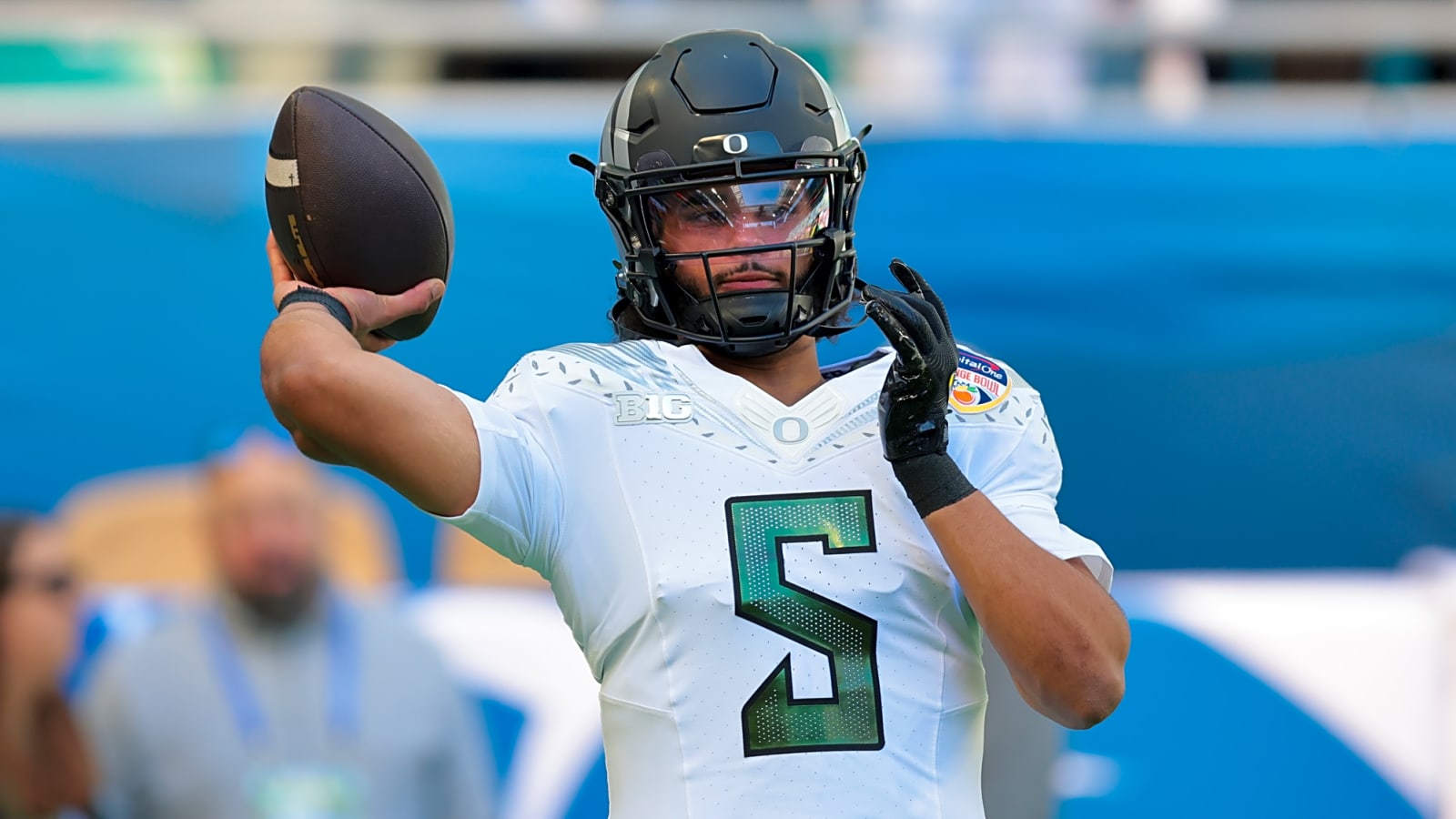
1. QB Dante Moore, Oregon Ducks
Moore was sitting on a potential top-five pick and walked away from it anyway. The Ducks quarterback had a 2025 season that backed up every bit of the hype surrounding him. He recorded 3,565 passing yards, 30 touchdowns and a 71.8 percent completion rate that ranked inside the national top 10.
Then the Peach Bowl happened. Two fumbles, a pick-six and a College Football Playoff run that ended badly. Moore knows it too. He came back because there is unfinished business in Eugene.
2. QB Darian Mensah, Miami Hurricanes
Mensah's road to Coral Gables was not a straight line. A disputed NIL deal at Duke, a lawsuit, a settlement and then a transfer to Miami later, he finally landed somewhere that fits his repertoire. In 2025 with the Blue Devils, he threw for 3,973 yards and 34 touchdowns, both ranking second nationally, while completing 66.8 percent of his passes and throwing just six interceptions.
Now, Mensah steps into a program that just played for a national title and needs someone to replace Carson Beck.
3. QB Arch Manning, Texas Longhorns
Manning closed out his sophomore year with 3,163 passing yards, 26 touchdowns and 399 rushing yards, solid numbers that still left room for the bigger statement his junior year demands. The Red River Rivalry win told the world what he is capable of.
He went 21-of-27, composed and efficient in a 23-6 rout of Oklahoma that looked easy. The 21-year-old returns to a roster built for a deep CFP run. This is the season that sets his draft position, still a potential No. 1 pick at the 2027 NFL Draft, and everyone in Austin knows it.
4. QB Jayden Maiava, USC Trojans
Maiava has the arm. He has the aggression. What scouts want to see is consistency, and that is exactly what another year at USC gives him the chance to build. He challenges coverage constantly and can take over a game when he is in rhythm.
The Trojans rebuilt their roster around him, and if he strings together a full season of that, the conversation around him changes fast heading into 2027.
5. DL A'Mauri Washington, Oregon Ducks
Washington is the kind of interior defender who makes life difficult before the play even starts. Offenses have to account for him at the line, which creates openings for everyone else on Oregon's front.
His decision to stay gives the Ducks a defensive anchor most programs would trade their top offseason addition to have. He is as important to Oregon's title case as Moore is.
6. EDGE Damon Wilson II, Miami Hurricanes
Miami lost Rueben Bain Jr. and Akheem Mesidor to the NFL Draft, and the edge rush needed a jolt. Wilson transferred from Missouri and brings exactly that.
He plays with a high motor, consistently pressuring quarterbacks and forcing decisions before they are ready to make them. The Hurricanes did not hesitate to make this move. With Wilson on board, the defense has teeth again.
7. CB Brice Pollock, Texas Tech Red Raiders
Pollock can play man and zone, and make plays on the ball in both. That combination is what had NFL scouts paying attention, and it is the same reason his decision to return raises his 2027 draft ceiling rather than lowering it.
A complete season against Big 12 competition could vault him into first-round territory by April. Texas Tech gets its best corner back, and Pollock gets the stage to make his case.
8. OL Carter Smith, Indiana Hoosiers
Indiana won the 2025 national championship. Smith was part of the line that made it happen, and keeping him in the fold gives the Hoosiers the continuity they need to defend it.
He anchors the unit with size, leverage and communication that holds protections together on both sides of the ball. For a program now carrying the weight of a title, that kind of stability up front is not a small thing.
More must-reads:
- League insiders believe Raiders' Fernando Mendoza decision is clear heading into NFL Scouting Combine
- Five things you need to know about 2026 NFL Scouting Combine
- The 'Schools to win a CFP game' quiz
Breaking News
Trending News



Customize Your Newsletter
 +
+




Get the latest news and rumors, customized to your favorite sports and teams. Emailed daily. Always free!
PRIVACY POLICY COOKIE POLICY CONTACT US
ABOUT YARDBARKER TERMS OF SERVICE


By using this site, you agree to our Terms of Service and Privacy Policy.
This site is for entertainment purposes only.
There is no gambling offered on this site.
Gambling Problem? Call 1-800-Gambler.
