-

-


Follow Us
-

 On Facebook
 On Flipboard


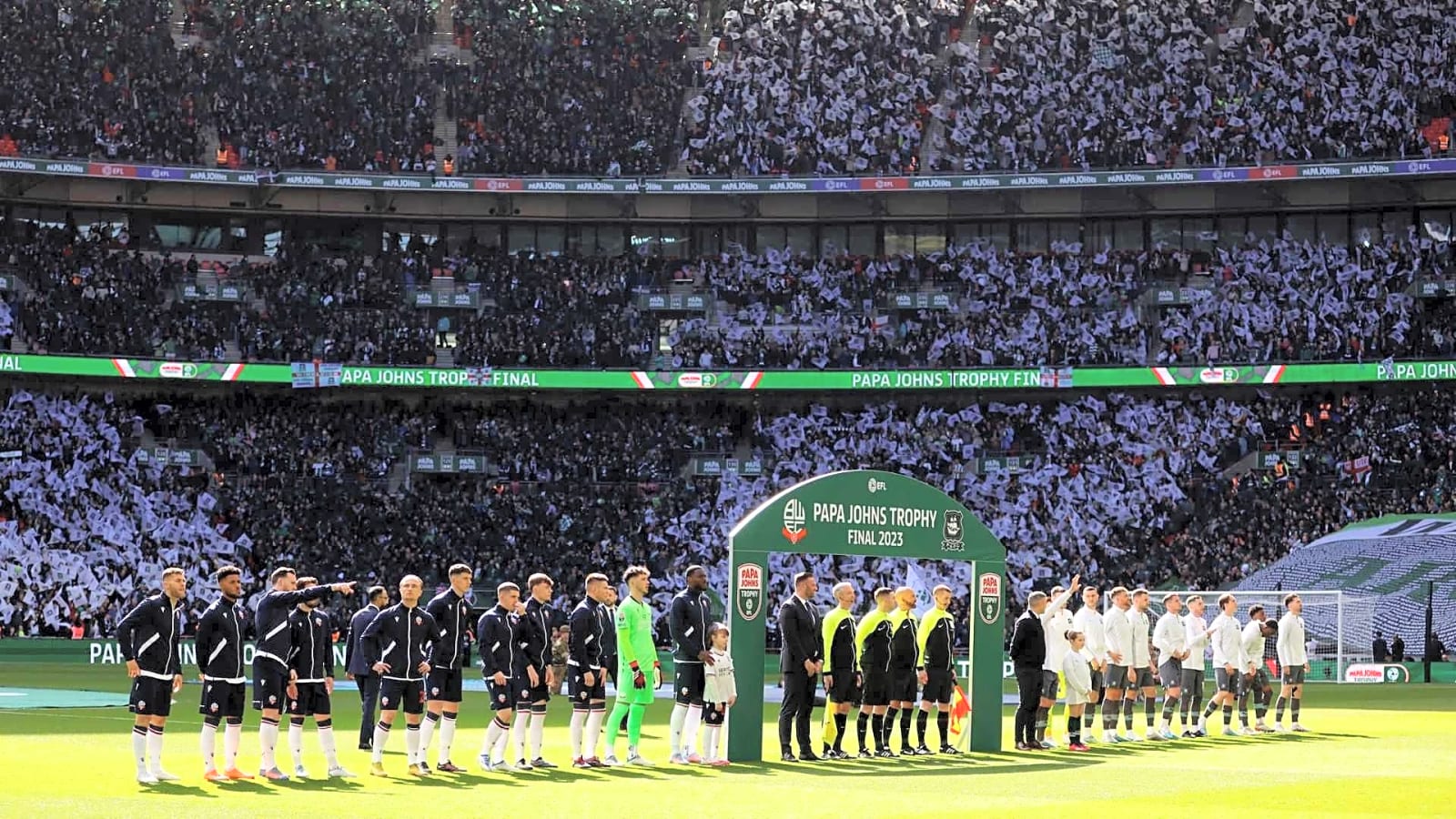
EFL supporters will tend to disagree on most topics, but amid the incessant discourse and fierce daily debates, there is one thing that the majority of fans sing from the same hymn sheet with.
Club and player performance, divisional standards, club size, fanbase volume and stature and hit-or-miss signings are all subjects which invariably promise to polarise and split opinion, yet that's not the case for every single EFL-related matter.
As such, one notable topic may often spark discussions among supporters of League One and League Two clubs but they rarely disagree on it, and their school of thought also has backing from two of the nation's most prominent pundits in Jamie Carragher and Gary Neville.
Jamie Carragher and Gary Neville reveal that they 'don't like' the EFL Trophy
That subject is, of course, the EFL trophy, which currently goes under the name of the 'Jersey Mike's Trophy' and is contested by clubs in League One and League Two alongside 16 Category One Premier League under-21 sides.
The formatting of the competition includes one academy team for each group, of which there are a total of 16 on a regionalised basis with eight northern and eight southern, and the top two progress to the knockout stages. All fixtures are regionalised until the semi-final stages, with the final two sides ultimately battling it out for silverware at Wembley.
For a number of reasons, however, the EFL trophy and the requirement of each EFL club outside the Championship to compete in the tournament has long represented a point of often-frustrated discussion, and exactly how Carragher and Neville feel about it has become clearer.
Speaking on the latest episode of The Overlap's Stick to Football podcast, the high-profile punditry pair began the show by discussing the participation of Carragher's son James in the competition for Wigan Athletic's 2-1 Group B victory at Crewe Alexandra on Tuesday evening.
Carragher revealed that he switched the match off at half-time, before Neville disclosed that he doesn't like the competition through his boardroom role with League Two leaders Salford City - who lifted the trophy over Portsmouth behind-closed-doors at Wembley back in 2021.
The ex-Liverpool defender explained: "He (James) played last night. It was on at 7 o'clock, you can get it on Sky and he told me he was playing 45 minutes.
"I just switched it off at half time, so I missed the second half. They won 2-1, I think they had already qualified anyway.
Neville then added: "I don't like that trophy. It's a weird one."

Carragher responded that "it's probably a bit like the Carabao Cup for Premier League teams, but when you get to see something at Wembley," to which Neville recounted: "We (Salford) won it in COVID in League Two, we beat Portsmouth at Wembley.
"We were playing in the final against Portsmouth, it was going to be in March and, when lockdown came in February, they'd sold 32,000 tickets for the final and we were going to make quite a lot of money out of it because we'd sold five or six (thousand).
"It was looking at about 40,000, which is a decent crowd at Wembley and the money splits halfway. We ended up playing it the year after infront of no people, the directors and owners were in there but there was literally nobody in the ground and we had to sit two seats apart from each other.
"We absolutely battered them, it was mad."
Why EFL fans dislike the EFL Trophy
The EFL Trophy presents a variety of drawbacks for contestants as EFL outfits face much more jeopardy and risk than the competing under-21 sides, which is a key reason as to why many have slammed the tournament over the years.
Understandably, it is widely felt that the now-11-year-old decision to include Category One academy contingents undermines and devalues the competition's integrity and has created a tournament which is essentially designed to accommodate Premier League clubs, despite the fact that no under-21 side has ever lifted the trophy at Wembley.

Indeed, many age-group contestants will actually take prestigious youth tournaments such as the UEFA Youth League and Premier League International Cup more seriously, which only reduces the competitiveness of the EFL Trophy.
Therefore, the matchday experience for EFL Trophy encounters pales in comparison to any league fixture, as matches are often marked by extremely low attendances and non-existent atmospheres in near-empty stadiums in an accurate display of precisely how most EFL clubs and fanbases alike value the competition.
Another prominent issue is how it provides additional fixture congestion in already-hectic schedules, which proves particularly challenging for sides with weaker or lighter squads.
Naturally, it's frequently to the frustration of promotion-chasing or relegation-battling League One and League Two sides when they have to hop out of league action to compete for the trophy when much greater outcomes and jeopardy are on the line.
EFL rules mandate the fielding of a minimum number of experienced players, and some clubs can feel the benefits of promoting young talent into senior football through the competition, but the injury risks and fixture congestion often outweigh the advantages and you would be hard-pressed to find too many third and fourth-tier outfits who genuinely value their own participation.
The EFL Trophy has a couple of major advantages
The disadvantages of the EFL Trophy certainly outstrip the benefits for the overwhelming majority of EFL participants, though it's not all universally negative.
Quite obviously, the major upside is the prospect of lifting a trophy at Wembley. We're hardly talking about prestigious silverware here, of course, but either way, that opportunity is one that is nigh-on impossible to experience in any other fashion for almost any non-Championship EFL side unless they win the play-offs, though that's not a classic-style tournament.
Just how much of a benefit that really is remains open to debate, as with only one team capable of winning it per season by definition, everybody else misses out and fails to obtain such an exclusive advantage.
Few would say that trying to get to Wembley in a second-rate competition is of superior importance than trying to battle for promotion or against relegation, too, yet it's a rare upside that can provide supporters with something of a once-in-a-lifetime opportunity.
As aforementioned, meanwhile, the ability to integrate young academy-honed prospects who may not yet be reared and readied for consistent league action into a senior footballing competition, albeit one with debatable pedigree and competitiveness, is still not to be sniffed at.
It can have positive long-term effects, even if the short-term risks mean most clubs would perhaps wish to simply not participate in the first place.
More must-reads:
- 'Respect the opponent': Mauricio Pochettino embraces the present in his final USMNT fixture
- SEC backs off eligibility fight, paving way for former pro RJ Luis Jr. to play at LSU
- The 'National League MVPs' quiz
Breaking News
Trending News



Customize Your Newsletter
 +


Get the latest news and rumors, customized to your favorite sports and teams. Emailed daily. Always free!
PRIVACY POLICY COOKIE POLICY CONTACT US
ABOUT YARDBARKER TERMS OF SERVICE


By using this site, you agree to our Terms of Service and Privacy Policy.
This site is for entertainment purposes only.
There is no gambling offered on this site.
Gambling Problem? Call 1-800-Gambler.