
-

-


Follow Us
-

 On Facebook
 On Flipboard
 On Twitter
While on the surface Liam Rosenior’s tactical ideology can seem similar to Enzo Maresca, the two have a number of differences when you dig into the finer details. Both can start with a 4-2-3-1 but tend to end up with something a little different. In this article, we will be diving into what makes the two different and how Rosenior has shifted things in his brief tenure.
Liam Rosenior’s Tactical Versatility at Chelsea
Enzo Maresca Most Common Shape
By the end of his time with the Blues the Italian had a fairly interesting setup, both full-backs inverted in midfield to different positions while one of the pivot players pushed up and the wingers stayed as wide as possible.
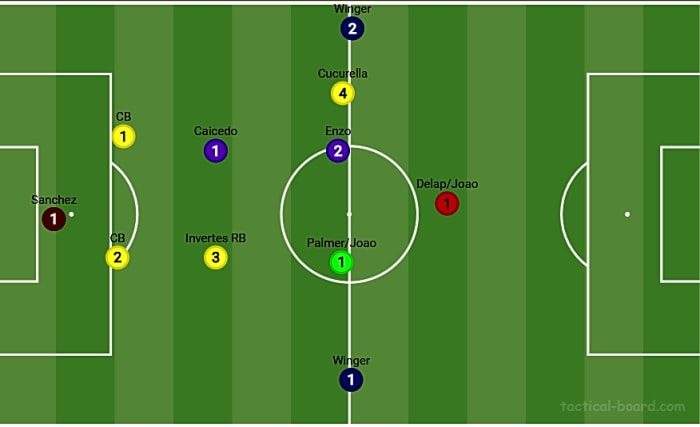
As you can see above, the pivot was regularly split with one pushing up to attack while the other sat back with some help. This caused issues in transition when both full-backs were spreading wide to get back to cover the wings while leaving Caicedo alone to shield the back line. This wasn’t set in stone either as sometimes Gusto would end up in that half-space on the right as almost another attacking midfielder.
There were other variations later with a more consistent James/DM pivot with Enzo pushed forward to a number ten role but for the most part one of the hallmarks of the Maresca system was his split pivot. Wingers were asked to stay wide and provide the width in 1 v 1 situations as players overloaded centrally to crash the box.
The New Look
Since being appointed, Rosenior has had some changes to the 4-2-3-1, still using the same system but putting his own spin on it. The positioning of certain players is different but the roles asked of everyone are similarly new.
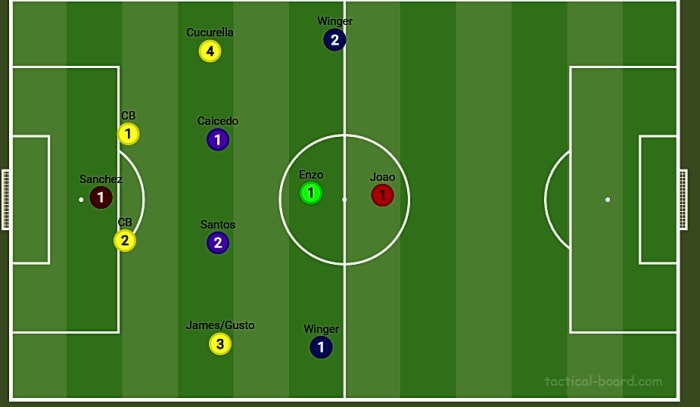
As seen above, Andrey Santos has now become a regular in the defensive midfield pivot, sometimes being replaced by James. This sees the two midfielders stay closer together as a duo in front of the back line instead of splitting, which has seen Enzo move to the number ten spot more permanently. This has a few effects but it mostly allows the pivot to shield the back line better.
The full-backs are also used in more interesting ways, they tend to stay wider now, offering underlaps or overlaps and helping the high press by recycling the ball. While they certainly can invert as Jorrel Hato did against Charlton, their primary aim is to help out the wingers in Roesnior’s tactics.
The positioning of the goalkeeper is also important, Rob Sanchez or Filip Jorgensen play much higher up, providing an extra body in the back line for the defenders to pass to, this along with the double pivot staying closer means that the team are finding it easier to build through presses than before.
The Extra Twist
In addition to having his own player roles and setup in the 4-2-3-1, the new manager has also shown his adaptability by using a 3-4-2-1 against both Napoli and Arsenal. What this does is allows the creative players like Enzo and Estevao to get inside to the half-space while the wing-backs provide width, the back three and pivot allow for better transition defending and easier build-up through a press.
The match with the Gunners showed an interesting tweak on this too as Liam Delap, usually a striker, was stuck against the right-back all night to run the channels and challenge him in aerial duels to spread the pitch. This didn’t work as Arsenal notably have some of the best hybrid full-backs in the game but not every team is going to have a left-back ready to defend against a physical striker in the air or on the ground.
More must-reads:
- Coach Phil Neville lauds 'dying for the shirt,' but his struggling Portland Timbers may need to learn to live in it instead
- UConn women unbeatable after throttling Syracuse in Round of 32
- The 'Most 5-three-pointer NBA games' quiz
Breaking News
Trending News






Customize Your Newsletter
 +
+




Get the latest news and rumors, customized to your favorite sports and teams. Emailed daily. Always free!
PRIVACY POLICY COOKIE POLICY CONTACT US
ABOUT YARDBARKER TERMS OF SERVICE


By using this site, you agree to our Terms of Service and Privacy Policy.
This site is for entertainment purposes only.
There is no gambling offered on this site.
Gambling Problem? Call 1-800-Gambler.
