
-

-


Follow Us
-

 On Facebook
 On Flipboard

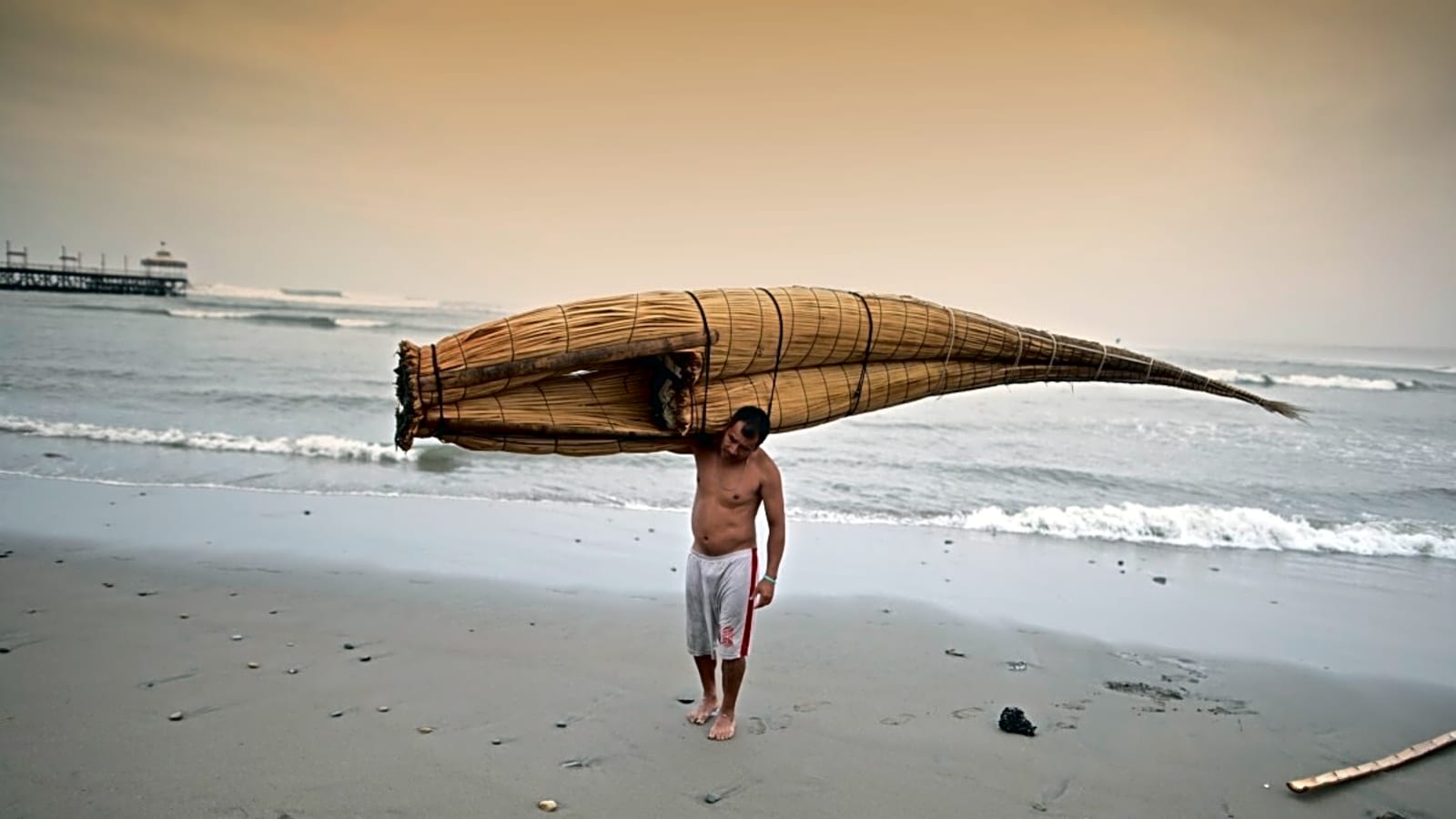
Picture yourself looking for a boat or boat-like hullform for breaking out through incessant swell and, likewise, gliding your way back in with a net full of finned critters and, like the ancient Moche of Peru, you, too, might have dreamt up something similar to the caballitos de totora, or “little reed horses” fashioned along Peru’s north shore with what was at hand: lots and lots of reed.
Some surf cognoscenti, such as Chas Smith in his history of the intertwinings of surfing and cocaine’s humble eastern pacific beginnings, claim that the caballito de totora is the first surf craft to have ever been built. Debatable, but in no way dismissible.
Of course, what with modern vessels, propulsion, and gear—to say nothing of fish-stock crises and plastic contamination—this surf craft of antiquity could be looking like it’s headed the way of the Land of the Incas’ late red-throated wood-rail (a regional bird last recorded in 1843).
To make matters worse, and deeply rooted though this tradition of hullforming may be, the totora reeds, which grow in particular ponds near the coastal town of Huanchaco and have given their all for hundreds of thousands of fisherfolk over the millennia, are in grave trouble thanks to a series of sewage spills in 2025. During that calendar year, more than half of the region's reed beds were wiped out.
And so now it is estimated that a mere 40 fishers still use caballitos, according to the Guardian. Help from NGO Conservation International came by way of 13 new ponds, but tempting new skippers—or old ones out of retirement—is still a tall order.
A 2018 law protects Peru’s “traditional ancestral fishing” as a matter of “national interest,” but efforts to guard the five-nautical-mile coastline reserved as an exclusive port for caballito seafarers have, reportedly, been minimal.
And so it would look dire for these weighty, vaguely 90-pound, 13- to 16-foot self-waterlogging, self-draining prototypes of the modern surfboard, if not for the modern peripatetic surf enthusiast.
Huanchaco is, being on the north coast of the land of lefts, a popular surf destination, and surf travelers tend on the intellectually curious side of things—or so it might be said.
In any case, said surf travelers are finding themselves enamored of the caballitos, and, conversely, many caballito builders and fishermen are turning to modern surfing and surf craft, and opening surf schools. It may be a simple novelty, but anything to keep surfing’s history alive and well, eh?
More must-reads:
- Browns have reportedly made huge Shedeur Sanders decision amid Deshaun Watson concerns
- Angel Reese is close to a WNBA suspension
- The 'Most three-pointers by NBA team' quiz
Breaking News
Trending News



Customize Your Newsletter
 +
+




Get the latest news and rumors, customized to your favorite sports and teams. Emailed daily. Always free!
PRIVACY POLICY COOKIE POLICY CONTACT US
ABOUT YARDBARKER TERMS OF SERVICE


By using this site, you agree to our Terms of Service and Privacy Policy.
This site is for entertainment purposes only.
There is no gambling offered on this site.
Gambling Problem? Call 1-800-Gambler.
