
-


Follow Us

 On Facebook
 On Flipboard
 On Twitter
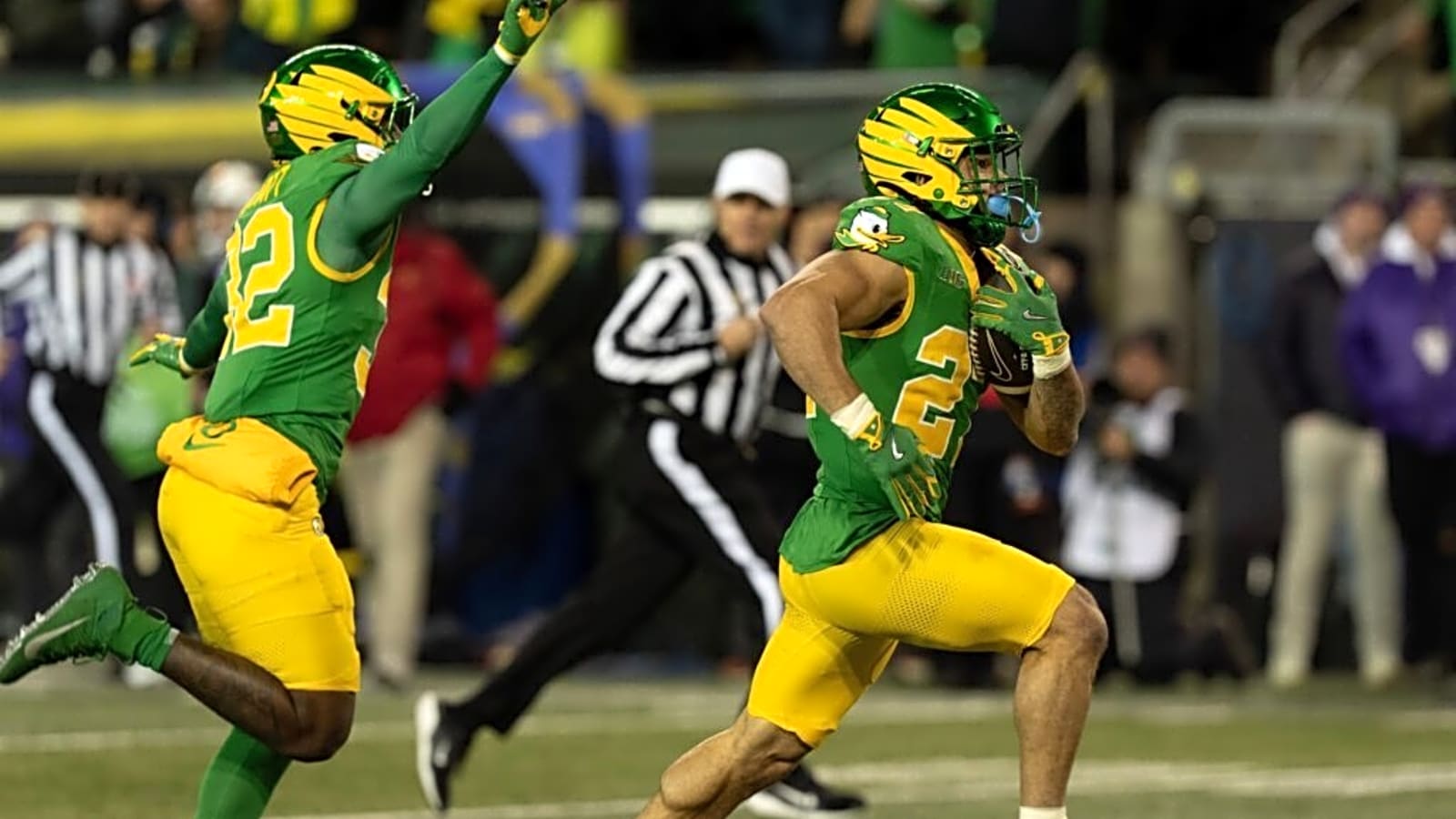
Former Oregon running back and Lake Stevens, Washington native Jayden Limar has committed to Washington in the transfer portal. The rising senior running back entered the portal prior to the Ducks’ College Football Playoff Semifinal game against Indiana. He’s one of three Oregon running backs to have entered the portal during this cycle. Limar was originally recruited by Washington, but he did not list the Huskies among his “top nine” schools back in 2022. Jedd Fisch’s Arizona Wildcats, with running backs coach Scottie Graham, were, however, among his “final four” schools.
Jayden Limar Transfers to Washington
Limar was a four-star recruit and the number two player out of the state of Washington in the 2023 class. The running back originally committed to Notre Dame, but he flipped to Oregon in December of 2022. After three years in Eugene, Limar never made his way to the top of the depth chart in what was a loaded running back room this past season.
Limar was Oregon’s fourth-leading rusher in 2025. On 46 attempts, he averaged 5.7 yards per carry with 262 yards and three rushing scores. Limar also caught 11 passes out of the backfield for 75 yards. Senior Noah Whittington and freshman Jordon Davison led the group with over 100 carries each. Dierre Hill Jr., another freshman, was third with 75 attempts and a team high 8.75 yards per carry. Limar wasn’t able to match the consistency of the other three, especially as he dealt with a foot injury, which caused him to miss the final six games of the regular season. That included the season finale at Washington. In three seasons at Oregon, he totaled 95 rushing attempts for 442 yards with four scores in 33 games played.
Replacement for Mohammed
Adam Mohammed was expected to be the Husky starter in 2026. Having played in all 26 possible games since arriving, and with 148 career attempts, Mohammed was tailored to become the premier tailback next year. Instead, he’ll continue his career at Cal. That leaves Jordan Washington as the room’s next-most experienced runner. He had 27 attempts last year for 233 yards (8.6 yards per carry). But he’s only appeared in 12 career games. Behind him, true freshmen Quaid Carr had four attempts, and Ryken Moon had five.
The addition of Limar from Oregon fills an experience void in the tailback room for Washington. But it will not be a one-to-one replacement in terms of running style. Mohammed, at 6’-0” and 220 pounds, is a physical and decisive runner. His confidence while running with the football took tremendous strides in 2025, which, in turn, resulted in explosiveness. Mohammed finished the regular season with back-to-back 100-yard rushing performances, averaging 6.1 yards per carry in that stretch. That included his 7.5-yard per rush game against Oregon’s top-20 run defense.
Limar notched 10 missed tackles forced on 46 carries in 2025, good for about 21%. Mohammed’s 40 missed tackles forced on 106 carries is 38%, but he also had more than double the opportunities than that of Limar. The new Husky running back had just two games with double-digit rushing attempts this season. But in those games, Limar combined for eight missed tackles on 23 attempts (35%). The physicality is there, but it hasn’t been put on display in the same way. That’s likely due to the lack of reps during his time at Oregon.
Run Style Comparison
Decisiveness is crucial for running backs to be successful in Washington’s run scheme. Fisch’s run game is primarily zone. Washington running backs attempted 267 runs in 2025, and 220 of them were zone scheme (82%). For Mohammed, 78% of his carries were behind zone blocking this past year. Limar’s stats indicate zone run on 25 of his 46 attempts in 2025 (54%), and just 12 of his 25 attempts the year prior (48%). Limar’s ability to fill in for Mohammed’s departure will hinge on how he adapts to rushing behind primarily a zone blocking scheme.
In zone, running backs aren’t running through a defined gap. Instead, they make in-play decisions on where to carry the ball based on the directional blocking of the offensive line. Inside zone, mid-zone, and outside zone dictate the verticality and aim-point of the running backs’ attack. But it’s the runner’s decision on whether to cut back, “bang” through the aiming point, or bounce it to the outside. That decision is made based on how running lanes open up due to the linemen’s first- and second-level directional blocking.
This is why confidence is so important as a running back in this system. Fisch spoke to Mohammed’s heightened confidence as the year progressed as the primary reason for his increased success carrying the football. A running back needs to trust his eyes and read the play as it develops in order to have success behind zone blocking. Limar’s 4.7 yards per carry and nearly three yards after contact per attempt during his career at Oregon indicate his potential. But he doesn’t have the volume of zone run scheme reps that Mohammed did. This will be one of the focus points in evaluating Limar during spring football this coming April.
More must-reads:
- Five most improved teams since opening of 2026 college football transfer portal
- Ohio State lands two former five-star recruits from Alabama in transfer portal
- The 'Heisman Trophy winners since 2000' quiz
Breaking News
Trending News








Customize Your Newsletter
 +
+




Get the latest news and rumors, customized to your favorite sports and teams. Emailed daily. Always free!
PRIVACY POLICY EDITORIAL POLICY CONTACT US
ABOUT YARDBARKER TERMS OF SERVICE


Use of this website (including any and all parts and
components) constitutes your acceptance of these
Terms of Service and Privacy Policy.
This site is for entertainment purposes only.
There is no gambling offered on this site.
Gambling Problem? Call 1-800-Gambler.
