
-

-


Follow Us
-

 On Facebook
 On Flipboard

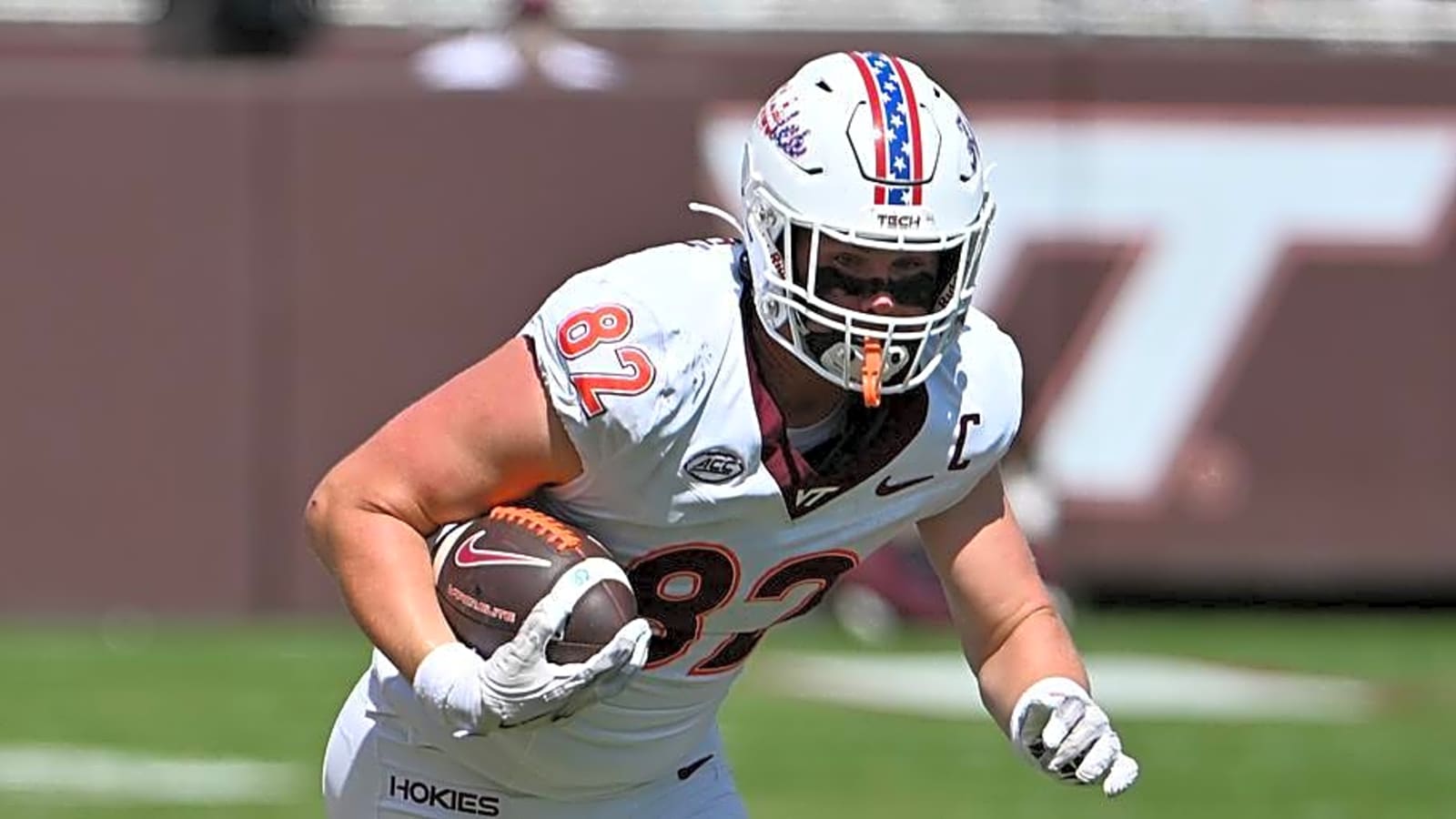
In part 4 of our Virginia Tech football position-by-position previews, I'll be taking a look at the Hokies' tight ends, previewing who's coming back from the 2025 unit and who's new, taking a look at who's favored to start this year, the biggest question mark surrounding the unit and what the bottom line to take away from the squad is.
Previous Installments
Returners:
- Benji Gosnell (r-Sr.): Gosnell is back for one final season after serving as Virginia Tech's starting tight end over the last three years. While the Hokies' passing game struggled in 2025, he still started all 12 games and recorded 12 receptions for 86 yards. His best campaign came in 2024, when he hauled in 32 catches for 341 yards and two touchdowns, proving he can be a reliable all-around option when featured in the offense.
- Harrison Saint Germain (r-Sr.): Saint Germain returns as one of the room's veterans after spending the past several seasons as a depth piece. His experience in the system gives Virginia Tech another reliable blocker and special teams contributor. Saint Germain has recorded 53 receiving yards on eight receptions over the last two seasons for the Hokies.
- Cole Reemsnyder (r-Sr.): Reemsnyder provides additional veteran depth entering his final collegiate season. The 6-foot-5 tight end has largely served in a reserve role on special teams but gives the Hokies another experienced body if needed in what has become one of the deeper position groups on the offense. He has not hauled in any receptions, though he did recover an onside kick against Miami this past season.
- Ja'Ricous Hairston (r-Jr.): Hairston, a quarterback back in high school, contributed as a reserve and on special teams in 2023 and 2024 but enters 2026 with valuable experience in the program after a strong 2025 season. At 6-foot-2 and 251 pounds, he's one of the Hokies' more physical tight ends and should compete for rotational snaps behind the top two options. Last year, Hairston hauled in a room-high 112 receiving yards and a joint-team-high three receiving touchdowns.
Newcomers
- Brody Jones (r-Jr.): Jones was a member of the linebacker corps but changed his position prior to 2026. He's played in 19 games in his time in college; in his time on the defense, he made two tackles and recorded a quarterback hurry. Jones played quarterback in high school at Virginia High School (Bristol, Va.), accumulating 2,370 passing yards and 35 passing touchdowns as a senior.
- Luke Reynolds (Jr.): Reynolds headlines the room after transferring from Penn State alongside head coach James Franklin and offensive coordinator Ty Howle. The former five-star recruit played in 13 games last season, catching 26 passes for 257 yards after posting nine receptions for 111 yards as a freshman. His familiarity with Franklin's system should allow him to make an immediate impact in Blacksburg.
- Matt Henderson (r-Fr.): Henderson followed Reynolds from Penn State after redshirting his true freshman season. While he has yet to record a collegiate reception, he was a well-regarded in-state prospect coming out of Powhatan High School (724 yards, eight touchdowns in senior season) and adds developmental upside to the room. Henderson played in five games last season, including the Pinstripe Bowl against Clemson.
Who is favored to win the starting TE role?
Gosnell brings three years of starting experience and is one of the team's most dependable blockers, but Reynolds arrives with considerably more upside as a receiver after developing in Penn State's offense under Franklin and Howle.
Virginia Tech does have the players to feature plenty of 12 personnel. Reynolds likely becomes the primary receiving threat, while Gosnell still carves out a very significant role.
Biggest question mark:
How much will the offense revolve around the tight ends?
On paper, this is arguably Virginia Tech's deepest tight end room in years. Reynolds has NFL-caliber talent, Gosnell is an experienced all-around player and the Hokies have legitimate veteran depth behind them.
Penn State consistently leaned on tight ends in both the passing game and as blockers, but Virginia Tech's previous recent offenses rarely made them focal points. If the Hokies fully embrace Franklin's philosophy, this group could become one of the offense's defining strengths. The tight ends logged 205 of the spring game's 428 receiving yards, potentially signalling that they could be in line for a serious role.
Bottom line:
This should be one of Virginia Tech's better position groups entering 2026.
Adding Reynolds gives the Hokies a legitimate difference-maker who is already in tune with a Franklin offense, while Gosnell remains one of the ACC's steadier all-around tight ends. Just as importantly, the depth behind them is strong, giving Virginia Tech the flexibility to play multiple-tight-end formations without sacrificing production.
If Reynolds develops into the receiving weapon many expect and Gosnell continues to provide his dependable two-way play, the tight end room has a chance to become one of the biggest beneficiaries of Virginia Tech's offensive overhaul in 2026.
More must-reads:
- Northwestern's new Ryan Field tour leads to incredible Chip Kelly photo
- What the updated Protect College Sports Act would change for college athletes
- The 'Youngest 4K-yard NFL passers' quiz
Breaking News
Trending News



Customize Your Newsletter
 +
+




Get the latest news and rumors, customized to your favorite sports and teams. Emailed daily. Always free!
PRIVACY POLICY COOKIE POLICY CONTACT US
ABOUT YARDBARKER TERMS OF SERVICE


By using this site, you agree to our Terms of Service and Privacy Policy.
This site is for entertainment purposes only.
There is no gambling offered on this site.
Gambling Problem? Call 1-800-Gambler.
