
-

-


Follow Us
-

 On Facebook
 On Flipboard
The Philadelphia Phillies' all-time outfield is simply stacked.
While the franchise's all-time infield has featured legends such as Jimmy Rollins, Mike Schmidt, Chase Utley, and Larry Bowa, the franchise's immortal outfield becomes increasingly difficult to rank when considering the sheer amount of history behind this franchise.
From the early 1900s at Shibe Park to Veterans Stadium, the Phillies' rich history lends itself to reams of legends from left to right field. Here is our take on the top five to ever do it in Philly.
5. Bobby Abreu (1998-2006)
Abreu spent the majority of his prime in Philadelphia, locking down right field during a transitional period for the Phillies between their 1993 World Series loss to the Blue Jays and the playoff success of the Rollins-Howard-Hamels era that would soon follow.
While Abreu's banner years came in 2004 and 2005, he put together strong campaigns from 1998 to 2003, where he put up consistently impressive on-base numbers paired with strong power and availability.
Abreu christened Citizens Bank Park on Opening Day in 2004 with a home run, a marker of what was to come - Abreu would that year become the first player in MLB history to record 30 home runs, 40 doubles, 40 stolen bases, and 100 walks in a single season.
4. Bryce Harper (2019-Present)
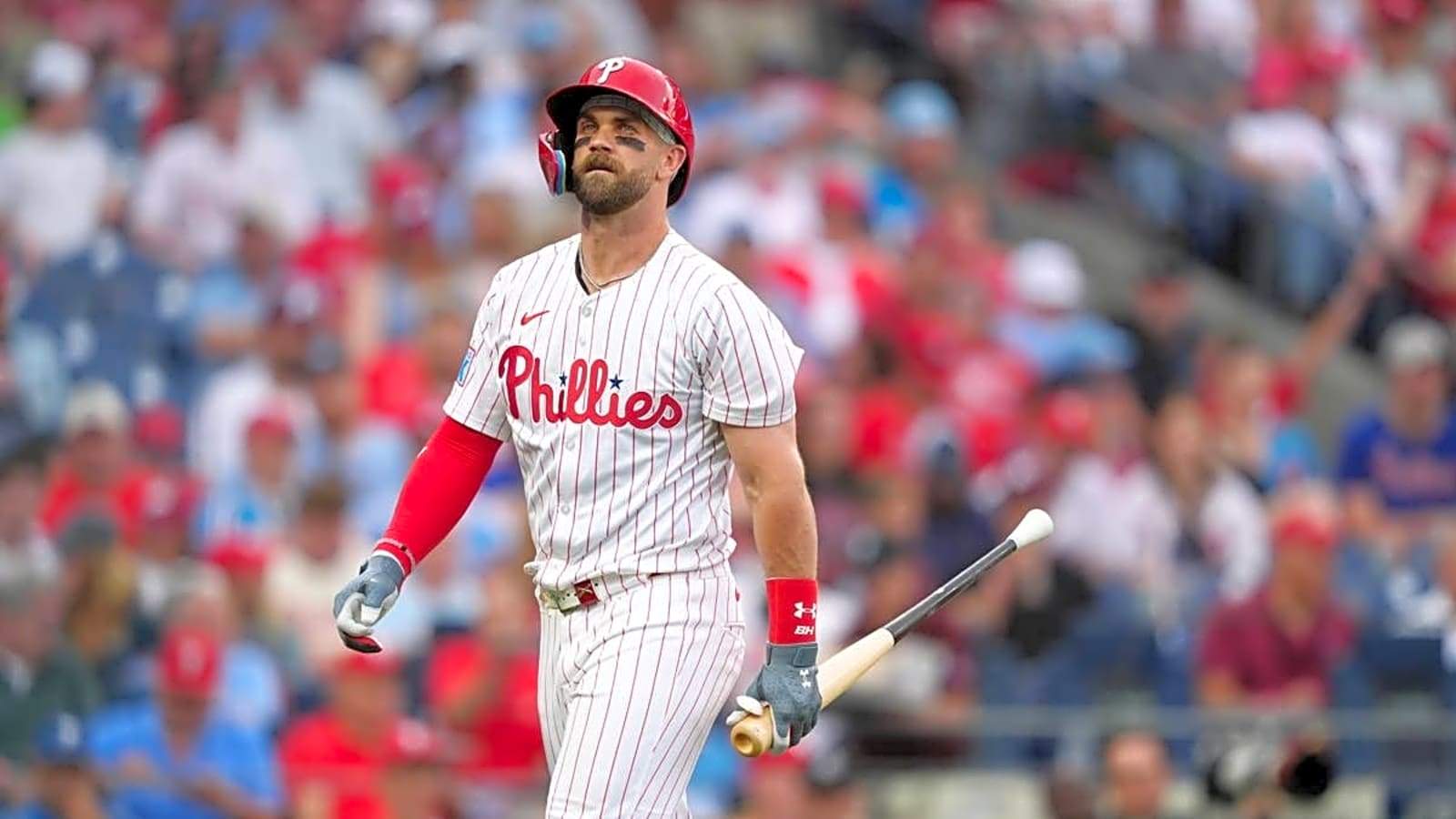
Harper only played in the Phillies outfield for four seasons (three, if we're being technical and accounting for the shortened 2020 season), but is the most iconic player in this current, competitive iteration of the Phillies and has rightfully earned his place in this list, even if the last three and a half years have seen Harper transition to first base following UCL surgery.
When Harper signed a 13-year, $330 million contract in 2019 to join the Phillies, it ushered in a new era for the city and the team and inked them a franchise star who would seamlessly become a cultural icon. An outspoken and natural leader, Harper has helped the Phillies navigate being in the spotlight as a player who himself has been in the spotlight since he was 16.
His 2021 season - spent in the outfield - is his most remarkable year in Philadelphia, as Harper took home his second National League MVP award and led the league in OPS (1.044) and doubles (42).
Harper's 2022 postseason heroics nearly took the Phillies to the top of the mountaintop, and Harper's "swing of his life" in the NLCS against the Padres remains one of the most iconic moments in franchise history.
3. Chuck Klein (1928-1933; 1936-1944)
Klein has an undeniable place on this list, as the 1980 Hall of Fame inductee produced one of the most statistically impressive stretches in not only Phillies history but baseball history.
Klein's eye-popping 170 RBIs in the 1930 season is a record still held today, while his .386 batting average and 445 total bases (fourth in MLB history) to go along with the clutch production rivals that of fellow era star Ted Williams.
Had he left any doubt, Klein won the Triple Crown in 1933, leading the league in batting average (.368), home runs (28), and RBIs (120) in an all-time great campaign.
Klein's incredible career was aided by the Phillies' home ballpark, the Baker Bowl, which had a 280-foot right field fence, leading to Klein's moniker of "The Babe Ruth of the National League."
2. Ed Delahanty (1888-1889; 1891-1901)
Delahanty is a perfect example of just how rich the Phillies' history is, playing for what was then the Philadelphia Quakers from 1888 to 1889. He would join the Phillies for the latter 10 years after a brief, failed stint with the Cleveland Infants of the short-lived Players League.
Over the course of a full career, Delahanty led the National League in offensive categories 24 times, including two home run crowns. To this day, Delahanty is the only player in NL history to hit .400 over three seasons, and his .346 career average ranks fifth in MLB history.
Delahanty was part of the "The Untouchables" outfield rounded out by Billy Hamilton and Sam Thompson, which in 1894 became the only outfield in Major League history to have all three players bat over .400.
After a brief stint with the Washington Senators, Delahanty died at 35 years old after a "mysterious" incident near Niagara Falls, but his legacy endures in Phillies history, and his story is enshrined in Citizens Bank Park's "Ashburn Alley."
1. Richie Ashburn (1948-1959)
Speaking of Ashburn Alley, its namesake is one of the most beloved figures in franchise history. Ashburn made his debut with the Phillies as a 21-year-old rookie, replacing veteran and reigning NL batting champion Harry Walker as the team's leadoff hitter, though he didn't show any pressure about filling Walker's shoes.
Immediately, Ashburn rattled off a 23-game hitting streak and possessed a .380 batting average in June. That was a sign of what was to come, as Ashburn would make four All-Star teams while in Philadelphia, including later in the 1948 season where he'd become the third rookie to start in an All-Star game along with Joe DiMaggio and Dick Wakefield.
Over a stellar, Hall of Fame career, Ashburn racked up 2,574 hits and hit to a career .308 batting average. He didn't hit much for power -- just 29 home runs in his career -- but was given the nickname "Putt-Putt" by either Ted Williams or Stan Musial because of his elite sprint speed.
After his playing career, Ashburn served as the Phillies' radio and TV color commentator, and was a legitimate candidate to be the namesake of the Phillies' new stadium in 2004. Ashburn Alley, the centerpiece of Citizens Bank Park and the home of its historical insignias, feels fitting for an all-time franchise icon.
More must-reads:
- Yankees announce Cam Schlittler as Game 1 starter for AL wild-card series
- Justin Verlander gets a surprise from Kate Upton in his final career game
- The 'Multiple 30/30 MLB seasons' quiz
Breaking News
Trending News




Customize Your Newsletter
 +
+




Get the latest news and rumors, customized to your favorite sports and teams. Emailed daily. Always free!
PRIVACY POLICY COOKIE POLICY CONTACT US
ABOUT YARDBARKER TERMS OF SERVICE


By using this site, you agree to our Terms of Service and Privacy Policy.
This site is for entertainment purposes only.
There is no gambling offered on this site.
Gambling Problem? Call 1-800-Gambler.
