
-

-


Follow Us
-

 On Facebook
 On Flipboard
The Chicago Cubs spent the better part of a decade dismantling themselves to build toward one championship, and when that window finally opened in 2015, they used it.
But even a franchise that ended a 108-year drought has made mid-season moves it regrets — sometimes for what was acquired, sometimes for what was surrendered, and sometimes for both at once.
These are the five deadline acquisitions that haunt Wrigley Field.
5. Dan Haren — July 31, 2015
The Cubs were 57-48 at the 2015 trade deadline — a first-year contender under Theo Epstein who hadn’t yet fully arrived — and were looking for starting pitching help heading into the stretch run.
Veteran right-hander Dan Haren was 7-7 with a 3.42 ERA in Miami and available for a modest return. The Cubs sent Double-A shortstop Elliot Soto and right-hander Ivan Piñeyro, neither of whom was a top organizational prospect. The Marlins threw in $500,000. It looked like a low-risk rotation depth move.
The first five starts told a different story.
Haren went 1-2 with a 6.31 ERA in his initial run as a Cub, looking every bit like a 34-year-old whose best seasons were firmly behind him. He steadied somewhat in his final six starts — just eight earned runs in 32⅔ innings — but the Cubs had seen enough.
When October arrived, they left Haren off the postseason roster entirely, starting Jason Hammel as the fourth starter in the NLCS instead. The Cubs fell to the Mets in four games that October, one year ahead of their championship. Haren announced his retirement the following month.
The cost was minimal and the Cubs’ 2015 run didn’t hinge on his performance. But acquiring a veteran who posts a 6.31 ERA in his first five turns before getting left off the playoff roster captures a certain kind of deadline futility that belongs on any honest list.
4. Willi Castro — July 31, 2025
The Cubs acquired switch-hitting utility man Willi Castro from the Minnesota Twins on the 2025 trade deadline, sending pitching prospects Ryan Gallagher and Sam Armstrong north in exchange for a player who’d slashed .245/.335/.407 with 10 home runs in 86 games for Minnesota.
Castro was supposed to give the Cubs lineup versatility and a capable switch-hitter who could play multiple positions. He had been an All-Star-level contributor for the Twins.
What followed was one of the more historically inert half-seasons in recent Cubs history.
Castro posted a .153/.167/.237 slash line in 63 at-bats with Chicago — a wRC+ of 7, meaning he was producing at roughly 7 percent of the league average. He didn’t walk, didn’t drive in runs at any meaningful rate, and offered so little at the plate that the Cubs couldn’t find ways to keep him in the lineup.
The Twins’ Willi Castro and the Cubs’ Willi Castro appeared to be entirely different hitters.
He departed as a free agent after the season. The Cubs went into the offseason once again evaluating whether their lineup was actually constructed to compete, and Castro’s half-season served as a reminder that deadline numbers don’t always survive the change of scenery. The cost was two non-top prospects, which softens the blow — but “7 wRC+ in 63 at-bats” is the kind of stat line that gets remembered.
3. Jeimer Candelario — July 31, 2023
The Cubs arrived at the 2023 deadline in a somewhat unusual position: a team that had finished 74-88 the year before, was now 57-51 and fighting for a wild card spot.
They decided to act like buyers, and their most significant move was reacquiring third baseman Jeimer Candelario from the Washington Nationals. The cost was left-handed pitching prospect DJ Herz — who carried a 3.97 ERA and 80 strikeouts in 59 innings at Double-A — and shortstop prospect Kevin Made, the 14th-ranked player in Chicago’s system.
Candelario had been excellent for Washington before the deal — .258 with 16 home runs, third in the NL in doubles, and an .823 OPS in 99 games — but he was a different player in Chicago. In 41 games as a Cub, he hit .234/.318/.445 with the team eventually losing its grip on a wild card spot and finishing outside the postseason. He left as a free agent that winter.
The real cost came into focus in 2024, when Herz made his major league debut with Washington and showed exactly why the Cubs had once ranked him so highly.
In 19 starts, he posted a 4.16 ERA that wildly undersold what he was doing: a 3.29 expected ERA, a 29.3 percent whiff rate, and a .207 expected batting average against. He looked like the kind of left-hander teams build rotations around. Then, in 2025, he underwent Tommy John surgery.
Whether Herz eventually becomes the pitcher those numbers suggested remains to be seen — but the Cubs gave him up for 41 games of a player who hit .234, and that’s the kind of ledger that stings.
2. Rich Harden — July 8, 2008
At first glance, this trade doesn’t look like a bust at all.
The 2008 Cubs were the best team in baseball — 97-64, winners of the NL Central by 7.5 games — and they gave up the goods to get Rich Harden from the Oakland Athletics: outfielders Matt Murton and Eric Patterson, right-hander Sean Gallagher, and a minor league catcher named Josh Donaldson.
Harden had been dominant for Oakland (5-1, 2.34 ERA in 13 starts before the deal), and in Chicago he was even better — a 1.77 ERA in 12 starts, one of the best half-seasons any starting pitcher had that year.
Then the Cubs were swept in the first round of the 2008 NLDS by the Dodgers, missed the postseason entirely in 2009 despite being the team that was supposed to dominate the decade, and Harden walked in free agency after going 14-9 with a 4.09 ERA in his second Chicago season.
The pitcher worked out fine in the short run. The minor leaguer buried in the deal did not stay minor.
Josh Donaldson arrived in Oakland as a catcher tucked into the bottom of the trade package — not a top prospect, not a player anyone was writing think-pieces about at the time.
The Athletics converted him to third base. In 2013, he finished fourth in AL MVP voting. In 2014, he finished eighth. In 2015, playing for the Toronto Blue Jays, Josh Donaldson won the American League Most Valuable Player Award — slashing .297/.371/.568 with 41 home runs and 123 RBI, one of the most dominant offensive seasons a third baseman has produced in years. He went on to make four All-Star teams.
The Cubs traded Josh Donaldson for 18 months of Rich Harden, one first-round NLDS sweep, and no rings. That’s the deal.
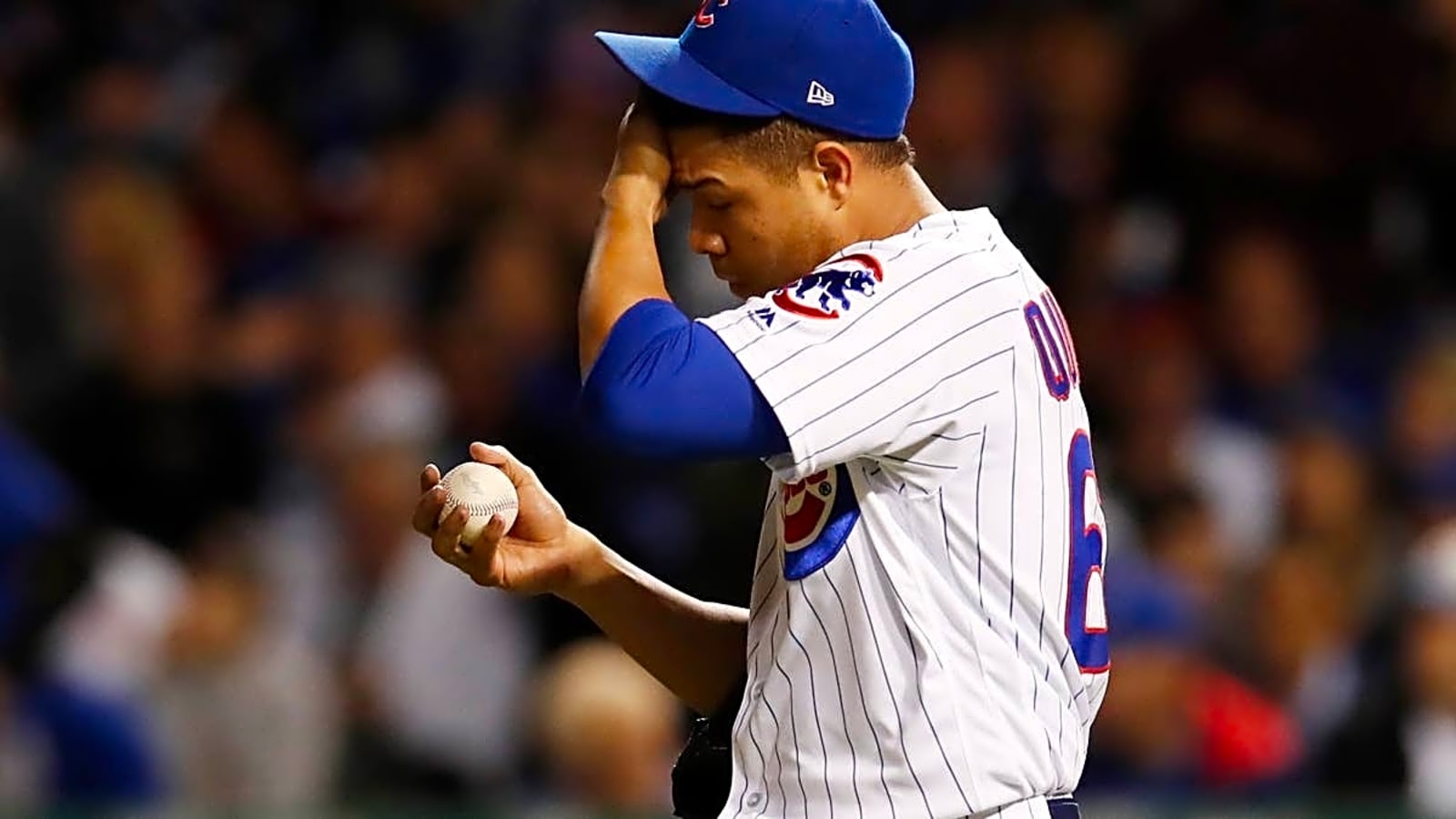
1. José Quintana — July 13, 2017
This is the one.
The defending World Series champions were struggling — 43-45 at the All-Star break, sitting 5.5 games behind Milwaukee in the NL Central — and Theo Epstein decided the moment called for an aggressive response.
On July 13, 2017, the Cubs sent left-handed prospect Eloy Jiménez (the club’s top prospect, ranked in the top five nationally), right-handed pitching prospect Dylan Cease, infielder Matt Rose, and outfielder Bryant Flete to the crosstown White Sox in exchange for starting pitcher José Quintana.
They believed Quintana — a reliable 28-year-old who had averaged 190 innings per year and posted a 3.51 ERA over five seasons — gave them the second ace behind Jon Lester that would jumpstart their season and carry them back to the World Series.
The trade held up in 2017. Quintana went 7-3 with a 3.74 ERA in 14 starts, the Cubs won 92 games, and they made the NLCS before falling to the Dodgers in five games.
In 2018, the wheels started loosening: 13-11, 4.03 ERA. In 2019, they loosened more: 13-9, 4.68 ERA in 32 starts. The Cubs never got back to the World Series during Quintana’s tenure.
In 2020, a thumb laceration limited him to just four starts in the COVID-shortened season. He left as a free agent that winter. The window closed faster than anyone expected.
What happened on the other side of the deal has become one of the most-cited prospect regret stories in recent baseball history.
Eloy Jiménez reached the majors in 2019 and immediately hit 31 home runs in 122 games — the kind of raw left-handed power the White Sox had been waiting for. Dylan Cease went to Chicago and kept developing. In 2022, he finished second in American League Cy Young voting with a 2.20 ERA, 227 strikeouts, and a WHIP under 1.10 — one of the best pitching seasons in White Sox history.
The Cubs traded Dylan Cease and Eloy Jiménez for two and a half seasons of a very good but not great starting pitcher who produced zero playoff series wins. In the same period, Cease became a Cy Young contender and Jiménez became one of the more feared power hitters in the American League. It’s the worst deal in Cubs deadline history since 2005, and it isn’t close.
The Cubs’ deadline list looks different from the Yankees or Mets — the mistakes are fewer, and they often carry better excuses. They were sellers for most of their rebuild, their championship-window deals were mostly sound, and the Epstein regime was disciplined enough to avoid the blockbuster disasters that define some other franchises.
But Quintana remains a cautionary tale for any front office: giving up two future stars for a pitcher who was very good — but not good enough to push you over the top — is the kind of deal that echoes long after the contract expires.
More must-reads:
- Biggest winners, losers from a wild MLB trade deadline
- Rival teams are reportedly ‘stunned’ by Adley Rutschman trade
- The 'Pitching Triple Crown winners' quiz
Breaking News
Trending News


Customize Your Newsletter
 +
+




Get the latest news and rumors, customized to your favorite sports and teams. Emailed daily. Always free!
PRIVACY POLICY COOKIE POLICY CONTACT US
ABOUT YARDBARKER TERMS OF SERVICE


By using this site, you agree to our Terms of Service and Privacy Policy.
This site is for entertainment purposes only.
There is no gambling offered on this site.
Gambling Problem? Call 1-800-Gambler.
