
-

-


Follow Us
-

 On Facebook
 On Flipboard
 On Twitter
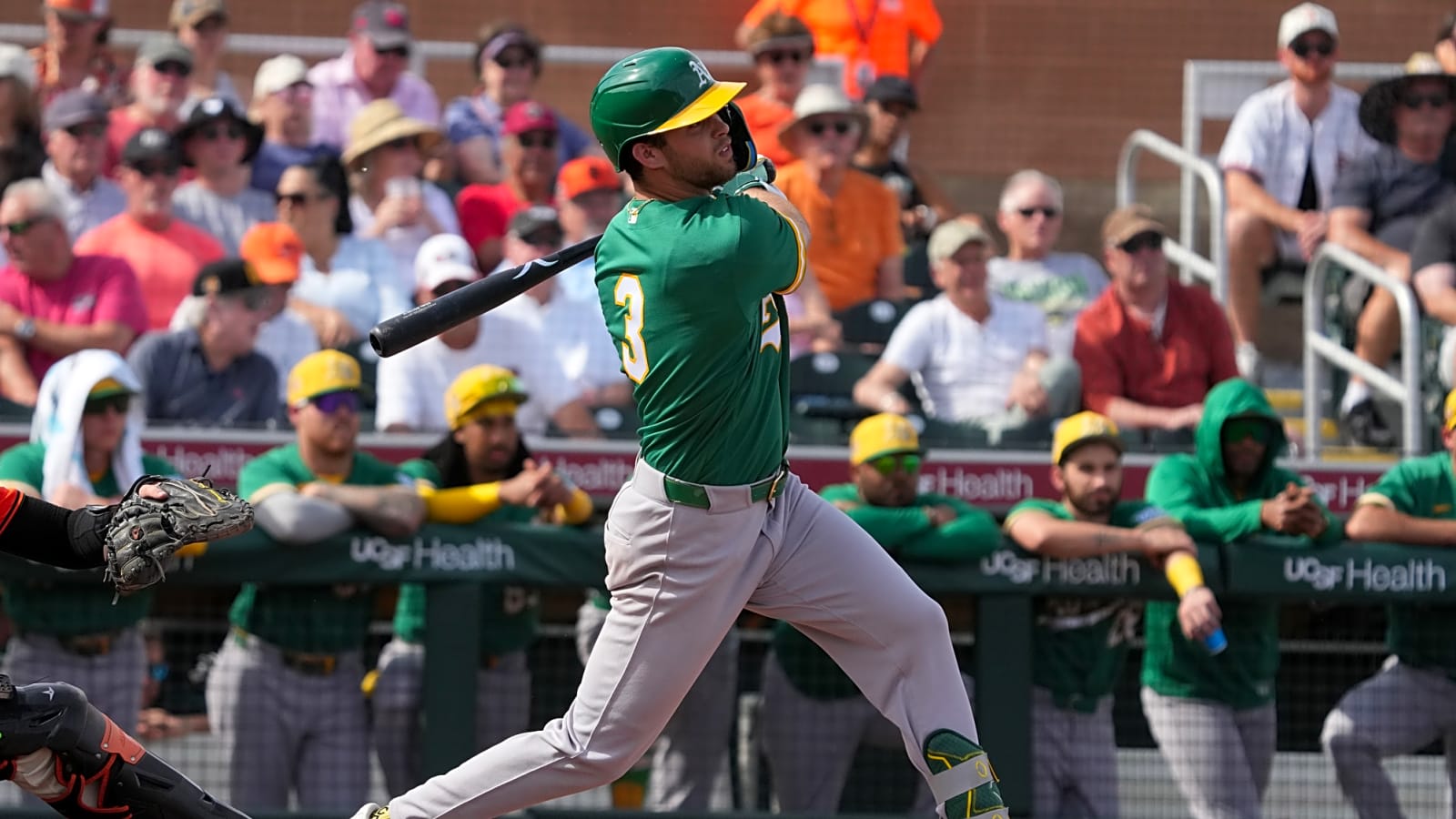
Over the past few seasons, the Athletics have had their fair share of breakouts. Brent Rooker, Lawrence Butler, Tyler Soderstrom, Shea Langeliers, and Nick Kurtz have all had their defining moments transitioning to All-Star-caliber players.
While breakouts are not guaranteed every year, the A’s might have another one on their hands with Max Muncy.
Muncy, the 25th-overall selection in the 2021 draft, did not come with the top-100 prospect accolades of a Tyler Soderstrom or Nick Kurtz. As far as first-round picks goes, Muncy was relatively unknown to people outside of the prospect space.
A solid but unspectacular climb through the minors did not generate much buzz, but a fantastic showing this spring has caught many eyes.
The Athletics entered spring training with an open competition for third base. Max Muncy, Andy Ibanez, Brett Harris, and Darell Hernaiz were all battling for one spot with Muncy seen as the favorite, but hardly by much.
Fast forward a few weeks, and Muncy looks like a player who not only has secured a spot but could be impactful for this lineup.
Spring Spectacular
I’ll be honest, when the A’s entered spring training with the current crop of players to fill third base, I was skeptical.
I didn’t see a path where they would get above-average production but figured the strategy of playing younger players at third and batting them at the bottom of the order was perfectly fine.
But what he have seen from Muncy gives the A’s a chance of having a much higher ceiling than I, or many, anticipated.
As of March 19, Muncy has slashed .405/.490/.810 with four home runs across 49 spring training plate appearances. Impressive, but we all know spring training stats can be funky. Bad pitchers, unique fields, weird conditions, and small samples, among other things.
However, Baseball Reference offers “OppoQual,” which is a stat that measures the pitchers a certain batter faces. A major-league pitcher would be a 10 while rookie ball pitchers grade out between 1.5-3.0.
For spring training, this helps tell you the quality of pitcher a batter is facing; Muncy is currently at 7.6.
Even with that in mind, Muncy’s success is noteworthy not only because of the stats but the way he’s getting to those numbers. His approach and free-swinging mentality is what held him back last season, and we have seen a course correction so far. A 14.3% walk rate and only 18.4% strikeout rate are drastic improvements from last season.
The small sample size plays a factor without a doubt. But seeing Muncy lay off pitches is step one in growing as a player. Seeing that right now, regardless of sample size, is important for his development.
Muncy Mash pic.twitter.com/1UUemeTZ37
— Athletics (@Athletics) March 11, 2026
While I still think Muncy’s strikeout numbers will be higher than you’d like, it becomes easier to stomach if the power plays up. His four home runs and five doubles this spring has flashed the type of power upside that he brings to this club.
A 38-home run pace is not something to bet on, but 20 long balls is within reach.
In order to reach his power potential, Muncy must improve his quality of contact and zone coverage. So far, the quality of contact is trending in the right direction. Last season, his average exit velocity was 87.1 mph and this spring it is up to 92.6 mph.
Not only is he hitting the ball hard, but he’s lifting the ball more, resulting in an untick in extra-base hits.
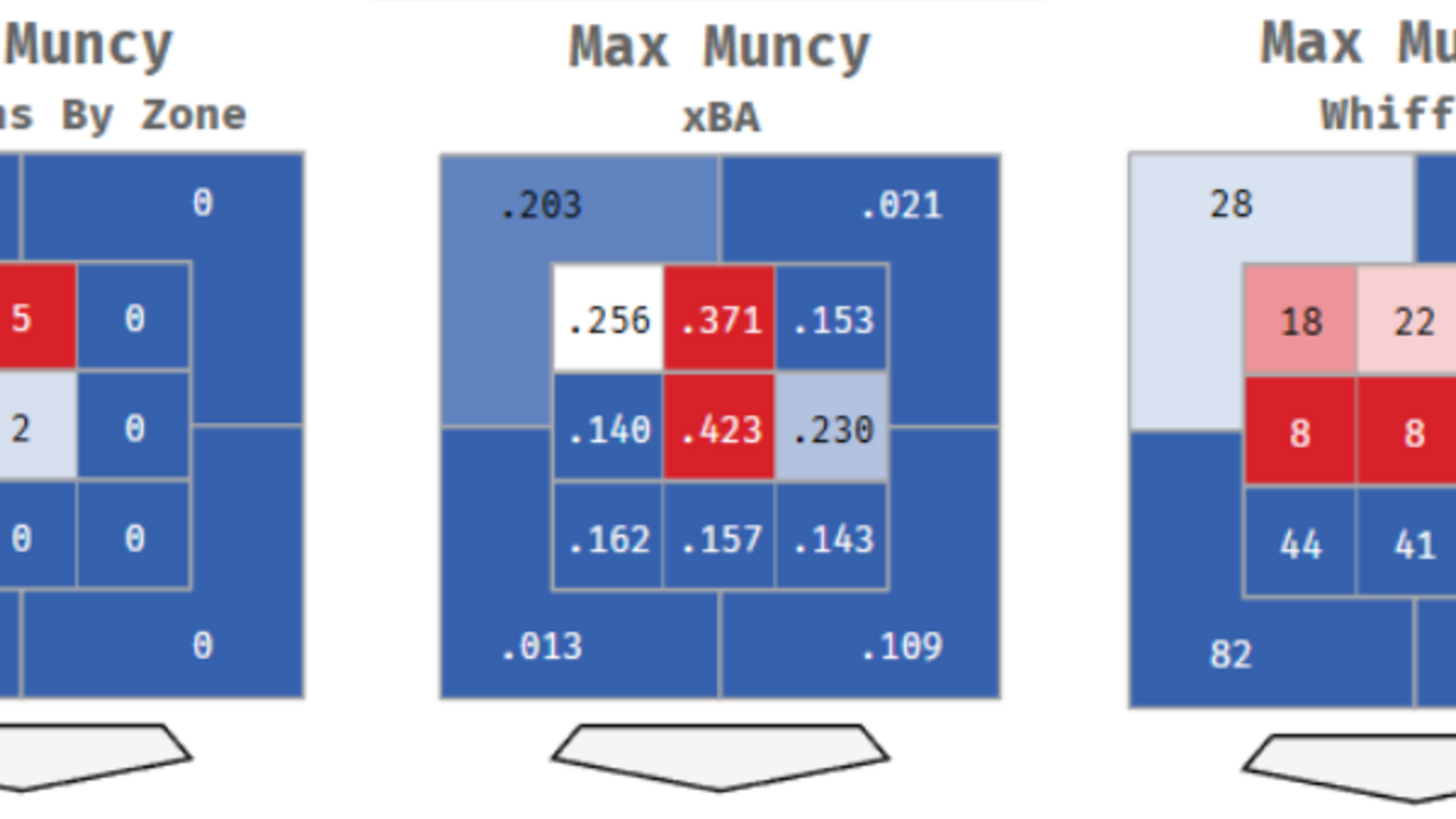
Via Baseball Savant
With one box checked, the next will be improving in different areas of the strike zone. The graphic above shows (from a catcher’s perspective) how Muncy fared in each area of the strike zone. The upper part of the zone is where most of his power and production came from while the lower third was a struggle.
The lower third is where Muncy saw most of his breaking balls and off-speed pitches, which resulted in over a 40% whiff rate. If his improvements on laying off balls outside of the zone continue into the regular season, he will start to see more pitches in the zone, allowing him more opportunity to do damage.
Muncy does not need to develop into a complete hitter in order to be productive. Better swing decisions should afford him enough opportunities to make an impact even if his swing and miss numbers are not spectacular. He’s athletic enough to rack up extra-base hits even if his power is average.
Will Defense Hold Him Back?
Muncy was drafted out of high school as a shortstop and played 278 games at the position during his minor-league career. In 2025, his rookie season, Muncy appeared in only seven games at the position as Jacob Wilson has cemented himself as the long-term starter.
Muncy bounced between second and third, but the addition of Jeff McNeil and Zack Gelof still in the mix makes second base a bit more crowded.
So, Muncy is left learning a new position and one that he only played 161 innings at during his minor-league career.
Third base was a struggle right out of the gate. Six errors in 32 games in 2025 was not the start anyone would had hoped for, but it was understandable considering how new he was to the hot corner.
Athletically, Muncy has the tools to pan out. An adequate arm and footwork of a natural shortstop, experience and time on task is needed.
“Our biggest focus right now is on the defense. We’ve been working really hard with him in those areas, and we’ve seen some improvement. We’re going to continue to follow that progress,” said manager Mark Kotsay to reporters last week.
For what it’s worth, the A’s have sacrificed defense for offense in the past. Last season, they moved Miguel Andujar from left to third in order to get Tyler Soderstrom in the lineup, sacrificing defense at third. Muncy is a naturally better defender than Andujar, so I expect the A’s to give him plenty of time to get his feet under him.
I’m sure it will be a learning curve, but all you ask for is improvement. Muncy will need to get a feel for the different angles and timing that come with making the throw to first while also improving his footwork at a position in which the ball gets to you quicker.
If he struggles defensively early in the year, that’s okay. If he’s still making the same mistakes as the year goes on, there could be a problem.
Final Thoughts
We can debate how important spring training performance is or isn’t until we are blue in the face. Bottom line, Max Muncy is displaying an ability that I did not expect. At least not this early in his career. There’s still a lot that he needs to prove, but we now have some proof that the ability is there.
The A’s do not need Muncy to develop into a middle-of-the-order bat. They already have that covered. All they need is the type of production that, when talking about a Max Muncy, makes people ask, “Which one?” I think he can get there, and further, in 2026.
More must-reads:
- Bryce Harper had classy gesture for Venezuela after losing WBC final
- Trey Yesavage to miss start of season; can Blue Jays’ rotation hold up?
- The 'MLB Rookies of the Year since 2000' quiz
Breaking News
Trending News


Customize Your Newsletter
 +
+




Get the latest news and rumors, customized to your favorite sports and teams. Emailed daily. Always free!
PRIVACY POLICY COOKIE POLICY CONTACT US
ABOUT YARDBARKER TERMS OF SERVICE


By using this site, you agree to our Terms of Service and Privacy Policy.
This site is for entertainment purposes only.
There is no gambling offered on this site.
Gambling Problem? Call 1-800-Gambler.
