
-

-


Follow Us
-

 On Facebook
 On Flipboard

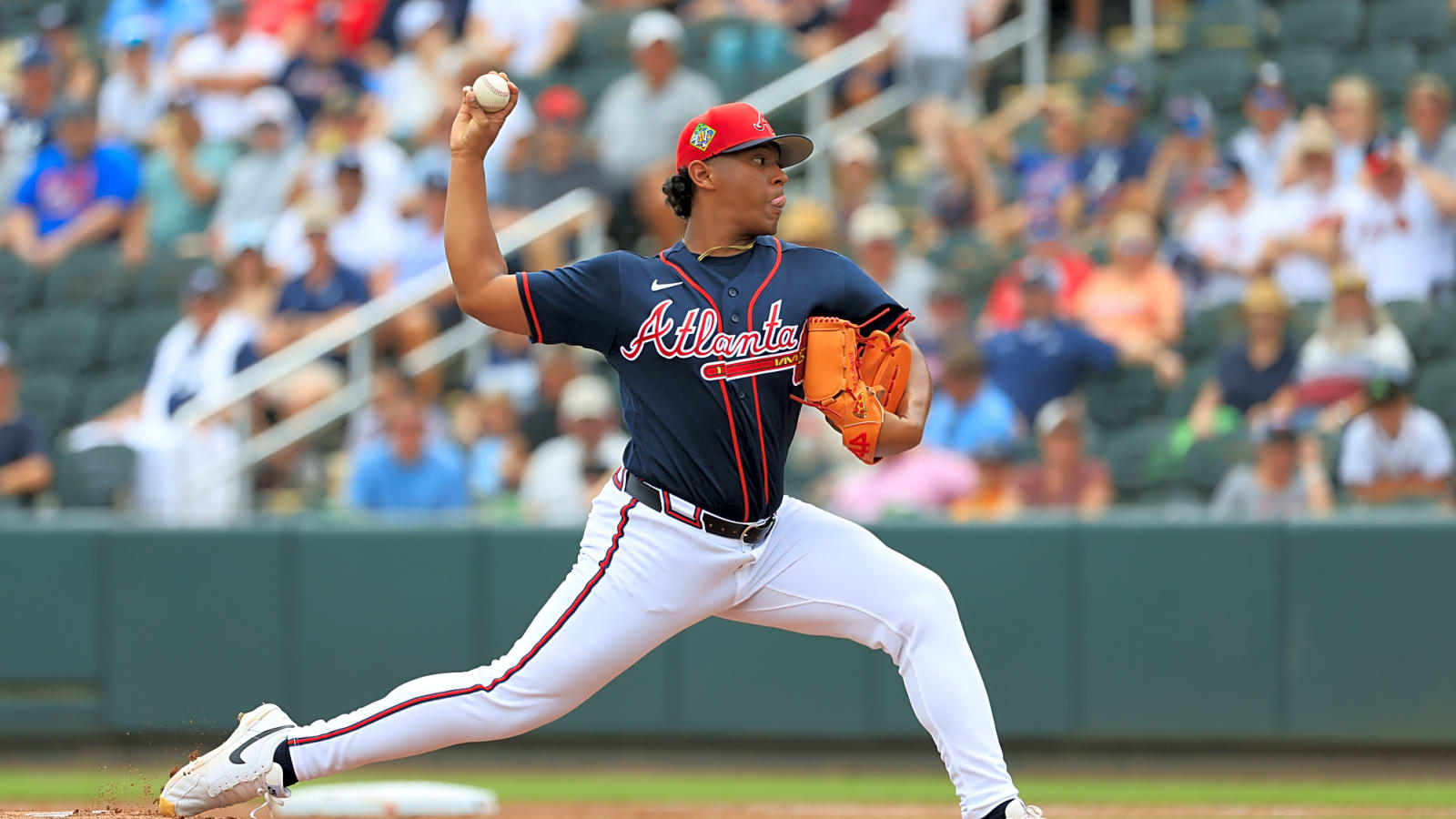
The 2026 MLB season is fast approaching, and the Atlanta Braves‘ rotation has gone from a strength to a question mark fast.
Just one month ago, it felt pretty set. Chris Sale as the ace. Spencer Strider a full offseason removed from surgery. Spencer Schwellenbach trending up. Hurston Waldrep looking like he secured his spot. The only debate was about who should grab the fifth spot between Grant Holmes, Reynaldo López, or an external option.
Now? Completely different conversation.
Schwellenbach and Waldrep have both landed on the IL after undergoing elbow cleanups. Suddenly, Braves fans are not debating the fifth starter – they are trying to piece together a full rotation.
Still, there have been some positives. Holmes looks healthy after choosing rehab over surgery this spring, throwing 12.1 innings, allowing just three hits, zero runs, and six walks while striking out 16 batters.
López has also been solid after being shelved for nearly the entire 2025 season, giving up 11 hits, four earned runs, and six walks while striking out 14 through 12.2 innings this spring as well. But once you get past that, things get thin quickly.
Bryce Elder is currently lined up as the fifth starter. He will take the ball, he always does, but you are still waiting for more consistency. When he is good, he is really good. The issue is when he is not, things get sideways extremely quickly for the Braves.
José Suárez is now your likely sixth option and long man out of the bullpen after Joey Wentz went down. With the Braves playing 13 straight games to open the year, that depth will be tested immediately.
So yes, the rotation is the story right now. But if you have been watching spring training games, there is also a different storyline building. Atlanta has arms. A lot of them.
At the time of this writing, Atlanta is 16-5-2 this spring. While the offense has been making noise, it’s the pitching staff that has been the underrated hero.
So far, the staff as a whole has a 3.86 ERA, 1.23 WHIP, and 229 strikeouts to 84 walks. Not only have guys with secured spots on the Opening Day roster looked good, but exciting prospects such as JR Ritchie, Just Baseball’s No. 83 overall prospect, and Owen Murphy look legit. There is real depth coming, but neither will start the year in Atlanta.
Then there is the one guy who, despite a rough debut last season, might have the highest ceiling of all of them: Didier Fuentes.
IFA Penalties That Still Affect Atlanta
To understand why Fuentes matters more than you may think at first, you have to go back to 2017.
At the conclusion of the 2017 season, Rob Manfred dropped the hammer on the Braves for international signing violations. After a two-month investigation, general manager John Coppolella and special assistant Gordon Blakeley were out, and the penalties were heavy.
Atlanta lost multiple top international prospect signees, including Kevin Maitan and Yunior Severino. They were prohibited from signing another top prospect in Robert Puason. They lost a third-round draft pick.
Most importantly, they were basically shut out of the international market for a few years. The Braves were prohibited from signing any IFA prospects for more than $10,000 until the 2020 signing period. Then, in 2021, their international bonus pool was cut down by 50%, further limiting signings.
That matters more than people think. The international market is where a huge chunk of MLB talent comes from. When you are out of it, your pipeline takes a serious hit. And we are seeing that effect with how the Braves’ farm system has been ranked over the last few years.
Thankfully for Braves fans, the organization survived it because of stars already in-house. Players like Ronald Acuña Jr., Ozzie Albies, Austin Riley, and Max Fried joined Freddie Freeman and helped carry the load to maintain the success we saw during these years.
But the depth behind them? Not the same. Typically, international free agents are signed around the 16 or 17-year-old range. This means it takes around four to five years to see them break into the majors, on average. These players would be on the cusp of making their debut today.
When Atlanta’s restrictions were over, the early returns were mixed. They handed out six deals worth at least six figures, including one to top-10 overall IFA prospect Diego Benitez, who received $2.5 million. However, there is a lot of disappointment coming out of the first international class post-restrictions. Benitez, along with Douglas Glod (among others), just have not lived up to the hype.
Yet, when you continue to read down the list, there was a $75,000 signing out of Columbia that flew well under the radar. He would end up making his big league debut just three days after his 20th birthday.
Fuentes’ Fast Track to the Big Leagues
At age 17, Fuentes spent the entire 2022 season in the DSL, where he posted a 2.25 ERA, 2.94 FIP, 1.02 WHIP, and 28.9% strikeout rate to just a 5.8% walk rate across 11 appearances.
He was then brought stateside, skipping the complex, and was aggressively pushed into A-ball for 2023. After a rough season at age 18, it was his age-19 season in 2024 where things really clicked.
Fuentes posted an impressive 2.74 ERA, 3.31 FIP, 1.02 WHIP, and 32.1% strikeout rate to 6.9% walk rate across 18 appearances.
Then 2025 happened.
| Level | GS | ERA | FIP | WHIP | K% | BB% |
| A+ | 3 | 5.54 | 2.01 | 1.00 | 34.0% | 9.4% |
| AA | 5 | 4.98 | 3.10 | 1.29 | 25.0% | 7.3% |
| AAA | 5 | 3.63 | 3.18 | 1.08 | 32.6% | 4.5% |
| MLB | 4 | 13.85 | 9.14 | 2.23 | 17.4% | 8.7% |
It took only three games in High-A, still at 19 years old, for him to prove he was ready for a promotion. Being one of the younger players in Double-A, Fuentes held his own despite getting hit around a bit.
Seeing the potential in Fuentes’ arm at such a young age and knowing he ran into a bit of bad luck that inflated his Double-A numbers, Atlanta pushed him up to Triple-A.
Fuentes made the most of his five starts in Gwinnett, which was quite impressive as he was still just a teenager.
As he was making a name for himself in the minor leagues, Atlanta’s big league rotation began to fall to injury. One by one, all five of the Braves’ Opening Day starters landed on the 60-day IL at some point during the season. They needed help to get through the schedule.
Three days after his 20th birthday, Didier Fuentes made his big league debut.
His debut did not go as hoped, but then again, at barely 20 years old, he was not even supposed to be there. Just after four appearances, he was sent back down to Triple-A, where he would remain for the rest of the season.
The important part is this: The Braves saw enough to put him on the 40-man roster and give him a real look. That alone tells you what they think of his potential.
Why Fuentes’ Stuff Jumps Off the Screen
Fuentes is not your typical Braves pitching prospect. He brings velocity unlike most others in the system.
The fastball sits mid to upper 90s and can touch 99 with room to grow. It has real life up in the zone and plays even better because of his lower release point. Minor league hitters had no chance against it.
However, big league hitters bat .486 against his fastball and only whiffed 18.8% of the time. Throwing this pitch at roughly a 58% clip, if he can have the success he had in the minors, we should expect better results moving forward.
So far this spring, he has averaged 97.2 mph with 15.7 IVB on 45 pitches thrown. Success has come with it, as he has recorded a 37.5% chase rate and a 40% whiff rate on the four-seamer.
His slider is the real weapon right now. Averaging 87/88 mph, he typically throws it 25-28% of the time to great success. Big leaguers hit just .188 and slugged just .375 against the sweeping slider, recording an impressive 33.3% whiff rate on 80 thrown last season.
This pattern has continued during spring training, recording a 38.5% chase rate and a whopping 50.0% whiff rate.
The rest of his arsenal is still a work in progress. Fuentes has flashed a curveball that he only threw 11% of the time, which dips down to 79 mph. He threw just 35 of them last season in the big leagues, but only gave up two hits and recorded an encouraging 35.7% whiff rate. However, this spring, he has yet to debut the pitch.
Atlanta has seemingly fallen in love with the splitter as an organization, and Fuentes has used this in-game as well. It is still well behind the rest of his arsenal, however. This spring, he has thrown five of them, averaging 88.8 mph, but has yet to land in the zone or record a whiff.
If this archetype sounds familiar, it should. To me, he looks a lot like a very early version of Spencer Strider. The high velocity fastball produces whiff. A wipeout slider. The need to continue to develop another pitch.
For reference, Strider did not make his first minor league appearance until age 22, and Schwellenbach at age 23. Fuentes is still 20 years old. The possible ceiling here is higher than many outside of Braves Country have yet to realize.
The Case To Break Camp
A lot of people saw his four big league appearances last year and decided he is not ready. He probably was pushed a little fast last year, but now that he has been there. This spring has been loud, and you can’t ignore the progress.
In his first appearance this spring vs. the Baltimore Orioles, he shoved. Over two innings, he gave up zero hits, runs, or walks while striking out four. His fastball averaged 97.4 mph with 16 IVB, producing a 70% whiff rate.
Then, against the New York Yankees, he shoved again. He yet again gave up zero hits, runs, or walks over the course of three innings and struck out five. And it was not against minor leaguers either; he got Trent Grisham, Cody Bellinger, Ryan McMahon, and Oswaldo Cabrera to K. This time, it was the slider that impressed, producing a 67% whiff rate.
Didier "Silent Assassin" Fuentes struck out 5 batters in 3 perfect innings today
— MLB Pipeline (@MLBPipeline) March 13, 2026
The @Braves' No. 3 prospect hasn't allowed a hit in 5 frames this spring. pic.twitter.com/jFFs7t4wuO
Small sample, sure. But it passes the eye test. He looks more mature, both physically and mentally, on the mound.
So, what do you do with him?
JR Ritchie has also impressed this spring, but he has yet to be placed on the 40-man roster. Owen Murphy will need more time in the minors before earning a debut. However, Fuentes has started his clock and has sniffed the majors already.
Atlanta does not have to force him into the rotation immediately. They have a blueprint they have used in the past that would be perfect for Didier Fuentes.
Remember mentioning he looks like an early version of Spencer Strider? Well, they have the opportunity to use that same exact path.
Let him break camp in the bullpen. Let him throw multiple innings in relief during the first part of the season and build confidence and experience against big league hitters. Then, when you inevitably need a spot start, he is ready to step right into the role.
In 2021, Strider made his big league debut out of the bullpen near the end of the season. He pitched a total of 2.1 innings, giving up two hits, one run, one walk, and zero strikeouts across two outings.
In 2022, he made the first 11 appearances of the season out of the bullpen, averaging 2.2 innings per outing while eclipsing three innings pitched four times. In his 11 bullpen outings, he posted a 2.22 ERA and 1.18 FIP, while striking out 37 batters and walking only 11.
On May 30th, Strider entered the rotation and finished with a total of 20 starts, posting a 2.77 ERA, 1.92 FIP, averaged 8.3 Ks and 1.7 walks per outing, and finished runner-up to teammate Michael Harris II in the Rookie of the Year race.
In Alex Anthopoulous’ media availability before spring training, my good friend Lindsay Crosby with Braves Today asked him about his willingness to use prospects in this type of fashion:
“We’ve done with guys over time. I think like anything else we talk about it all the time. I actually, in a perfect world, I think it’s a great way to work guys in. You look at way back in the 80s, 90s, early 2000s a lot of guys broke in out of the pen. Even talking to guys like Fried he thought it was great for him. Just coming in and learning to attack. I think guys like Reynoldo López got better as a result of it.”
Sounds great, but he then explained why they have not done so as of late. It is all about balancing need at the big league level and a pathway to development in the minors.
“In the minor leagues, you stick to these guys in the rotation from a development standpoint, right? Even though you ultimately might believe that they’re relievers, you want them to get as many reps as they can, as many innings as they can have, bullpens, side work, go deep into the games. You have a guy in the minors who’s a one-inning reliever, you might have a 10-pitch inning and not really get to work on things.”
It may not be the traditional starter path, but Atlanta has used this to ramp up not only Strider, but AJ Smith-Shawver and Max Fried in the past, to success as well. It has been done before, and should be done again.
Fuentes has already proven he can handle every level he has been pushed to thus far. He has already gotten a taste of the majors. And right now, he looks much better than he did the last time he was there.
At some point, you stop waiting. You just give him the ball.
More must-reads:
- Awful Aaron Judge injury update could define Yankees' season
- Shohei Ohtani has a historically absurd ERA after 10 starts
- The 'Foreign-born 250-HR club' quiz
Breaking News
Trending News


Customize Your Newsletter
 +
+




Get the latest news and rumors, customized to your favorite sports and teams. Emailed daily. Always free!
PRIVACY POLICY COOKIE POLICY CONTACT US
ABOUT YARDBARKER TERMS OF SERVICE


By using this site, you agree to our Terms of Service and Privacy Policy.
This site is for entertainment purposes only.
There is no gambling offered on this site.
Gambling Problem? Call 1-800-Gambler.
