
-

-


Follow Us
-

 On Facebook
 On Flipboard

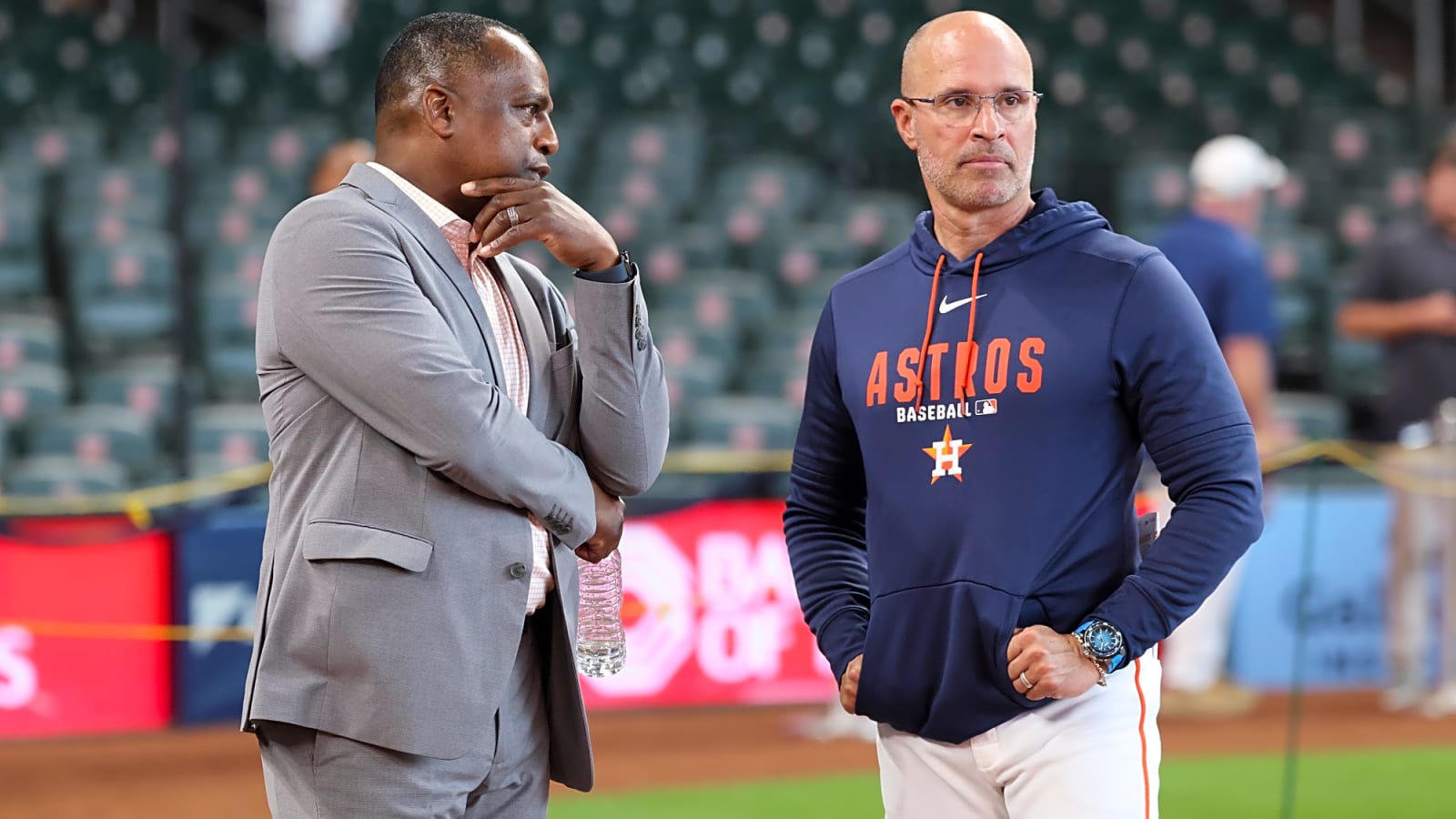
Dynasties rarely announce when they are over.
There is usually no clean ending, no obvious moment when a team goes from feared to vulnerable. The names are still familiar. The banners still hang. Enough talent remains to convince everyone that one more run is possible.
That is what makes the 2026 Houston Astros so interesting.
Their season ended with a lifeless two-game sweep at home, but the White Sox did not end the Astros’ dynasty. They simply forced Houston to confront a question that has been getting harder to ignore.
The team that ruled the American League for most of the last decade is gone.
What remains is a franchise caught between honoring what it built and deciding how aggressively it is willing to build what comes next.
It may finally be time for the Houston Astros to tear it down. pic.twitter.com/yyrAn7HnLm
— Just Baseball (@JustBB_Media) October 1, 2026
An Ugly Ending
The 2026 Houston Astros went out with a relative whimper, dropping two straight at home to a White Sox team that had not won a playoff series in more than two decades—ironically, since beating these same Astros in the 2005 World Series.
Chicago was the sharper team in both games, and aside from a handful of high-leverage outs that kept runners stranded, Houston put up little resistance. This was one of the worst teams to reach the postseason by a myriad of advanced metrics, and over two games nearly every one of its flaws was exposed.
A lack of pitching depth forced Houston to use an opener in both games, neither of whom executed particularly well. The lineup, meanwhile, had spent much of the season disproportionately dependent on Yordan Alvarez. When he went 1-for-8 in the series, there was nobody capable of picking up the slack. Alvarez was still hitting the ball extremely hard, but he put it on the ground more frequently than usual, and a team built around one singularly dominant offensive force suddenly looked exactly as vulnerable as that construction suggested.
The 2026 Houston Astros won the AL West. That is about the extent of the praise that can be heaped upon them.
Alvarez was brilliant throughout the regular season and will be justly rewarded with the MVP, but these Astros never inspired the kind of fear their predecessors did. For most of the last decade, Houston entered October feeling inevitable. Even when another team appeared better on paper, everyone understood that eventually you were probably going to have to go through the Astros.
Nobody felt that way about this team.
And that leaves Houston facing a much larger question than what went wrong over two ugly nights in October:
Who are the Houston Astros in 2027 and beyond?
A Hard Look in the Mirror
To understand who the Astros are moving forward, it is important to appreciate who this team has been.
Houston played in every ALCS from 2017 through 2023. Seven straight. They reached four World Series and won two of them. That kind of sustained success is historic. There will always be a cloud hanging over the 2017 championship because of the sign-stealing scandal, but what followed made it impossible to dismiss Houston’s larger run as some sort of fluke. They kept winning. They kept reaching October. For seven consecutive seasons, every American League pennant either belonged to Houston or went through Houston.
When you become that team, it has to be difficult to stop viewing yourself that way.
There is a certain human nature involved in believing you can continue doing something spectacular when you have years of evidence saying that you can. Every time the Astros appeared to be losing something, they found something else. George Springer left. Carlos Correa left. Gerrit Cole left. Players aged, pitchers got hurt and pieces moved around, yet Houston kept appearing in the ALCS.
But these Astros aren’t those Astros.
There is no Justin Verlander or Framber Valdez sitting atop the rotation. Alex Bregman, Kyle Tucker and Springer aren’t written onto the lineup card. Two of the franchise icons who remain, Correa and Jose Altuve, are in a different phase of their careers and no longer the players they were at the height of this run.
The core of the dynasty has largely disappeared. More concerningly, the next wave has not arrived behind it.
Alvarez blossomed into one of baseball’s best hitters during the run. Jeremy Peña and Hunter Brown became legitimate homegrown contributors. But those successes haven’t been accompanied by another deep generation of talent pushing its way toward Houston. The Astros currently possess one of baseball’s weaker farm systems, with little obvious impact talent positioned to materially alter the outlook of the 2027 or 2028 major-league roster without significant breakouts.
Cam Smith is almost the perfect illustration of where the organization is. Houston acquired him from Chicago and immediately accelerated his development, putting him on the Opening Day roster despite the fact that he had played just 32 professional minor-league games—and none in the Astros’ system. He may still become an important part of whatever comes next, but Houston didn’t have the luxury of letting one of its best young players marinate in the minors. It needed help immediately.
That organizational thinness shouldn’t simply be viewed as an indictment of the Astros. In many ways, it is the bill for everything that came before it.
Houston spent years turning prospect capital into major-league talent. They traded for Verlander twice. They sent four players to Pittsburgh for Cole, including Joe Musgrove. They repeatedly moved future big leaguers and prospects for bullpen pieces and reinforcements designed to help the club win right now.
Those aren’t moves that should be relitigated with the benefit of hindsight. Going pedal to the floor is how you hang banners.
But it does not come without a cost.
The Astros’ farm system spent much of the dynasty functioning as a net exporter of talent, and an already difficult replenishment process was made significantly harder by the punishment stemming from the sign-stealing scandal. Houston forfeited its first- and second-round selections in both the 2020 and 2021 drafts. The damage wasn’t limited to losing four opportunities to select players; those picks also carried substantial bonus-pool allotments, reducing Houston’s ability to maneuver throughout those drafts.
Compete deep into October every season, trade prospects for established stars, draft near the bottom of every round and then remove four premium selections from the equation entirely, and eventually something has to give.
Now it has.
That leaves the Astros in an uncomfortable position. The current roster isn’t devoid of talent. Alvarez is coming off an MVP season. Peña remains one of the better shortstops in baseball. Brown has shown the ability to pitch near the front of a rotation.
There are good players here, there just aren’t enough obvious reinforcements behind them.
As presently constructed, there is little reason to expect the 2027 Astros to suddenly look dramatically different from the 2026 version. And the clock is beginning to matter. Peña can become a free agent after next season. Alvarez is under control for only one additional year beyond that.
When you’ve been the champion, it is hard to look at yourself as anything else. Thirty teams try to climb the mountain every year. Houston reached the top twice. They damn near did it two other times. For the better part of a decade, they were the story of the American League.
But eventually you have to splash some cold water on your face and look in the mirror.
The Astros are no longer the bully on the block. And, as presently constructed, there aren’t many obvious paths back to becoming one. This creates the most uncomfortable question this organization has faced in years: what do you do with the valuable pieces that remain?
The Crossroads
There is nothing easier, as an outside observer with no emotional investment in the outcome, than looking at this situation and saying: blow it up.
From the perspective of maximizing the long-term health of the organization, there is a compelling argument that this is exactly what Houston should do.
Yordan Alvarez alone could command the type of prospect haul capable of completely reinvigorating an Astros farm system desperately in need of impact talent. He is coming off an MVP season, remains one of the best hitters on the planet and has two years of control remaining. His value may never be higher.
Jeremy Peña presents a different but much more immediate decision. He produced 5.8 fWAR in just 125 games in 2025 and another 3.4 in 112 games this season. He enters 2027 in his final year of team control, and after the two sides failed to reach a long-term extension earlier in his career, there should be a robust market for a premium defensive shortstop who has shown he can provide significant offensive value as well. If Houston does not believe it can meaningfully contend next season, allowing Peña to simply play out his final year makes little sense.
Hunter Brown requires more patience. He isn’t coming off his best season, but there are still two years of team control remaining for a pitcher who has flashed legitimate frontline stuff. Houston doesn’t have the same ticking clock with Brown that it does with Peña, and moving him now would mean selling from a position of considerably less urgency.
Isaac Paredes should have a market of his own. His offensive profile is unusually dependent on environment, but put him in the right ballpark and his pull-side power becomes extremely valuable. With a manageable option for 2027, he represents another useful chip for an organization that badly needs to replenish the talent underneath its major-league roster.
That is the cold, calculated version of the decision.
Rip off the Band-Aid. Turn Alvarez, Peña, Paredes and potentially others into as much young talent as possible. Accept a few ugly seasons and begin building the next great Astros team rather than desperately trying to extend the life of this one.
It sounds easy until you’re the one who has to sell it.
Fans don’t experience a rebuild through prospect rankings and surplus-value calculations. They experience it 162 games at a time.
Houston fans were booing a team that had just won its division during a home playoff elimination game. Whatever goodwill remains from the greatest period in franchise history is clearly no longer infinite. Follow an 81-win season with a deliberate teardown and a couple of 65-win teams and the organization risks something more difficult to quantify than the value of any individual prospect: apathy.
There is a generation of Astros fans that has known almost nothing except winning. Since 2017, October baseball hasn’t felt like a reward in Houston. It has felt like an expectation. Telling those fans that the price of building the next contender is watching a dreadful major-league product for several seasons is different from telling an executive to maximize expected future wins.
That is why simply riding this out is defensible, too.
Alvarez and Peña aren’t merely assets on a spreadsheet. They are homegrown stars who won a World Series in Houston. There is something to be said for allowing fans to continue watching great players in an Astros uniform, even if doing so isn’t the perfectly optimized transaction. Not every decision an organization makes has to be based solely on extracting maximum future value.
That makes the situation facing Houston’s next lead baseball decision-maker unusually difficult.
Dana Brown is no longer running the baseball operation from a personnel perspective. Altuve and Correa have significant guaranteed money remaining and are, for practical purposes, much harder pieces around which to reshape the roster. But much of what surrounds them is movable. Houston can choose to aggressively dismantle what remains, attempt a more selective retool around Alvarez and Brown, or take another run with largely the same core and hope that better health and targeted additions can squeeze another October run out of it.
None of those choices is painless.
That may be the hardest reality for an organization that spent most of the last decade making everything look easy.
For years, the Astros could lose stars, replace them, absorb injuries, trade prospects, change managers and keep showing up in October anyway. Every decision existed within the comfort of knowing that Houston remained one of the defining teams in baseball.
That comfort is gone now.
The next person entrusted with running this organization isn’t simply deciding what the 2027 Astros should look like. They are deciding when one of the greatest runs in modern baseball officially ends—and whether the pieces that remain from it are used to chase one last October or to build whatever comes next.
The Astros spent a decade refusing to go away.
Now they have to decide what they want to become.
More must-reads:
- Phillies have reportedly made their decision on Don Mattingly
- Kyle Schwarber makes feelings clear on Don Mattingly after Phillies season ends
- The 'Active 100-hit MLB seasons' quiz
Breaking News
Trending News




Customize Your Newsletter
 +
+




Get the latest news and rumors, customized to your favorite sports and teams. Emailed daily. Always free!
PRIVACY POLICY COOKIE POLICY CONTACT US
ABOUT YARDBARKER TERMS OF SERVICE


By using this site, you agree to our Terms of Service and Privacy Policy.
This site is for entertainment purposes only.
There is no gambling offered on this site.
Gambling Problem? Call 1-800-Gambler.
