
-

-


Follow Us
-

 On Facebook
 On Flipboard

MLB prospecting is in a great place. We have a generational talent in Konnor Griffin eyeing an Opening Day debut. Our number two-ranked prospect, Kevin McGonigle, is in a similar boat.
Nolan McLean, the top pitching prospect on Just Baseball’s Top 100, comes in at number three while starting for the United States in the WBC.
You won’t find the next pitching prospect until No. 12, where Bubba Chandler lands after a strong 2025 debut. Trey Yesavage is close by, with Thomas White and Andrew Painter following.
All of our top-ranked pitching prospects have something in common: they’re set to graduate from the prospect ranks at some point in 2026. There also isn’t a clear heir to take over as the next top pitching prospect.
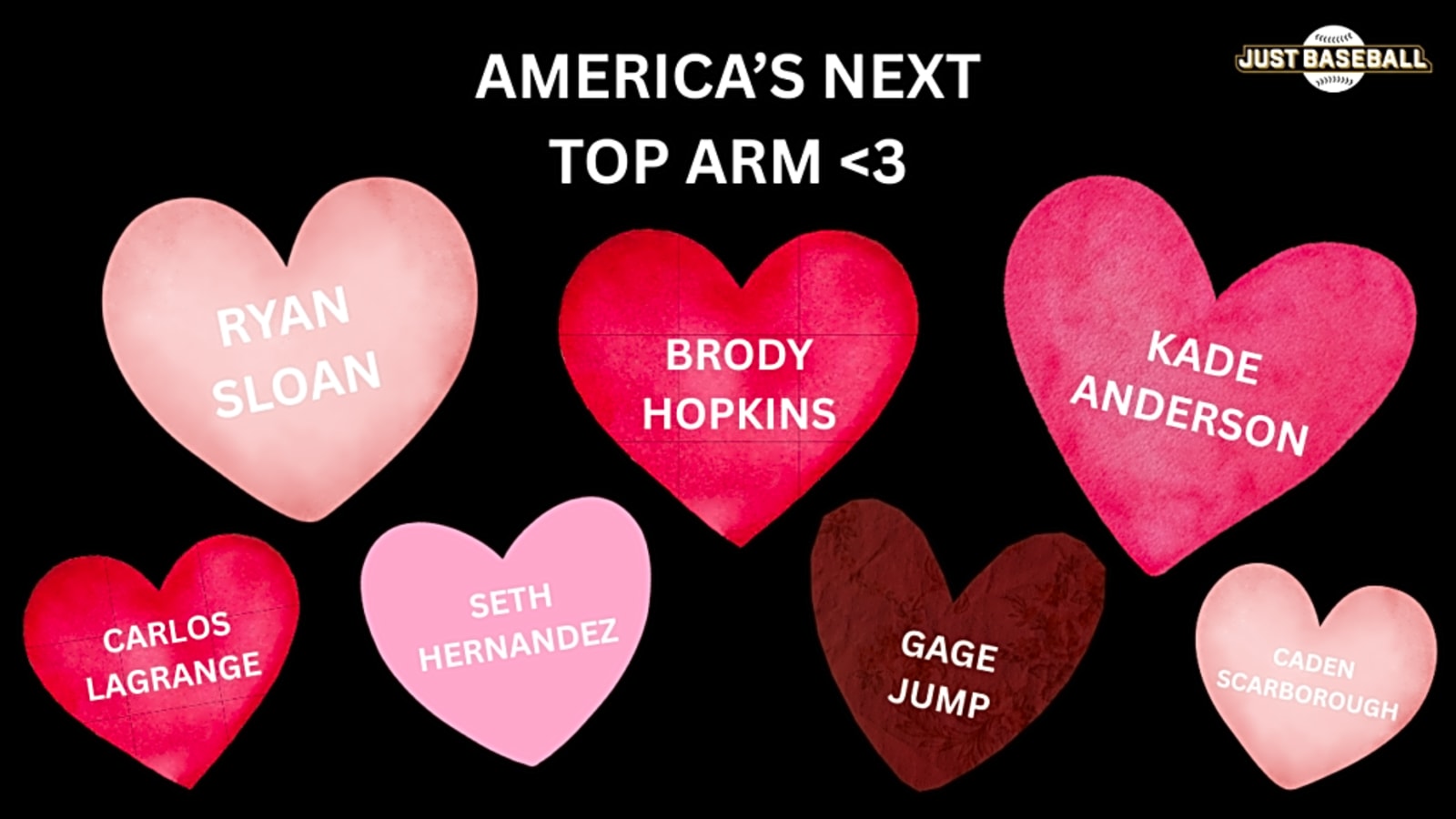
A pair of teammates, Kade Anderson (no. 26) and Ryan Sloan (no. 29), are both likely to begin their year in either High-A or Double-A, making one of them the supposed leader in the clubhouse for America’s Next Top Arm (my kind of reality TV).
College Days
Then we get to spot 38, where my beloved Brody Hopkins sits.
While Hopkins has a chance of making the big leagues this year, I would project him to retain prospect status next offseason, where I’m predicting he’ll be the top pitcher on our list.
The Hopkins story is a fascinating one. In his draft year, Hopkins transferred from The College of Charleston to Winthrop, where he would make 12 starts on the mound and 46 starts in the field.
The path forward for Hopkins was clearly on the mound, with above-average velocities from a funky arm slot making him a surefire draftee. He’s also the perfect size for a pitcher, standing at 6’4, 200lbs.
The Mariners took Hopkins in the sixth round of the 2023 draft, signing him to a bonus of $225,000. The Mariners are one of the best in the business at identifying mid-major pitching talent, focusing more on release traits and pitch characteristics, rather than results.
While Hopkins and Bryan Woo are not super comparable from a pitching standpoint, both come from similar draft profiles that the Mariners exploited.
Pro Ball
Hopkins got off to a quick start in 2024 with the Mariners, cutting his walk rate from 16.7% at Winthrop to 11.2% in Single-A. Hopkins made 18 starts before being dealt to the Rays in the trade that would bring Randy Arozarena to the Mariners.
Aidan Smith and Hogan Windish joined Hopkins on the Rays, with Smith being seen as the best prospect dealt from the Mariners. Hopkins would make seven more starts for the Rays, immediately being sent to High-A, where his walk rate would continue to decline.
There has never been a question about Hopkins’ stuff. While he has developed a ton in pro ball, velocity and movement have come naturally to the right-hander. Hopkins has had a strikeout rate above 26% at every minor league stop in his short career.
2024 was a year that put Hopkins on the map, but 2025 was the true breakout for a player who was a mid-major two-way player just two years before.
Hopkins spent all of last year in Double-A, where he pitched to a 3.33 FIP in 116 innings. He had a 28.7% strikeout rate, one of the better marks in the minor leagues for a full-time starter.
I think we’ve established that Hopkins is good, but let’s dig deeper. Why does he have ace upside?
His combination of unique release traits and stuff is something that I’ve never seen before. Take a look at this TJstats plot from his first Spring Training outing; it’s bonkers.
Brody Hopkins (#68 Prospect) made his debut!
— Thomas Nestico (@TJStats) February 25, 2026
I will preface this by saying he is missing some data, but wow! This level of stuff is what cemented him as a consensus Top 100 prospect last season and could propel him into pitching prospect stardom if he can sharpen up his command pic.twitter.com/btHBiFT3Fv
Arsenal Breakdown
The fastball is a 70-grade offering. Coming in at a sub-negative four vertical approach angle with 20 inches of induced vertical break is a ridiculous combination.
Pair that with upper 90’s velocity, with the ability to reach back for 101, and you’ve got one of the best fastballs in all of baseball.
Hopkins favors a cutter as his main secondary, a plus pitch that has enough separation from the heater to get whiffs while also acting as a bridge pitch to both his sweeper and curveball. His cutter has 15 inches of separation from the heater, while still maintaining velocity within 6 mph.
Despite the beautiful fastball and great cutter, his best overall offering might be his curveball. With an extremely vertical shape, Hopkins is able to get his curveball to -12 IVB while throwing it harder than 85mph.
In general, the best curveballs in the league are the ones thrown the hardest with the most vertical movement. 85 mph is often the target velocity for a tight curveball. Hopkins is able to get to 85mph with over 30 inches of separation from his fastball. There are only a handful of pitchers in baseball that can meet that criteria.
Hopkins mixes in a big sweeper as well, primarily against right-handed hitters. He doesn’t even really need the sweeper, but he has it, and it happens to be his best graded pitch by tjstuff+.
The changeup is a work-in-progress command-wise, but it flashes outlier movement. A changeup with over ten inches of both vertical and horizontal separation from a fastball is very hard to achieve, but Hopkins casually mixes it in as his fifth offering.
Moving Forward
The only thing holding Hopkins back right now is the control and command of his arsenal. Let me get one thing straight: when your pitches move that much, it will inevitably be harder to control the zone. Hopkins being a competent starter is a bit of a miracle itself.
I don’t think he needs a sub 10% walk rate to succeed as an MLB starter. He could walk 13% of batters in the MLB tomorrow and still be a solid mid-rotation arm. The ace upside comes when the command continues to improve.
Brody Hopkins has one of the best curveballs in all of professional baseball pic.twitter.com/FYCXBrFo1w
— Just Baseball (@JustBB_Media) February 20, 2026
Hopkins is entering his third year as a full-time pitcher, which really isn’t a very long time. The Rays have already shown that they aren’t going to rush him to the major leagues, likely coming to a similar conclusion that I have.
While he could help the team in 2026, you have one of the best pitchers in baseball waiting for you if the command improves.
The Rays have actively made adjustments to Hopkins mechanics in an effort to get him around the zone more. His arm slot raised a significant amount in 2025, and his forward move is much more linear than in the past.
He has some drop and drive tendencies, which helps his approach angle but can also lead to some inconsistencies with weight shift. It’s a lot of moving parts flying toward home plate. Hopkins can frequently have small timing differences between his upper body and lower body, causing some arm side floaters or glove side yanks.
With that being said, there aren’t any major mechanical flaws with Hopkins. I mostly see a guy who needs to keep stacking innings to get in the zone more.
We are in an era of low slot supinators within baseball. Hopkins is the poster child for this movement. The slow slot supinator can get to more pitch shapes than anyone else. When talking to scouting and player development departments, organizations are actively seeking out low slot supinators in the draft like never before.
Hopkins was basically made in a pitching lab. I’m expecting his command to trend upward at age 24, and when it does, there will be no question marks left. If Hopkins doesn’t force his way onto the Rays by midseason, we’re looking at the best pitching prospect in baseball next offseason.
More must-reads:
- Cubs' Pete Crow-Armstrong makes franchise history with latest HR
- Yankees reveal Aaron Judge's injury status after concerning exit vs. Twins
- The '10K-yard, 80-TD NFL receivers' quiz
Breaking News
Trending News





Customize Your Newsletter
 +
+




Get the latest news and rumors, customized to your favorite sports and teams. Emailed daily. Always free!
PRIVACY POLICY COOKIE POLICY CONTACT US
ABOUT YARDBARKER TERMS OF SERVICE


By using this site, you agree to our Terms of Service and Privacy Policy.
This site is for entertainment purposes only.
There is no gambling offered on this site.
Gambling Problem? Call 1-800-Gambler.
