
-

-


Follow Us
-

 On Facebook
 On Flipboard

Garrett Crochet, Tarik Skubal, Bryan Woo, Hunter Brown, and Paul Skenes all rank among Just Baseball’s top 10 starting pitchers, and each relies on a second fastball variation at least 15% of the time.
It’s a cutter for Crochet; a sinker for Skubal, Woo, and Brown; and “splinker” for Skenes, but these pitchers’ arsenals share a common thread. They all pair multiple fastball shapes to control contact, steal strikes, and turn lineups over.
Seeing so many of the game’s premier arms lean into this approach raises a natural question: Are two-fastball arsenals on the rise, and more importantly, are they effective?
To explore that question, I analyzed pitcher data from 2023–2025, focusing on arsenals that pair a four-seam fastball with a secondary fastball offering at above 12%. The goal was not to crown a single “best” pitch mix, but to understand the tradeoffs between approaches that prioritize whiffs, low contact quality, command, and sustainability.
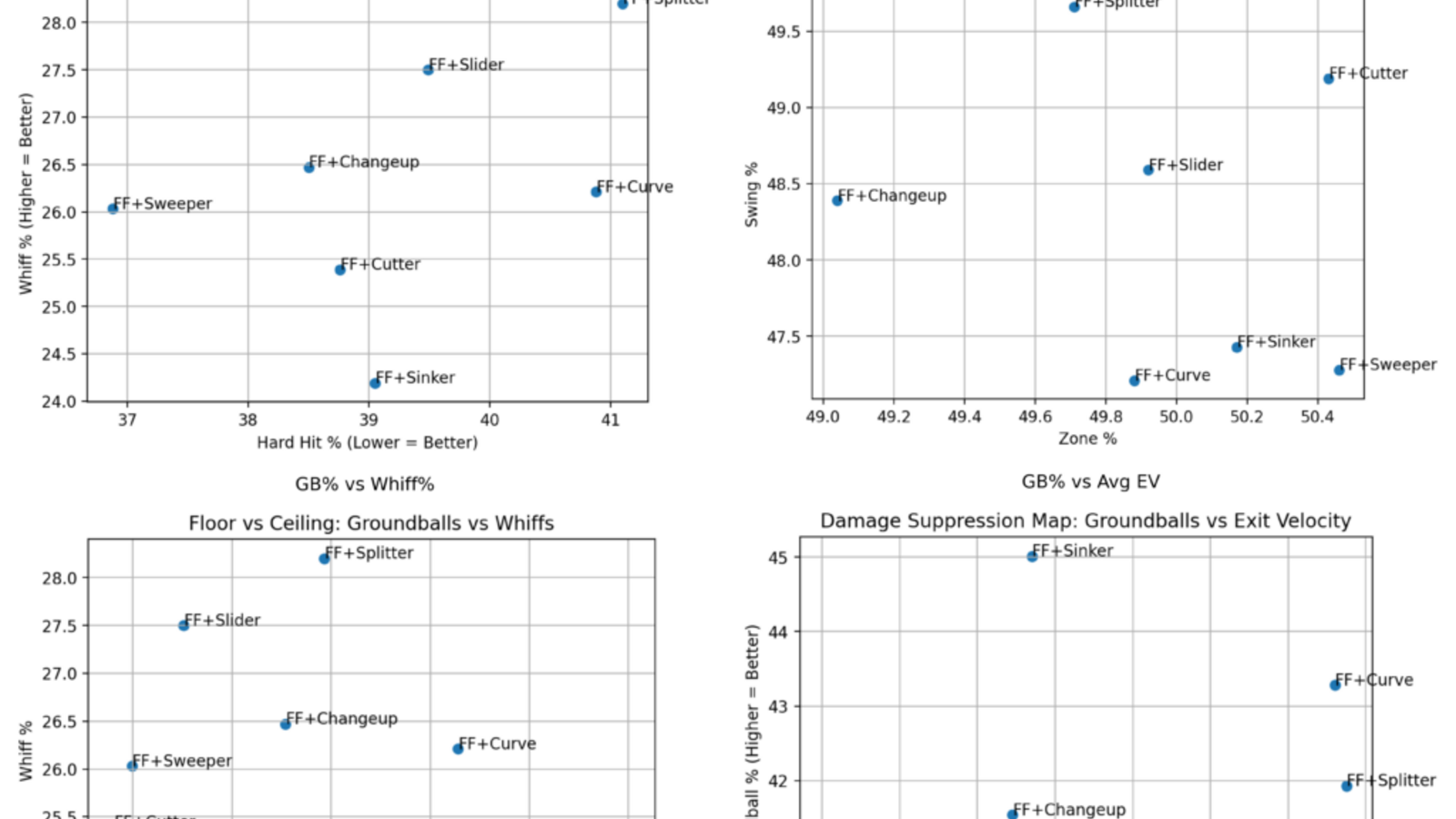
Sinkers appear to be absorbing some curveball usage, particularly for pitchers whose breaking balls lack elite shape.
The appeal is clear. Sinkers drive groundballs at rates well above the league average, allowing pitchers to suppress damage even when contact is made. The tradeoff comes with a lack of whiff generation.
In relation to curveballs, sinkers have a much tighter movement profile and are not going to dart under barrels the same way.
Compared to the overall arsenal baseline, fastball/sinker combinations generate fewer swings and misses, an outcome that might initially raise alarm in an era that prioritizes bat-missing.
But this lack of whiff is, in part, by design. These arsenals are built to utilize two fastball shapes to keep hitters off balance and induce weaker contact rather than chase strikeouts. They live around the zone more than the average arsenal, and that combination of zone presence and low-quality contact makes them particularly effective at turning lineups over.
While missing bats remains the optimal outcome, the tradeoff in contact quality makes the reduced whiff rate tolerable. For pitchers tasked with eating innings, the ability to generate groundballs and avoid loud contact provides a stable floor that traditional breaking-ball-heavy mixes do not always offer.
Cutters are increasingly absorbing usage that once belonged to sliders, particularly when the slider lacks elite shape or proves difficult to command.
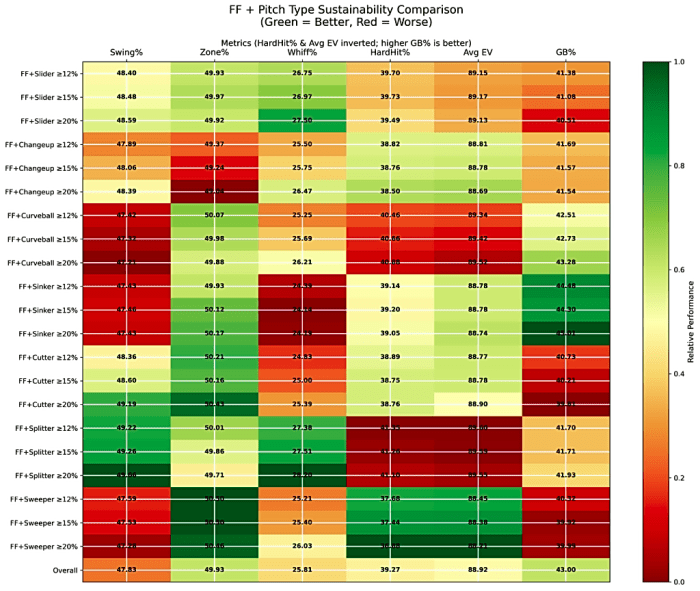
The cutter’s tighter, shorter movement profile makes it inherently easier to locate, and that advantage shows up in the data. Pitchers using fastball/cutter combinations live in the zone more frequently and generate more swings than their slider-heavy counterparts.
Importantly, this added swing volume does not come with major concessions in contact quality. Exit velocities and hard-hit rates remain muted, suggesting that while hitters are putting the ball in play more often, they are not doing so with authority.
The primary risk of a cutter-heavy approach lies in its relative lack of depth and its susceptibility to elevation. Mistakes can be easier to lift, and cutters do not generate many whiffs on their own.
At first glance, the reduced whiff totals compared to slider arsenals may appear to be a significant drawback. Sliders remain one of the game’s premier swing-and-miss weapons, and no cutter can fully replicate that bat-missing ceiling.
However, the tradeoff is more nuanced. Cutters trade peak whiff for stability. They produce more swings overall, but the quality of contact on those swings is generally lower than what we see against slider-heavy mixes.
In that sense, the cutter functions less as a replacement for elite sliders and more as a stabilizer for imperfect ones. It’s a pitch that improves command, sustains swing engagement, and suppresses damage, even if it sacrifices some swing-and-miss upside.
None of this diminishes the reality that sweepers remain the gold standard when it comes to pairing whiff generation with contact suppression. At their best, they combine bat-missing ability with weak contact in a way few pitches in the modern game can match.
The challenge is that the sweeper shape is difficult to perfect; a feel for sweepers is not a feel that every pitcher possesses. For many arms, especially those without elite lateral movement or command of the pitch’s depth, chasing a sweeper can introduce volatility rather than value.
In that context, the rise of two-fastball arsenals offers a compelling alternative. By pairing shapes — sinkers for groundballs and damage mitigation, and cutters for strike-throwing and swing engagement — teams appear to be pursuing a model built on stability, efficiency, and lineup turnover.
In an era where durability and innings are increasingly scarce, these arsenals may not offer the same ceiling as elite breaking balls, but they provide a sustainable path for starters to navigate lineups multiple times and work deeper into games.
More must-reads:
- Dodgers' Shohei Ohtani decision should already be made
- Guardians explode for 14 hits, seven runs in ALCS Game 1 win over Rays
- The 'Most 3-HR MLB Playoffs' quiz
Breaking News
Trending News







Customize Your Newsletter
 +
+




Get the latest news and rumors, customized to your favorite sports and teams. Emailed daily. Always free!
PRIVACY POLICY COOKIE POLICY CONTACT US
ABOUT YARDBARKER TERMS OF SERVICE


By using this site, you agree to our Terms of Service and Privacy Policy.
This site is for entertainment purposes only.
There is no gambling offered on this site.
Gambling Problem? Call 1-800-Gambler.
