
-

-


Follow Us
-

 On Facebook
 On Flipboard


It’s rare for a player to stop platooning more than two years into his career. More often, platoon roles harden into labels — shorthand for a structural weakness that teams plan around rather than try to fix. The Boston Red Sox are betting that Wilyer Abreu is the exception.
Abreu enters his third full season at the big league level, having proven himself more than capable of holding down a bulk platoon role. He owns an overall 115 wRC+ in his career, with a 125 wRC+ against right-handed pitchers.
However, Abreu’s career wRC+ against same-handed pitching is a much more disappointing 62, 38% worse than league average. In 2025, posted an 85 wRC+ left-on-left with a hard-to-believe .110 drop in slug in those matchups.
Yet, manager Alex Cora has been explicit about the organization’s intent to expand Abreu’s role.
“We need to have Wilyer figure out lefties. We’re going to push him to do that, and I truly believe he can do that,” Cora said when discussing the outfield alignment and Abreu’s development path.
The skipper has also framed the opportunity as a natural progression, noting that if Abreu can “hit lefties and hit for power and play defense the way he’s done the last few years, he can be the guy.”
Through his first two seasons, Abreu’s opportunities against left-handed pitching have been limited, and the sample we do have is both small and heavily skewed toward plate appearances against relievers.
Late-inning matchups often feature higher-velocity arms and sharper breaking profiles, which can exaggerate platoon effects and obscure how a hitter might perform with more balanced exposure. That context makes it difficult to draw firm conclusions from his traditional splits alone.
What does translate from that sample is his ability to keep strikeouts under control. Even in same-handed matchups, Abreu has avoided the kind of swing-and-miss spike that often forces players into strict platoons. Maintaining manageable strikeout rates provides a pathway to everyday viability.
So, why the expanded role for Abreu? To answer that question, I used my matchup model to evaluate how his swing path holds up against league-average left-handed pitching. Or, more accurately, against the shapes and sequences that typically define the left-on-left disadvantage.
Left-on-left matchups have long carried a built-in disadvantage for hitters, but the reason isn’t simply handedness.
Left-handed pitchers create steeper horizontal approach angles to left-handed hitters, allowing glove-side sweep — sliders, sweepers, and slurvy breaking balls — to move across the hitter’s decision window. What begins as a pitch that looks hittable can finish off the plate, forcing earlier commitment or disciplined takes.
Velocity alone rarely drives the platoon gap. Instead, it’s the interaction between swing path and horizontal movement that determines whether a hitter can stay on plane long enough to make quality contact. In that sense, same-handed matchups become less about bat speed and more about decision-making: Which pitches should they decline, and which counts will earn them more fastballs?
To evaluate how Wilyer Abreu’s performance could translate against left-handed pitching, I used a matchup model designed to simulate how a hitter’s swing characteristics interact with common pitch shapes.
The model incorporates bat speed, swing path geometry, and attack direction, comparing those traits against league-average pitch movement and velocity profiles.
The goal isn’t to produce a precise projection of future performance. Instead, the model is meant to be directionally informative, highlighting structural strengths, potential vulnerabilities, and the types of pitches most likely to influence outcomes.
By isolating how swing geometry interacts with pitch shapes, the model offers a clearer picture of why a platoon gap might exist and whether it is likely to persist.
With that framework in mind, the model outputs provide a clearer picture of how Abreu’s swing geometry interacts with the pitch shapes he is most likely to see from left-handed pitchers.
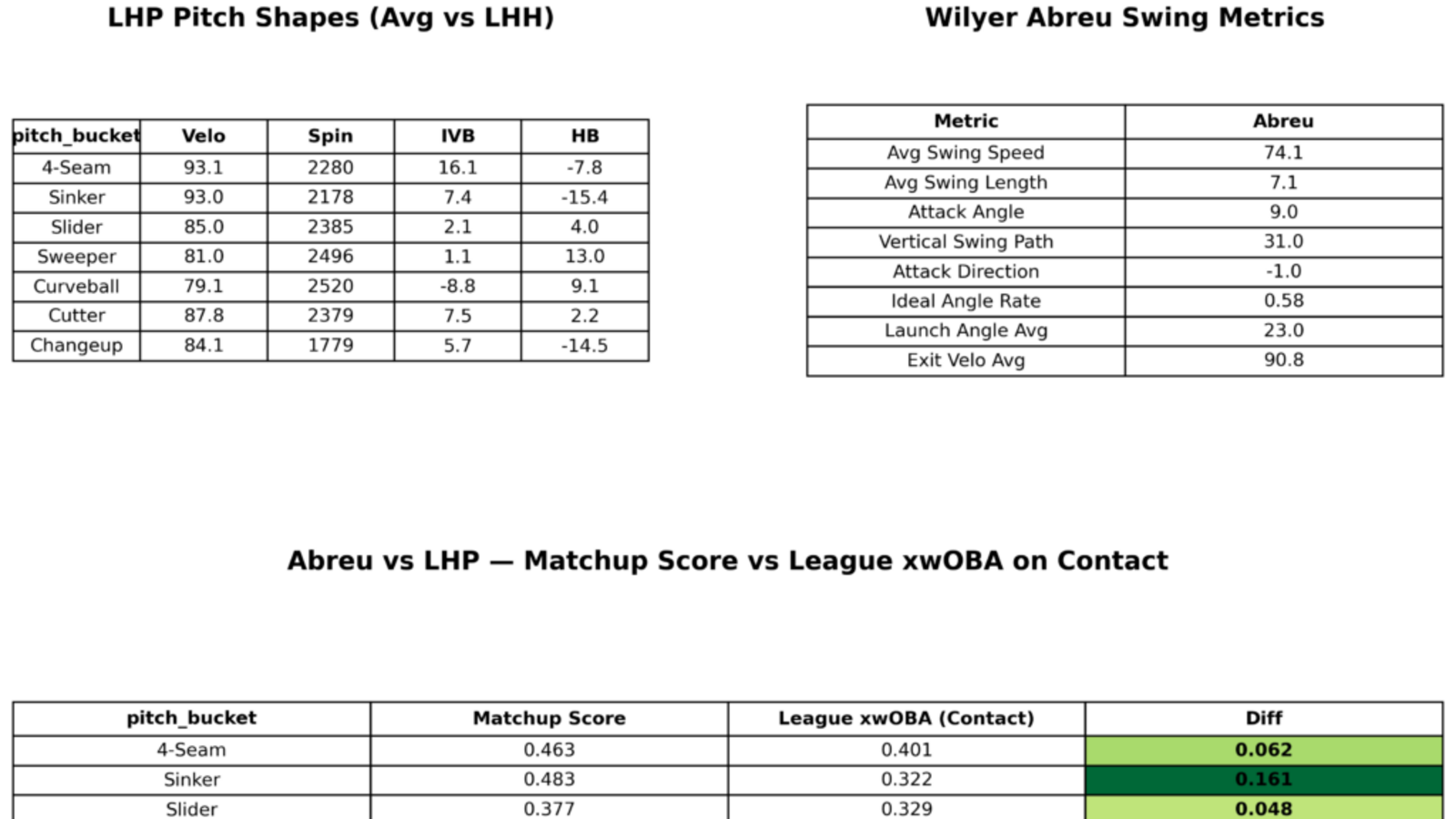
The results reinforce that velocity is not the primary obstacle in left-on-left matchups for Abreu. Against four-seamers and sinkers, his swing path projects favorably, suggesting he can match plane early and stay on line long enough to produce quality contact when he earns fastball counts.
Where the margin tightens is against horizontal spin. Sliders, sweepers, and changeups, which move across the hitter’s decision window, still suppress contact quality league-wide, and Abreu’s projected drop-offs against those pitches reflect the same underlying challenge.
His success against left-handed pitching will hinge less on bat speed and more on swing decisions; can he decline sweep and force pitchers back into the zone?
At the same time, the model suggests a more encouraging outlook than traditional platoon splits might imply.
Even using league-average pitch shapes, Abreu projects slightly above the typical left-on-left baseline across most pitch types. That relative performance helps explain why Boston is willing to expand his role. If the structural platoon penalty is smaller than expected, the upside of everyday playing time begins to outweigh the risk.
The significance of Abreu’s everyday viability extends beyond platoon splits. It is a question of value accumulation. Abreu is already an elite defensive outfielder, and that skill alone raises his floor. Even if increased exposure to left-handed pitching trims his offensive efficiency slightly, everyday playing time allows his defensive value and overall run contribution to compound over a full season.
Abreu has already shown he can produce a three-win season in 400-plus plate appearances. If he pushes closer to 600, the math is straightforward: more opportunities translate to more runs created, more defensive innings, and greater WAR accumulation. The result is not merely a productive role player, but a potential four-win outfielder — that is approaching All-Star level value.
For Boston, that outcome carries outsized importance because of Abreu’s contract status. With four years of team control remaining, including the 2026 season, an everyday Abreu represents significant surplus value. Cost-controlled players producing at a four-win pace are foundational pieces, whether they remain in the lineup or become leverage in roster construction decisions.
The Red Sox find themselves in a rare position. They have four outfielders capable of producing at a high level. Ceddanne Rafaela and Roman Anthony are secured on pre-arbitration extensions, leaving Jarren Duran and Abreu as the movable pieces.
Either player represents a dynamic trade asset given their production and years of control. By green-lighting Abreu as an everyday option, Boston increases its flexibility and makes the possibility of a Duran trade more realistic — a decision that could shape not only the roster, but the trajectory of the season.
The model suggests the risk is manageable. His swing path supports competitive outcomes against velocity, his projected performance against left-handed pitching compares favorably to the typical left-on-left baseline, and the primary vulnerability (horizontal spin and arm-side fade) is as much a decision challenge as a mechanical one.
More importantly, the upside extends beyond Abreu’s individual performance. If he proves capable of holding an everyday role, Boston gains a cost-controlled outfielder with four-win potential and multiple years of team control. That’s a valuable asset in any roster construction phase.
Such an outcome would provide Craig Breslow and the front office with meaningful leverage, whether by stabilizing the lineup around a core of young, controlled talent or by creating the flexibility to move from a position of strength in the outfield.
What begins as a question about platoon splits ultimately becomes a question about organizational advantage. By betting that Abreu can manage the decision environment against left-handed pitching, Boston is not just filling out a lineup card. It is positioning itself to extract maximum value from one of its most versatile and controllable players, a choice that could reverberate well beyond the margins of left-on-left matchups and shape the club’s path forward.
More must-reads:
- White Sox shortstop Colson Montgomery set dubious record
- Blue Jays' Vladimir Guerrero Jr. apologizes for contract comments
- The 'Most lefty-homers in a season' quiz
Breaking News
Trending News








Customize Your Newsletter
 +
+




Get the latest news and rumors, customized to your favorite sports and teams. Emailed daily. Always free!
PRIVACY POLICY COOKIE POLICY CONTACT US
ABOUT YARDBARKER TERMS OF SERVICE


By using this site, you agree to our Terms of Service and Privacy Policy.
This site is for entertainment purposes only.
There is no gambling offered on this site.
Gambling Problem? Call 1-800-Gambler.
