
-

-


Follow Us
-

 On Facebook
 On Flipboard
Introduction
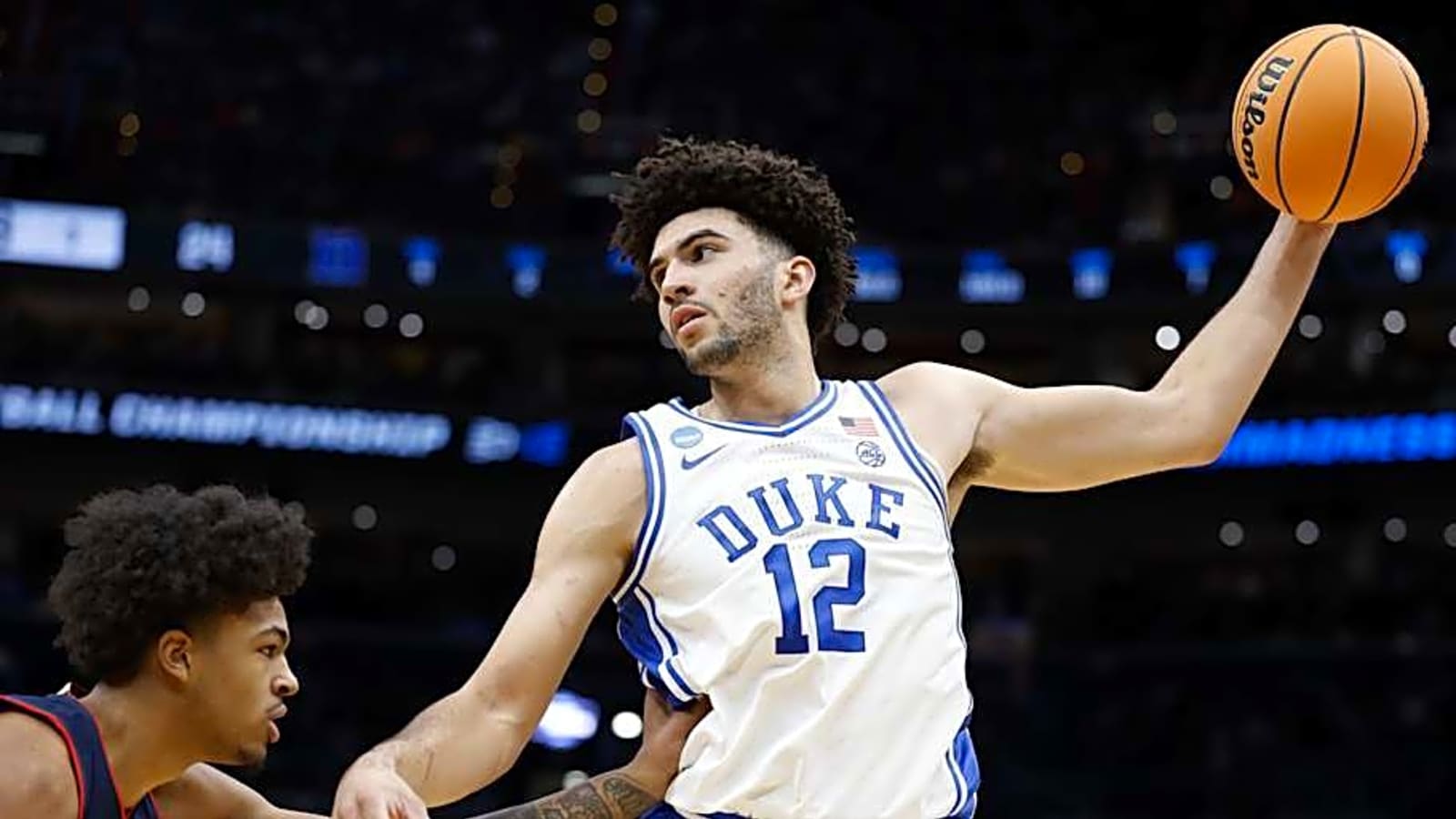
The 2026 NBA Draft is becoming interesting, with an unprecedented four projected first rounders deciding to return to college: Braylon Mullins, Thomas Haugh, Patrick Ngongba II, and Motiejus Krivas. This was just the tip of the iceberg, with players like Ivan Kharchenkov, Alijah Arenas, and other legitimate prospects also deciding to return to school. In total, there were only 71 early entrants--the lowest number since 2003. As a result, this draft may see an increased contrast between the one-and-done lottery selections, the sophomore breakouts, the occasional late first round upperclassman, and the larger group of players who have exhausted their eligibility.
Expect most players who have not exhausted their eligibility and are not guaranteed a roster spot (usually picks 1-40ish) to likely return to school. In the 2025 NBA Draft, in fact, 22 college players were taken in the 2nd round. Of those 22, only three players were not seniors or graduate students. Those three players were Rasheer Fleming, Adou Thiero, and Tyrese Proctor--all three signed contracts with at least their first two years guaranteed.
In an ever-changing draft landscape, there is increased uncertainty -- even amongst the one-and-done players projected in the lottery. To reduce uncertainty, it has become increasingly popular to design statistical queries to identify NBA talent. That being said, it is of the utmost importance to consider the logic behind the factors included in these queries. While exploring different statistics, I came across a combination of criteria that is logical through the “eye” test and reliably predicts talent. Let’s call it the Productive Young Athlete (PYA) query.
Before we dive into the statistical analysis, it’s important to define what “stick” means in my study. In this case, I considered a prospect to “stick” if they played five-plus seasons in the NBA. Prospects in the 2022 or 2023 NBA Drafts met the criteria of “sticking” if they are still in the league, due to the impossibility of them reaching five NBA seasons.
The Main Study
Since 2008, 78% of Freshmen with a MIN% ≥ 40, BPM ≥ 7.5, and 4+ Total Dunks throughout the season “stick” in the NBA. Out of the 86 prospects who matched these four criteria from the 2008-2023 college basketball seasons, 67 of them went on to play 5+ seasons in the NBA or are currently in the league. Although it’s fun to toggle around with different queries and Barttorvik.com to discover what metrics are most indicative of future success for prospects, it’s important to ask: “What do these four criteria really mean? What picture does it paint about prospects with these four criteria in common?”
Well, let’s define each. A freshman is the first-year of a player at a college or university, indicating a young age of around 18 years old. MIN% is the percentage of the team’s total minutes that a prospect plays in. These two criteria alone help narrow prospects down into college basketball players that are young, but are already trusted by their college coach and talented enough to play significant (defined here as ≥40% of the team’s total) minutes.
Next indicator, and this is the most important one, is a Box Plus-Minus greater than or equal to 7.5. Box Plus-Minus, or BPM, is a box score estimate of the points per 100 possessions a player contributed above a league-average player, translated to an average team. Widely considered as one of the most relevant publicly-available advanced statistics in the basketball world, BPM is applied to the NBA game as well. For example, to show its relevance, the four NBA players with the highest BPMs this season are the four favorites for MVP: Nikola Jokic (14.2), Shai Gilgeous-Alexander (11.7), Victor Wembanyama (10.7), and Luke Doncic (9.3). Therefore, if a prospect is a freshman with a MIN%≥40 and a BPM≥7.5, this means they are likely to be young, playing almost a majority of their team’s minutes, and contributing to the game significantly over a replacement-level player when out on the floor.
The final layer to this statistical Productive Young Athlete query is the threshold of four total dunks throughout the season. Despite this not seeming like a lot, it makes a significant difference. There have been only seven freshmen from 2008-2023 to play more than 40% of their team's minutes, have a Box Plus-Minus of 7.5 or greater, but have only three or less dunks throughout that entire season. Only two of those seven players (28.6%) stuck in the NBA and those players were Tyus Jones and Trae Young--both of whom are impactful both at the rim and as primary ball-handlers without needing to dunk. Interestingly enough, this is where projected lottery pick Keaton Wagler finds himself, as does his Illinois teammate David Mirkovic. In 2024 and 2025, respectively, we saw Jared McCain then Kon Knueppel meet this same unique situation as well. Assuming McCain and Knueppel both stick, four-for-nine (44.4%) is an undoubtedly low sample size but is still significantly lower than the 78% players who meet the Productive Young Athlete query find themselves in (on a much larger sample size). Overall, this dunk threshold helps to incorporate a baseline athleticism metric.
Therefore, 78% of freshmen with a MIN%≥40, BPM≥7.5, and Four Total Dunks throughout the season (Productive Young Athlete query) have “stuck” in the NBA historically due to them being young players trusted and talented enough to play big minutes, significantly contributing positively to the game, and having a baseline level of athleticism.
Who Didn’t Stick?
You may be wondering: “If these four criteria combined are so indicative, who are the 19 prospects since 2008 who met the criteria but didn't stick?”
Let's walk through each year:
2008: In the 2008 criteria-meeting class, Robbie Hummel and LaceDarius Dunn both met all four criteria but neither played five-plus seasons in the NBA. Robbie Hummel dealt with nagging injuries in his first two years in the NBA, and continued to deal with them overseas professionally. He retired in 2017 to become one of the best TV analysts in college basketball. On the other hand, LaceDarius Dunn had significant off-the-court question-marks and was indefinitely suspended from the Baylor Bears men’s basketball team.
2009: All three of the players who met the criteria “stuck” in the NBA, which included the likes of Gordon Hayward, Greg Monroe and Tyreke Evans.
2010: Xavier Henry was the only player not to “stick,” and he played in 185 NBA games over the course of five seasons and ruptured his left Achilles tendon nine games into his fifth season. Unfortunately, this ended his career and he was waived by the Lakers.
2011: Javon McCrea was the only player not to “stick,” and this was due to a clear lack of a perimeter game. He attempted only 4 threes his entire career at 6-foot-7 and shot only 66.7% from the free throw line. Lack of a perimeter game, in addition to unfortunate injuries, are the most common causes of why prospects didn’t “stick.”
2012: Four players didn’t “stick” out of the eight who qualified, and all four of whom struggled from the perimeter.
2013: Two players didn’t “stick” out of the six who qualified: Anthony Bennett and Sam Dekker. Regarding Bennett, nothing more really needs to be said as he is widely considered one of the bigger draft misses of all time. Dekker, meanwhile, appeared in 201 NBA games and fell just short of playing for five-plus NBA seasons (not counting his one minute played in one game on the Raptors in the 2021-22 NBA season).
2014: The one player who met the criteria “stuck” in the NBA (Joel Embiid).
2015: Eight out of nine players who met the criteria “stuck” in the NBA. The only player who didn't "stick" was Gary Clark out of Cincinnati, and he played 170 games over his four NBA seasons.
2016: The only player who qualified this season that didn’t “stick” was Mike Daum. The 6’9” South Dakota State phenom was a poor defender and didn’t provide much NBA-level athleticism.
2017: Two of the thirteen players who qualified in 2017 didn’t “stick,” and they were Justin Patton and TJ Leaf. Patton needed two surgeries to repair a broken left foot that limited him in his first season, then suffered a broken right foot the season after. Patton is another unfortunate example of injuries cutting a career short. TJ Leaf played in 146 NBA games over his first four NBA seasons, but eventually fizzled out of the rotations for both the Pacers and Blazers and subsequently signed a deal in China.
2018: Two players didn't "stick" out of the nine who qualified: Zhaire Smith and Jarrett Culver. Smith unfortunately fractured his foot in camp prior to his rookie season beginning, then dealt with a lingering knee injury the rest of his two-year career on the Sixers. Culver suffered a right ankle injury in his second season that required surgery and played 144 games over his four-year NBA career.
2019: Two players who met the criteria didn’t “stick” in the NBA, and they were Nick Musynski and Ignas Brazdeikis. Musynski, like a couple of the other prospects who didn’t “stick” despite meeting the four criteria, struggled shooting on the perimeter. When he qualified as a freshman, he was shooting 19% from beyond the arc. Despite improving his 3-point percentage as his college career progressed, Musynski wasn't heavily considered as a draftable prospect.
Ignas Brazdeikis is a unique case. Despite being considered someone who didn't "stick," as he appeared in only 65 NBA games over his first three NBA seasons, he won a championship with Žalgiris Kaunas in his home country of Lithuania in 2022-23 and was subsequently invited to the Toronto Raptors minicamp during the 2023 offseason. While he shot the ball efficiently in college (39.2% from three), Brazdeikis converted only 31.5% of his shots beyond the arc throughout his three year career (124 attempts).
2020: Vernon Carey Jr was the only player who met the criteria that didn’t stick in the NBA, and he struggled with injuries throughout his three years in the league.
2021: Both players who met the criteria in 2021, Jalen Suggs and Evan Mobley, have solidified themselves in the NBA.
2022: Both players who met the criteria in 2022, Chet Holmgren and Jabari Smith, have been impactful NBA players.
2023: All four players who met the criteria in 2023 are on track to stick in the NBA: Brandon Miller, Brice Sensabaugh, Jarace Walker, and Dereck Lively II.
Therefore, out of the 19 players who qualified by meeting the four criteria of Freshman with a MIN% ≥ 40, BPM ≥ 7.5, and 4 Total Dunks and didn't "stick":
- 7 of them lacked any sort of perimeter shooting
- 6 of them struggled with significant or continuous injuries
- 6 of them played in over 143 NBA Games over four-plus seasons
- 1 of them lacked significant degrees of NBA-level athleticism
- 1 of them had significant off-court issues
- 1 of them is widely considered one of the biggest draft misses of all time
*Some of the 19 prospects suffered from multiple of these commonalities
Note: Four players who met the criteria from 2008-2023 are currently excluded from both the 67 players who "stuck" number and the 86 player sample size. Those players are Trayce Jackson-Davis ('20), Oscar Tshiebwe ('20), DaRon Holmes II ('22), and Kennedy Chandler ('22), due to uncertainty surrounding whether they will stick in the NBA. More on this is discussed below.
Productive Young Athlete Query: Player Outcomes
Rather than wondering why certain players who met the criteria didn't stick, you may be wondering what were the outcomes of players who did stick. Sticking in the NBA is one thing, but how impactful were the players who stuck? Below I grouped the 90 players (including the four with unknown outcomes) who have met the Productive Young Athlete query from 2008-2023 into four subcategories based on Draft Express Pick Expectations. The highlight: 50% (45 of the 90 players) became NBA starters or All-Stars.
Players were grouped into the following five categories:
Unknown: Players who have uncertainty surrounding whether or not they will stick in the NBA, as it may be too early to tell.
Unknown Players who met the PYA Query: Trayce Jackson-Davis ('20), Oscar Tshiebwe ('20), DaRon Holmes II ('22), and Kennedy Chandler ('22)
Did Not Stick
Examples all shown above.
Backup: Five NBA seasons, with career 10-24 minutes per game, or over 4000 career NBA minutes
Backup Players who met the PYA Query: Michael Beasley ('08), Austin Daye ('08), John Jenkins ('10), Jared Sullinger ('11), Cody Zeller ('12), Ben Mclemore ('13), Nerlens Noel ('13), Jahlil Okafor ('15), Stanley Johnson ('15), Markelle Fultz ('17), Malik Monk ('17), Josh Jackson ('17), Landry Shamet ('17), Jonathan Isaac ('17), Robert Williams ('17), Zach Collins ('17), Mo Bamba ('18), Marvin Bagley III ('18), Jaxson Hayes ('19), Obi Toppin ('19), Brice Sensabaugh ('23), and Jarace Walker ('23)
Starter: Career 24 minutes per game or higher, or started over half of career NBA games (minimum 21 minutes per game)
Starter Players who met the PYA Query: OJ Mayo ('08), Gordon Hayward ('09), Tyreke Evans ('09), Greg Monroe ('09), Tristan Thompson ('11), Otto Porter ('12), Gary Harris ('13), Marcus Smart ('13), Justice Winslow ('15), Myles Turner ('15), Kelly Oubre ('15), D'Angelo Russell ('15), Jamal Murray ('16), Mikal Bridges ('16), Lonzo Ball ('17), Lauri Markkanen ('17), Miles Bridges ('17), Bruce Brown ('17), DeAndre Ayton ('18), Wendell Carter Jr ('18), De'Andre Hunter ('18), Tyler Herro ('19), Onyeka Okongwu ('20), Evan Mobley ('21)*, Jalen Suggs ('21), Chet Holmgren ('22)*, Jabari Smith ('22), Brandon Miller ('23), and Dereck Lively II ('23)
All-Star: Two or more appearances in the NBA All-Star Game
All-Star Players who met the PYA Query: Kevin Love ('08), James Harden ('08), Derrick Rose ('08), Blake Griffin ('08), John Wall ('10), Demarcus Cousins ('10), Anthony Davis ('12), Bradley Beal ('12), Joel Embiid ('14), Karl-Anthony Towns ('15), Devin Booker ('15), Ben Simmons ('16), Shai Gilgeous-Alexander ('18), Jaren Jackson Jr. ('18), Zion Williamson ('19), and Tyrese Haliburton ('19)
The Results
Out of the 90 players who have met the Productive Young Athlete Query from the 2008-2023 college basketball seasons...
- 21.1% of them did not stick in the NBA (19 players)
- 24.4% of them became Backups (22 players)
- 32.2% of them became Starters (29 players)
- 17.8% of them became multi-time All-Stars (16 players)
- 4.4% of them have outcomes that are still unknown and are uncertain to stick in the NBA (4 players)
More must-reads:
- Winners and losers from Tuesday's NBA playoff action
- Timberwolves HC provides Anthony Edwards injury update ahead of Game 2
- The '20-point, 15-rebound Game 7's' quiz
Breaking News
Trending News



Customize Your Newsletter
 +
+




Get the latest news and rumors, customized to your favorite sports and teams. Emailed daily. Always free!
PRIVACY POLICY COOKIE POLICY CONTACT US
ABOUT YARDBARKER TERMS OF SERVICE


By using this site, you agree to our Terms of Service and Privacy Policy.
This site is for entertainment purposes only.
There is no gambling offered on this site.
Gambling Problem? Call 1-800-Gambler.
