-

-


Follow Us
-

 On Facebook
 On Flipboard


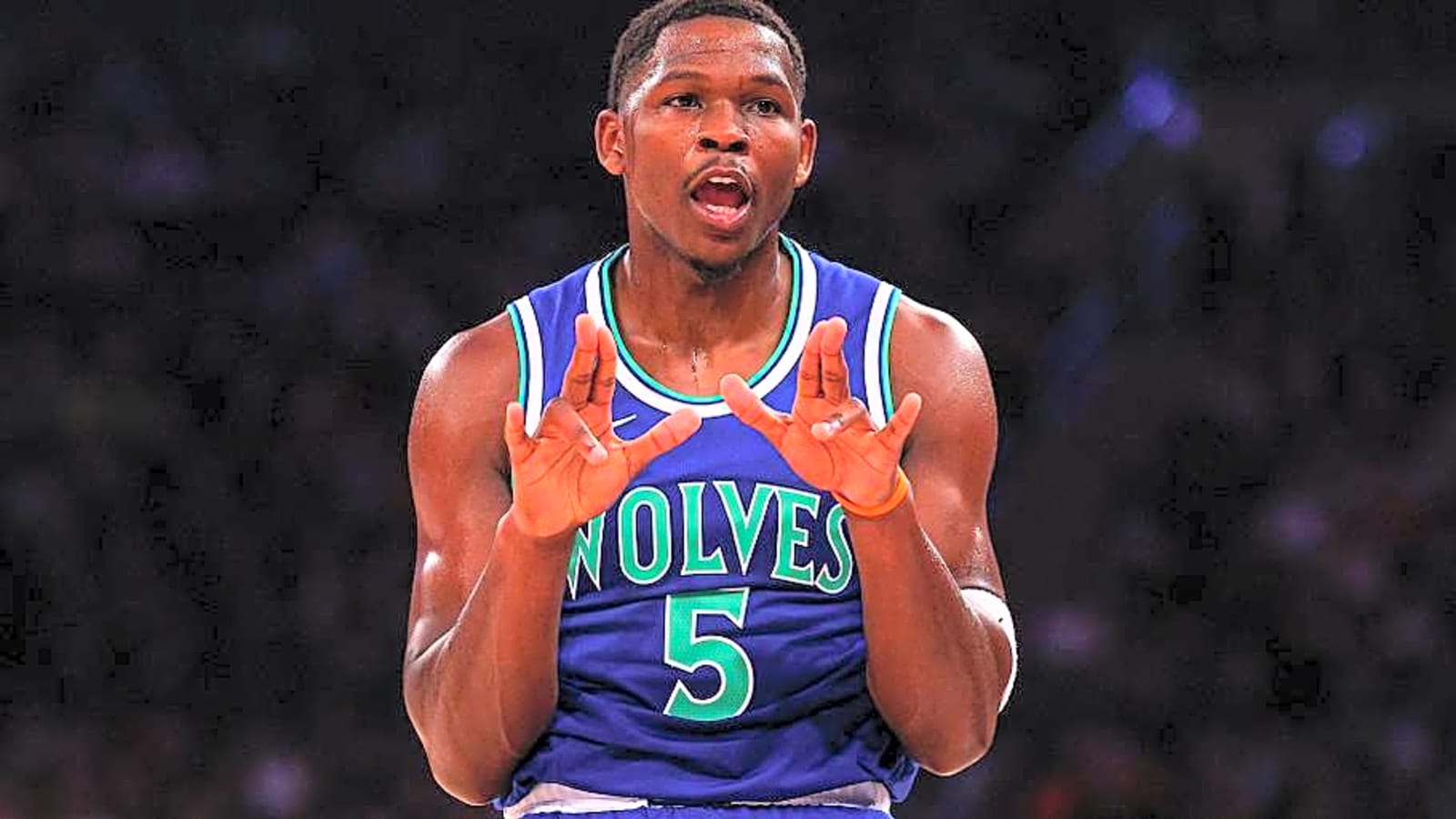
The Timberwolves put a bow on their six-game preseason schedule with a 133-116 loss to the Bulls in Chicago Friday night. Most of Minnesota’s rotation stayed in the Twin Cities as they continue preparing for their regular-season opener Wednesday night in Miami.
Meaningful basketball is on the doorstep. The Wolves went 3-3 in the preseason, highlighting an exciting offense among their starting five and raising concerns about their bench.
Because preseason games don’t count toward players' career stats, it is hard to know how much results matter. However, we can use the preseason as a check-in to see where players are at entering the season.
Here are my final takeaways.
Anthony Edwards
Edwards played in four preseason games. He led the Wolves in scoring at 19.8 points per game in just 22.6 minutes. He shot 40.7% from the floor and 44% from deep. Overall, his long-range shot—the shot that has launched him into superstar status—fell at its usual elite level.
YEAH FIVE pic.twitter.com/coHni6WanI
— Minnesota Timberwolves (@Timberwolves) October 13, 2026
Despite his shot-making, I have Edwards “trending down” entering the regular season because of the moments throughout the preseason at which he moved around the court sluggishly, both offensively and defensively.
Edwards suffered injuries to both of his knees at the end of last season. He hurried back from a left knee bruise and hyper-extension to rejoin his teammates for Game 1 of the second round against San Antonio, clearly not anywhere close to 100% healthy. Edwards then took two months off from basketball this off-season to help heal his knee injuries.
Because of all that, Edwards looking a step slow in the preseason is cause for some level of concern. I have a feeling that Edwards will be moving around the floor with more energy once the games start to count. But at the very least, his agility and side-to-side movement will be something to monitor as the season wears on.
Jaden McDaniels
McDaniels wants to become an All-Star this season. Anthony Edwards believes he can average 20-25 points per game.
In an ecosystem headed by two on-ball-heavy players in Ball and newly acquired LaMelo Ball, McDaniels will probably be hard-pressed to jump from the 14.8 points he averaged last year to 20-plus. He may simply not have enough shot attempts for an opportunity to significantly blossom as a scorer, which has been the case since he entered the NBA in 2020.
However, this preseason gave reason to believe that McDaniels is primed to take another meaningful step as a scorer in Minnesota.
McDaniels played in four preseason games, averaging 14.8 points in 20.7 minutes. He shot 60.6% from the floor while taking eight shots per game and also shot 71.4% from three-point range on 3.5 attempts.
look at Slim, man. pic.twitter.com/NJPVquupuS
— Minnesota Timberwolves (@Timberwolves) October 13, 2026
The Wolves believe that Ball’s elite-level passing will do wonders for McDaniels, and we saw that in the preseason. McDaniels benefited greatly from the speed and consistency with which Ball passed the ball and initiated actions in the half-court, which allowed McDaniels to exploit mismatches.
Last season, McDaniels averaged 14.8 points per game on 11 shot attempts. He gave Minnesota a high-volume offensive option on limited shot attempts, which fit perfectly alongside Edwards and Julius Randle. And after the Wolves traded Randle to the Nets this summer, McDaniels was set to become Minnesota’s second-option scorer behind Edwards.
But then Ball, a one-time All-Star, landed in Minneapolis in June. McDaniels subsequently slid back to being the “third option.” But this preseason proved that the Wolves’ offensive totem pole is less defined at the top. If Ball continues to pass the ball as he did in the preseason, McDaniels not only has the chance to take another step forward on offense, but he could finish the year as Minnesota’s second-leading scorer.
LaMelo Ball
Ball’s preseason stats don’t jump off the page. Through four games, he averaged 9.5 points, 5.8 assists, 3.3 rebounds, and 3.5 turnovers on 44.4% from the floor and from deep in 19.4 minutes per game.
But Ball made quick and decisive passes, sometimes for an assist, other times setting up someone else to assist. He simply kept the ball moving, which is a simple concept that Minnesota’s starting lineup has struggled with over the last few years. Ball quarterbacked the Wolves offense in the preseason to largely operate the way Minnesota’s coaching staff is hoping it will when the games count.
“I think we have a chance to play faster, be a better passing team, maybe people benefit from off-ball movement more,” Head coach Chris Finch told Britt Robson before the preseason. “With Rudy, a lot of different things (can happen), so I can see everything kind of get a little polished, if you will.”
great find pic.twitter.com/9mzBSaaXVz
— Minnesota Timberwolves (@Timberwolves) October 12, 2026
In an ideal world, Ball will clean up some of his turnovers once the regular season begins. But Finch is not overly concerned about them because he knows they are runoff from Ball promoting a positive offensive scheme.
“Yeah, there are good turnovers,” Finch said Wednesday (h/t Dane Moore). “We’ve been a high-turnover team historically. But if we’re trying to do the right thing, sometimes I think it’s overblown. I’ll say, turnovers are overrated sometimes.”
Here's Chris Finch talking about how not all turnovers are created equally, when asked about LaMelo Ball's passing.
— Dane Moore (@DaneMooreNBA) October 14, 2026
"Yeah, there are good turnovers... We've been a high turnover team historically. But if we're trying to do the right thing sometimes I think it's overblown. I'l… pic.twitter.com/MbL3QzAIQC
Ball is trying to do the right thing within Minnesota’s offense. He looked like a player fully aware of the scoring talent around him and leaned into that heavily in the preseason. In doing so, Ball promoted team-wide ball movement that—despite the turnovers—is exciting for his first regular season in the Twin Cities.
Rudy Gobert
Gobert still looks like the elite-level rim deterrent that he has always been. He did struggle against Jalen Duren and the Pistons, who dominated the paint against Minnesota with or without Gobert on the floor. However, much of Detroit’s rim success in that matchup stemmed from Minnesota’s lack of perimeter resistance. Gobert is still a stout rim protector, but the Wolves' backcourt must pull their weight to limit how often they put Gobert in a compromised situation.
Offensively, Gobert seems in tune with Ball, especially working out of pick-and-rolls.
Jonathan Kuminga
Kuminga had an up-and-down preseason. He played in three games, averaging 8.7 points, 2.3 rebounds, and 2 assists on 42.1% from the floor and 28.6% from deep in 18.3 minutes. His best preseason showing came against Detroit, when he recorded 16 points and three dimes on 5-of-6 from the floor and 2-of-3 from deep. In that game, he made quick decisions and decisive moves to score. That must continue into the season, especially in games where Ball and Edwards are having a tough time scoring.
Ayo Dosunmu
Dosunmu only averaged nine points in the preseason, which does not jump off the page for a guy who got paid $112 million this summer. Still, Dosunmu shot 42.9% from deep, played well next to Ball, maintained his chemistry with Bones Hyland, and competed hard on both ends. Dosunmu’s winning mindset shined in the preseason, and the Wolves will need that to continue into the regular season, especially for as long as Donte DiVincenzo is out.
Cody Williams
Minnesota acquired Williams, the eight overall pick in 2024, in a salary-dumping trade with the Jazz that sent Josh Green’s $14.7 million salary to Utah in exchange for Williams, John Konchar (whom the Wolves waived), and enough cap space to sign Jonathan Kuminga.
Williams joined the Wolves as a versatile defender at 6’8” who struggled offensively over his first two NBA seasons. He has shot 23.7% from deep over 117 games, which is the most concerning part of Williams’ game and likely why Utah gave up on him so quickly.
Still, Williams has obvious upside, and he showed it in the preseason, even though it didn’t show up in the box score. The former Colorado Buffalo played in all six exhibition games, starting two, and averaged 6.5 points, 1.7 rebounds, and 1 assist on 36.4% from the floor and 18.8% from deep over 15.7 minutes.
Cody Williams' overall comfort with the ball in his hands has popped during the preseason. He's been making good passes. The rim attacks — like this one — have been noticeable, too. pic.twitter.com/3PF1znnej0
— Charlie Walton (@CharlieWaltonMN) October 17, 2026
Despite Williams’s overall efficiency remaining low in the preseason, he made smart decisions with the ball in his hands. He passed the ball well and played quickly, which paired nicely with his versatile defense.
Williams scored 16 points against the Bulls on Friday. He started the game and shot 6-of-11 from the floor (1-of-6 from deep) in 27 minutes. Overall, Williams looked comfortable with the ball in his hands in the preseason. He made very few defensive mistakes, looking like a player who may have earned Finch’s trust to play meaningful minutes this season, either sporadically or perhaps even at the back end of the rotation.
Bones Hyland
Hyland, whom the Wolves re-signed this summer to a one-year, veteran’s minimum contract, did not travel with the team for Friday’s game, which could indicate that Finch expects him to be in his rotation to begin the season. And I believe Hyland earned that role with his preseason performance.
A concern I have with this team coming out of the preseason is how their second unit will hold up offensively as they begin the season without DiVincenzo. Finch has expressed a desire to play Ball and Edwards together rather than staggering their minutes as he did in the preseason.
If he does that, scoring off the bench will be at a premium this season. And that is where Hyland’s consistent role would come from.
BONES IS A BUCKET.
— Minnesota Timberwolves (@Timberwolves) October 11, 2026
23 PTS and counting. pic.twitter.com/pqYXMU5G6r
The Wolves are small in their front court, which has shown itself in their struggles to defend the rim and rebound in the preseason. At a slight 6’2”, Hyland does not help fix that issue. But his efficient three-point shooting, ability to operate out of a pick-and-roll, and frenetic speed in transition give Minnesota’s second unit a needed breath of fresh air, as it did last season. Hyland also fits perfectly next to Ayo Dosunmu.
Through five exhibition games, he averaged 8.2 points and 2.4 assists on 40.6% from the floor and 42.1% from deep in 13.8 minutes off the bench. In this year’s preseason, Hyland looked exactly like the energetic offensive presence he was last season. He was essential then and looks to be essential again this year for the Wolves.
Joan Beringer
Minnesota’s 19-year-old big man looked every bit of the raw yet exciting athletic prodigy that he is in the preseason.
Beringer averaged 8.3 points, 6.5 rebounds, and 1.5 blocks on 52.8% from the floor and 66.7% from the free-throw line in 18.8 minutes across all six exhibition games. His athleticism on the glass was encouraging, especially against centers bigger than him. Beringer battled through foul trouble and struggled against the Pacers’ fast-paced, spread offense.
The Wolves will once again be leaning heavily on Rudy Gobert’s defense this season. Beringer is still raw, and the Wolves will feel his growing pains. But the potential is oozing from him, and it is a good and necessary thing that he will be getting a bigger role to prove himself and learn the NBA.
Jaylen Clark
Clark’s defense remains rugged and certainly good enough for Finch to call upon when he needs a jolt on that side of the ball. Clark will need to continue improving his offense—especially three-point shooting—to get a more consistent role. Therefore, it was great to see him score 18 points on 6-of-12 from the floor in 29 minutes against the Bulls
Trey Lyles
Lyles played well enough in the preseason to be an option Finch can call on when he needs another big body on the floor this year. He struggled on the glass at times and looked a step slow. Still, the Wolves will need him should Beringer or Gobert fall injured. Lyles also shot 35% from deep in the preseason. His ability to stretch the floor is enticing amongst Minnesota’s ball-dominant players.
Terrence Shannon Jr.
Shannon enters his third year in the NBA and still struggles with the same issues he had coming out of Illinois in 2024. In this year’s preseason, Shannon averaged 8.2 points and 2.8 assists on 41.4% from the floor and 50% from deep in 17.4 minutes across five games.
Statistically, that looks like solid production. But the eye test shows that Shannon is still a concerningly unpolished player.
Shannon looked out of control as he attacked the rim in the preseason. His speed allows him to blow by point-of-attack defense, but his finishing ability around the rim is not polished. He continued to attempt left-handed layups on the right side of the rim. Shannon said he worked on improving his right hand this summer. But that work did not show up in the preseason.
The Wolves would greatly benefit from Shannon being a quality rotation piece this season because he has been a reliable three-point shooter and supplies a strong 6’6” frame that can help make up for Minnesota’s lack of size in the front court. But in the preseason, Shannon made too many defensive miscues, especially when defended off the ball.
I can’t help but wonder whether Shannon’s struggles in the preseason—with Hyland and Williams succeeding—have cost him a spot in Finch’s rotation.
We will find out Wednesday in Miami.
More must-reads:
- Thunder sign Cason Wallace to massive contract extension
- Warriors' fans can breathe a sigh of relief after Stephen Curry injury scare
- The 'Most WNBA double-doubles' quiz
Breaking News
Trending News




Customize Your Newsletter
 +




Get the latest news and rumors, customized to your favorite sports and teams. Emailed daily. Always free!
PRIVACY POLICY COOKIE POLICY CONTACT US
ABOUT YARDBARKER TERMS OF SERVICE


By using this site, you agree to our Terms of Service and Privacy Policy.
This site is for entertainment purposes only.
There is no gambling offered on this site.
Gambling Problem? Call 1-800-Gambler.