
-

-


Follow Us
-

 On Facebook
 On Flipboard

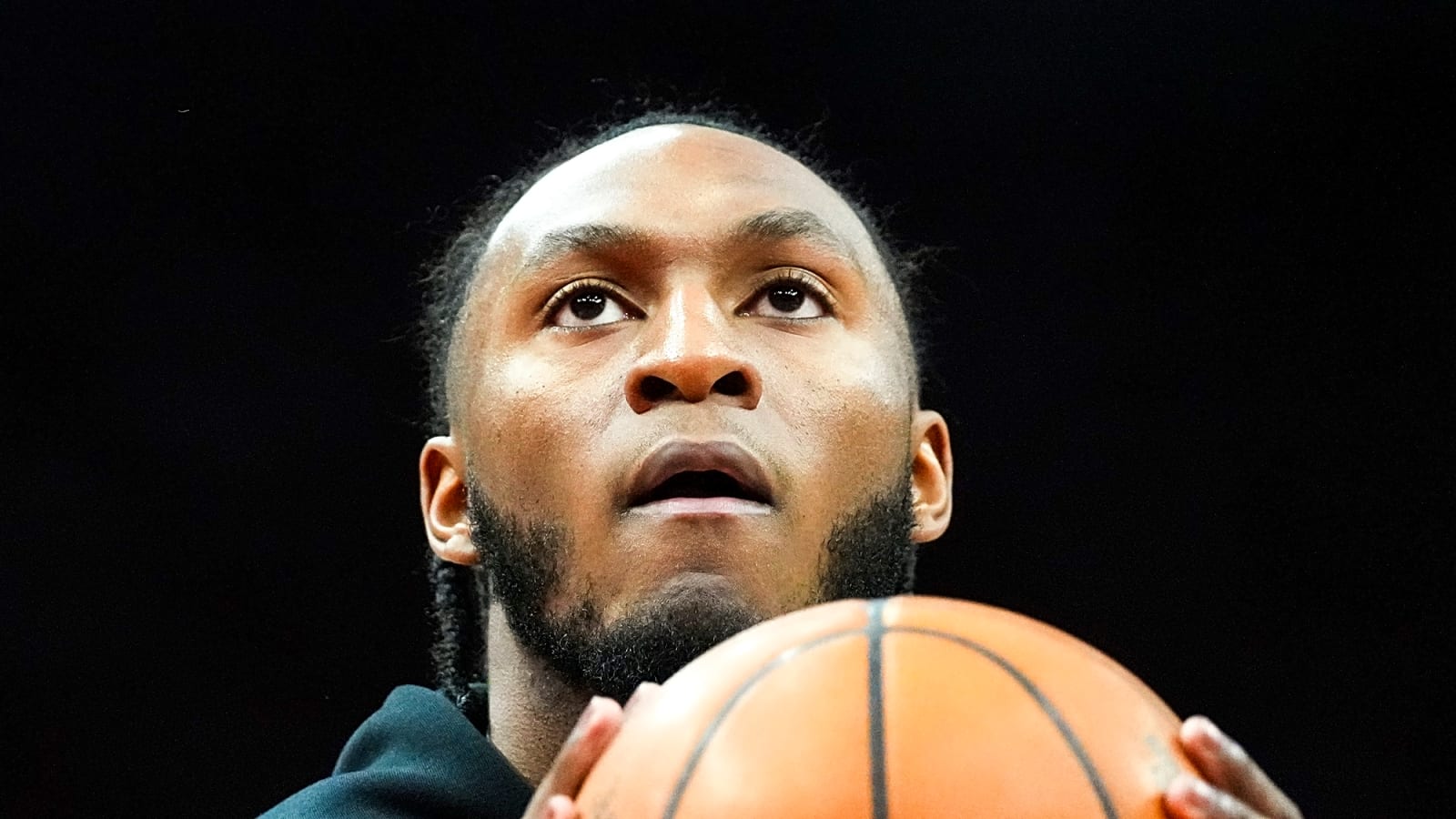
That Immanuel Quickley didn’t make it into a Toronto Raptors’ playoff game this year, on account of an ill-timed hamstring injury, was disappointing on multiple levels. Most pertinently, as someone who served a critical function for the Raptors, his participation could’ve made a real difference in their narrow first-round loss to the Cleveland Cavaliers. But in the big picture, beyond the outcome of that series, his absence felt like an even more significant missed opportunity for both player and team.
For the Raptors, who gained so much insight into the rest of their young core over seven playoff games, seeing Quickley in that environment would’ve taught them a lot more about what they have in their present and (as things stand) future starting point guard. For Quickley, it would’ve been a chance to prove that his struggles in previous postseasons have no bearing on the player he is today, now that he’s honed the type of skills that could’ve given him more answers to playoff defences.
Unfortunately, the carryover of those skills remains theoretical, and the playoff-specific questions will linger until this version of Quickley appears in the games that matter most. But after a strong season that ended with him watching helplessly from the sidelines, it’s worth shining a light on the subtle but meaningful strides he made on the court, specifically toward being a more well-rounded scorer.
When the Raptors made Quickley the centrepiece of their trade return for homegrown stalwart OG Anunoby midway through the 2023-24 season, his long-range shooting ability was clearly the biggest selling point. As the front office looked to retool around Scottie Barnes, it was obvious that the team needed a major injection of both proficiency and volume from beyond the arc. And on that score, Quickley very much delivered in his first season-and-a-half as a Raptor, shooting 38.7 percent from deep on 8.2 attempts per 36 minutes.
At the same time, as he adjusted to life as a lead guard for the first time in his pro career, he encountered challenges in other aspects of his offence. Tasked with making more decisions from the middle of the floor than ever before, he struggled to maintain a live dribble in tight spaces, to find the balance between scoring and playmaking, to decide when to rely on his floater and when to keep probing. All of which contributed to him shooting just 45.5 percent inside the arc across those first two partial Raptors campaigns, as his previously dependable in-between game went adrift.
For as vital as his 3-point shooting was, in order to succeed in his new role and reward the faith the front office showed him with a lucrative five-year extension, Quickley knew he needed to improve as a 2-point scorer. With the Raptors signaling a desire to turn a corner and be competitive, the 2025-26 season was going to be an important proving ground for the 26-year-old. So, after a difficult 2024-25 campaign in which injuries and tanking incentives limited him to 33 games, he got to work.
While some of the challenges of lead-guard life persisted this season, Quickley’s offseason efforts paid off in at least one very important area: he raised his 2-point percentage to a near-career-best 52 (and had it above 53 percent before a bout of plantar fasciitis sapped some of his effectiveness down the stretch). In the end, he fell 0.1 percentage points short of his high-water mark from 2022-23, but still blew away his career average.
Gains like that don’t tend to happen by accident.
“I wanna give a shoutout to my guy David Lam,” Quickley said when I asked him about that improvement, citing his longtime skills trainer. “That was one of our main focuses when he was working with me this summer.”
Lam is based in New Jersey and has been working with Quickley on and off since the latter’s time with the Knicks. He keeps close tabs on his client and occasionally sends him film during the season, but the real hands-on work happens in the offseason. So when he and Quickley linked up last summer, they knuckled down and collaborated on a plan to get him more comfortable and dynamic inside the arc.
“Looking at the stats, first and foremost, we were kind of targeting that — trying to get that 2-point field-goal percentage up closer to 50,” Lam told me. “Then, poring into his film, diving into some of the shots he was taking, some of the opportunities he was getting, we were really trying to read between the lines and see what opportunities were there that he could be more efficient in. I think the big thing was his shot selection, and just being more patient off of two feet. Which, credit to him, he was very self-aware of to begin with.”
Lam came armed with reams of film for Quickley to study and try to emulate, showing how similarly sized guards like Payton Pritchard and Jalen Brunson master the middle of the floor by doing exactly that: being patient and playing off of two feet.
“The overall premise was just to get him a little bit more poised, rather than picking the ball up early and getting into tough positions sometimes,” Lam said. “So, that was the first thing, just trying to improve the decision-making. To go along with that, a lot of the focus was on using extra dribbles to initiate bumps. To be able to, one, create a little bit more separation for himself, and two, give himself time — with those extra dribbles and the extra separation — to make more reads.”
They applied the lessons from the film room to the gym, working through extensive drills before scaling up to live action in pickup games, “where he could feel these things out and see how they worked for him,” Lam said.
They worked pretty well, as it turned out. We saw the practical application of that skill development over the course of the season, as Quickley worked in more jump-stops, pivots, up-fakes, spin-fades, and step-throughs.
Relevantly, his accuracy when shooting out of drives was the highest it has been during his time as a Raptor.
“I definitely think there’s more of an intention now to play off of two feet and initiate contact, especially as he gets below the free-throw line and into those areas where, previously, it might’ve been a little bit rushed,” Lam said of how this year’s Quickley differed from previous versions. “It’s just proof that he’s really maturing as a player.”
While those tweaks helped Quickley improve as a finisher at the basket, he still struggled to get all the way there, ranking in the 23rd percentile among point guards in rim frequency. But he made up for it with a significant leap in his efficiency on non-rim twos, going from 38 percent in his first two Raptors campaigns to 47 percent this season. For Quickley, the most important part of that shift was focusing on balance, which meant turning some of his one-footed runners into two-footed jumpers.
“A lot of it was just us watching film and (seeing that), even though my runner and floater game is really good, a lot of them were off-balance,” he explained. “And just being able to, sometimes, even take little mid-range jump shots — I’m a good shooter, so that can help me be on balance a little bit more. I think that’s something a lot of the 6-foot-4/6-foot-3 guards do really well, just being able to score in the short mid-range area.”
Quickley took more pull-up twos in 2025-26 than he had in any other season, and more importantly, hit a higher share of them than ever before: 46 percent, compared to 39 percent for his career coming in, per NBA Advanced Stats.
The fruits of his labour were also evident to head coach Darko Rajakovic, who reinforced Quickley’s observations while further noting his improved pick-and-roll synergy with Jakob Poeltl.
“He’s scoring much more off of two feet, which allows him to be better balanced, and to find better looks,” Rajakovic told me. “And also working together with Jak, they have very good chemistry playing off of each other. Jak does a really good job oftentimes of keeping the rim protector away from him, which allows him to get to his zone and knock down those shots.”
The heightened understanding of how to use Poeltl’s screening was probably the easiest change to spot in Quickley’s game. Especially when it came to keeping his dribble alive long enough to cross back and let Poeltl (or another screener, like Collin Murray-Boyles) seal his own guy with a Gortat screen. This is what Rajakovic was referring to:
That newfound patience was reflected in the numbers. Quickley had by far his most efficient pick-and-roll scoring season as a Raptor, averaging just over a point per possession (86th percentile leaguewide) despite the fact that he had a major down year as a pull-up 3-point shooter (27.5 percent, compared to 35.6 percent for his career and 38 percent in his previous two seasons). In other words, his success as a pick-and-roll ball-handler was entirely driven by what he did inside the arc.
Again, it’s a real shame that he didn’t get a chance to showcase what his refined skillset could look like in a playoff setting, where those in-between shots become even more resilient. But looking ahead, this is cause for optimism. Pair Quickley’s improved 2-point finishing with pull-up 3-point shooting that’s more in line with his abilities and career norms, and we could be talking about one of the more dangerous pick-and-roll scorers in the league. Which is particularly salient for a Raptors team that ranked second-last in both volume and efficiency of possessions finished by pick-and-roll ball-handlers in the playoffs.
And while specific statistical jumps like the one Quickley made this year can turn out to be outliers, the habits and targeted work that made it possible in this case should offer hope — not only that he can sustain those improvements, but that there’s still another level for him to reach. Because going through his film, as much as you see the areas where he’s improved, you also see ways in which his shot diet can be even more efficient. And to hear it from the guy who trains him in the summers, Quickley himself will understand that better than anyone.
“He’s a special player in the sense of, obviously the work ethic, but I think beyond that, how attentive he is to things,” Lam said. “He’s a smart dude, and to go along with that he’s very self-aware. He’s not just going to get in the gym and just do whatever. When you have a player like him who’s talented and self-aware and willing to put the work in, it makes my job a lot easier.”
More must-reads:
- Clippers owner Steve Ballmer expresses 'sincere regrets' in surprising statement
- Vikings HC Kevin O'Connell speaks on Kyler Murray's status after QB suffers concussion in Week 1 against Packers
- The 'Most points in a game by NBA team' quiz
Breaking News
Trending News




Customize Your Newsletter
 +
+




Get the latest news and rumors, customized to your favorite sports and teams. Emailed daily. Always free!
PRIVACY POLICY COOKIE POLICY CONTACT US
ABOUT YARDBARKER TERMS OF SERVICE


By using this site, you agree to our Terms of Service and Privacy Policy.
This site is for entertainment purposes only.
There is no gambling offered on this site.
Gambling Problem? Call 1-800-Gambler.
