
-

-


Follow Us
-

 On Facebook
 On Flipboard

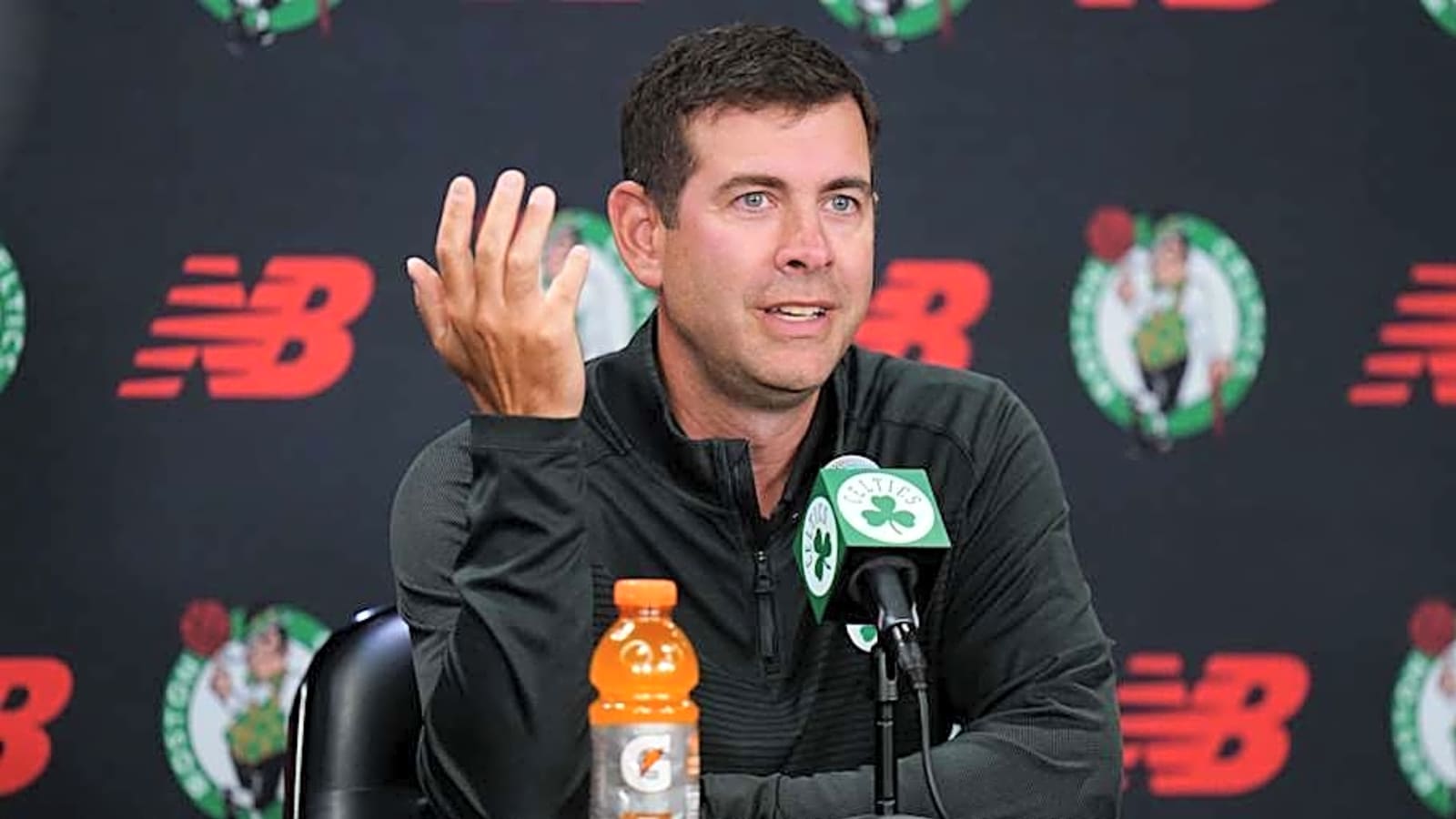
The Boston Celtics front office is full of very smart, very creative people. There aren’t many front offices with the brain power to figure out every possible trick available to them and manipulate them all into their favor.
The basis for this piece begins with that maneuvering the Celtics did to get themselves under the tax line, opening up tools to improve their team. They are far enough under the first apron now that the threat of it isn’t going to be a deterrent.
The second part of this is trying to look at the landscape created by the NBA’s collective bargaining agreement and understand its impact on players. One thing I think is happening is that guys worth $20-something million are having a tough time finding the money they want AND the situations they are hoping for. The $20-something million free agent contract is the financial equivalent of the mid-range shot, where there are only select guys and situations where it’s available.
The premise
Most of the guys making $20 million are at the tail end of a contract that started lower or on contract extensions. The only guy to switch teams for a contract starting in the $20-something million range was Myles Turner, and the Milwaukee Bucks went through some Simone Biles-ish cap gymnastics to make it happen.
Always keep in mind that the CBA was built to break up good teams and send good players to lower-tier teams in hopes of creating parity in the middle. The ultimate goal is to have only a couple of teams into the second apron for a short amount of time before selling, and a couple of teams at the bottom with unlimited spending potential. The goal is to have everyone else somewhere in between, fairly equal in salary and ability, to make the league as competitive as possible.
So the $20 million guys are getting squeezed down into the mid-level exception. Teams without cap space but space under the first apron can offer free agents $15 million and hope their pitch is enough to sell players on signing. Using the full MLE triggers a hard cap at the first apron ($209 million) so even with that tool available, a select few teams can use it.
The Celtics are one of those teams, but they have a way to out-bid the $15 million MLE teams and put themselves into the stratosphere of the cap space teams with more spending power.
The Move
The Celtics have a $27.7 million traded player exception, which can also be used to acquire a player via sign-and-trade. Doing so will also trigger a first-apron cap, but the Celtics are far enough under that where it shouldn’t be a problem.
That means they could use some of it (or all of it if they are willing to risk paying the tax) to offer a player more than the full MLE. It does come with a downside, which is giving up an asset to sign a player, which they wouldn’t have to do in free agency. But there are certain situations where they could make it work.
For example, let’s say LeBron James leaves the Lakers and Rui Hachimura is open to leaving as well. The Celtics could offer him a contract starting at $20 million in a sign-and-trade, and send Sam Hauser back to Los Angeles, who would have the cap space to absorb his contract. The Celtics would add about $9 million in salary. They would still have the full MLE at their disposal, and depending on the moves they make, they could use about $10-11 million of it before getting to the tax.
This opens up some restricted free agent discussions as well, like Walker Kessler, for example.
One key element to any Celtics plan that involves adding more than one significant player is moving off Hauser’s nearly $11 million deal. Baylor Scheierman will have to ascend into that role, whether it’s starting or off the bench, so the Celtics can improve while staying under the tax. So whatever anyone decides to cook up in a trade machine, I think Hauser’s money has to go to make it all work. He makes the right amount, and Scheierman shot 39.9% this season, albeit on half as many attempts as Hauser.
To summarize the point here, the $27.7 million TPE makes the Celtics more of a player in free agency than it might seem. Their maneuvering at the deadline has opened up the possibility of acquiring someone via sign-and-trade, which gives them a path to out-bidding the teams who can just offer the $15 million MLE. It also allows the Celtics to keep that as a tool.
Also keep in mind that the MLE also acts as a TPE in that it can be used to acquire players via trade. So Boston could use some or all of the $27.7 million TPE to acquire someone in a sign-and-trade, which effectively makes it a free agency tool, and then the $15 million can be used to acquire someone in a deal as well, making that how Boston trades for someone, even during the middle of the season.
It’s just another wrinkle for one of the most creative front offices to use this summer.
More must-reads:
- James Harden leads Cavaliers to Game 5 OT win over Pistons on monumental night
- Analyst urges Timberwolves to make blockbuster trade to help Anthony Edwards
- The 'Active NBA double-double leaders' quiz
Breaking News
Trending News







Customize Your Newsletter
 +
+




Get the latest news and rumors, customized to your favorite sports and teams. Emailed daily. Always free!
PRIVACY POLICY COOKIE POLICY CONTACT US
ABOUT YARDBARKER TERMS OF SERVICE


By using this site, you agree to our Terms of Service and Privacy Policy.
This site is for entertainment purposes only.
There is no gambling offered on this site.
Gambling Problem? Call 1-800-Gambler.
