
-

-


Follow Us
-

 On Facebook
 On Flipboard


At the beginning of the offseason, the Timberwolves completely reoriented their roster. They traded Julius Randle to the Nets and sent Naz Reid to the Hornets for LaMelo Ball.
To round out their summer, the Wolves convinced Jonathan Kuminga to sign a two-year, $12.4 million deal to come to Minnesota and start next to Rudy Gobert in the frontcourt. The Wolves adding Kuminga, given their lack of a quality power forward alternative, is undoubtedly a good bet for Minnesota to make.
Adding Kuminga, given their lack of a quality PF alternative, is undoubtedly a good bet for Minnesota to make. Kuminga balances the starting lineup and the rest of the Timberwolves' rotation and allows players like Ayo Dosunmu to move back to a sixth-man role.
Kuminga's addition also brings up potential downsides and questions about whether minutes with both him and Gobert on the court will go well.
There are both positives and negatives that come along with the pairing of Kuminga and Gobert. Which side of that ends up standing out above the other will play a huge role in the success or failure of the Timberwolves' upcoming season.
Pro: Size and athleticism
Before bringing in Kuminga, the Wolves were looking at starting Dosunmu, Terrence Shannon Jr., or another undersized player who would have caused issues with both defense and rebounding, even with Gobert at center as one of the best players in the NBA in both of those categories.
Now, with those players rounding out the Timberwolves' bench, Kuminga brings a combination of size and athleticism that the Wolves need, with the departure of Randle and Reid. The Wolves will still play smaller than last season, as Kuminga is two inches shorter and 25 pounds lighter than Randle, but they replace that with speed and verticality.
Kuminga and Gobert, as a frontcourt pair, bring both size, wingspan, and athleticism that should perform well on both sides of the court. The defensive side, with Gobert especially, is obvious, but Kuminga's speed should allow the Wolves to play up-tempo on offense more often than they have in the past.
The past few Timberwolves teams have been at their best when they utilize athleticism and physicality to overwhelm opponents. With Kuminga slotting in next to Gobert in the starting lineup, that will likely be the case again next season.
Con: Floor spacing
The key for any power forward next to Gobert is their ability to stretch the floor on offense. Given Gobert's limited skill set on that end of the floor, it becomes paramount that the other players on the court with him can space the floor to keep proper spacing within the offense.
Kuminga's three-point shot has been inconsistent throughout his NBA career. While he is far from a total non-shooter to the degree that Gobert is, Kuminga's career 33.2% from beyond the arc does not inspire confidence in his ability to space the floor next to Gobert.
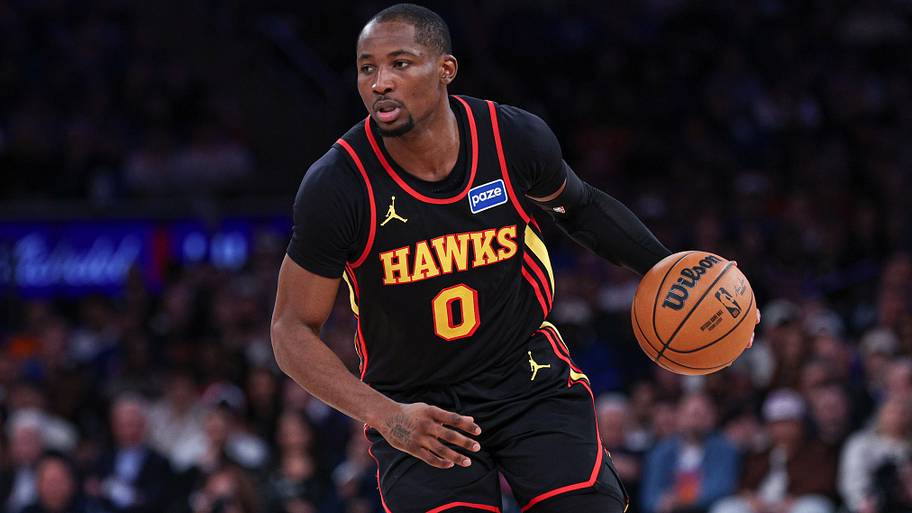
Kuminga will either need to match his career-high three-point shooting mark of 37% back in the 2022-23 season, or the Timberwolves will need to find other ways for him to be productive offensively with Gobert taking up most of the space in the paint.
Pro: Unlocking Kuminga defensively
Almost every player who plays next to Gobert as their starting center benefits from his defensive abilities. Gobert's teammates are afforded the ability to play their assignment aggressively, with the idea that Gobert will be anchoring the backline to clean up any mistakes.
Kuminga has not been a standout defensive player to this point in his career, struggling more with off-ball situations compared to when he is tasked with guarding another team's offensive engine, but playing with Gobert should allow Kuminga to maximize his game on that end of the floor.
Opening night against the Miami Heat is a perfect example of how the Kuminga-Gobert pairing can be utilized well on defense. Gobert will get matched up with Bam Adebayo, with Kuminga drawing his toughest assignment of the season, Giannis Antetokounmpo.
With Gobert behind him, Kuminga will not need to fully stop Antetokounmpo. His goal will be to funnel his matchup toward a spot on the court where Gobert can play help defense without leaving his man, Adebayo, wide open.
For most frontcourt pairings, the Heat would be near-impossible to cover. With Kuminga's willingness to guard the ball and a four-time Defensive Player of the Year behind him, the Wolves are as well-equipped as any team to slow them down.
Con: Lack of playmaking
One of the holes in Kuminga's game has been his playmaking ability and willingness to share the ball. Last season with the Warriors and Hawks, Kuminga averaged just 3.6 assists per 36 minutes, a noted step down from the Wolves' previous power forward, Randle, who put up 5.5 assists per 36 minutes.
The Wolves have often had trouble getting the ball to Gobert, with Randle as one of the better players on last year's Wolves team at finding Gobert near the rim for lobs and easy baskets. Now, the Wolves' issues with keeping Gobert integrated within the offense become even more pronounced.
The Timberwolves will need to find another way to get Gobert the ball in the paint, likely with LaMelo Ball, or risk their offensive rating sliding back from an already not good enough 13th-best last year.
More must-reads:
- Pelicans, Grizzlies agree to four-player trade
- Insider delivers harsh reality regarding Kevin Durant
- The 'Most points in a game by NBA team' quiz
Breaking News
Trending News


Customize Your Newsletter
 +
+




Get the latest news and rumors, customized to your favorite sports and teams. Emailed daily. Always free!
PRIVACY POLICY COOKIE POLICY CONTACT US
ABOUT YARDBARKER TERMS OF SERVICE


By using this site, you agree to our Terms of Service and Privacy Policy.
This site is for entertainment purposes only.
There is no gambling offered on this site.
Gambling Problem? Call 1-800-Gambler.
