
-

-


Follow Us
-

 On Facebook
 On Flipboard

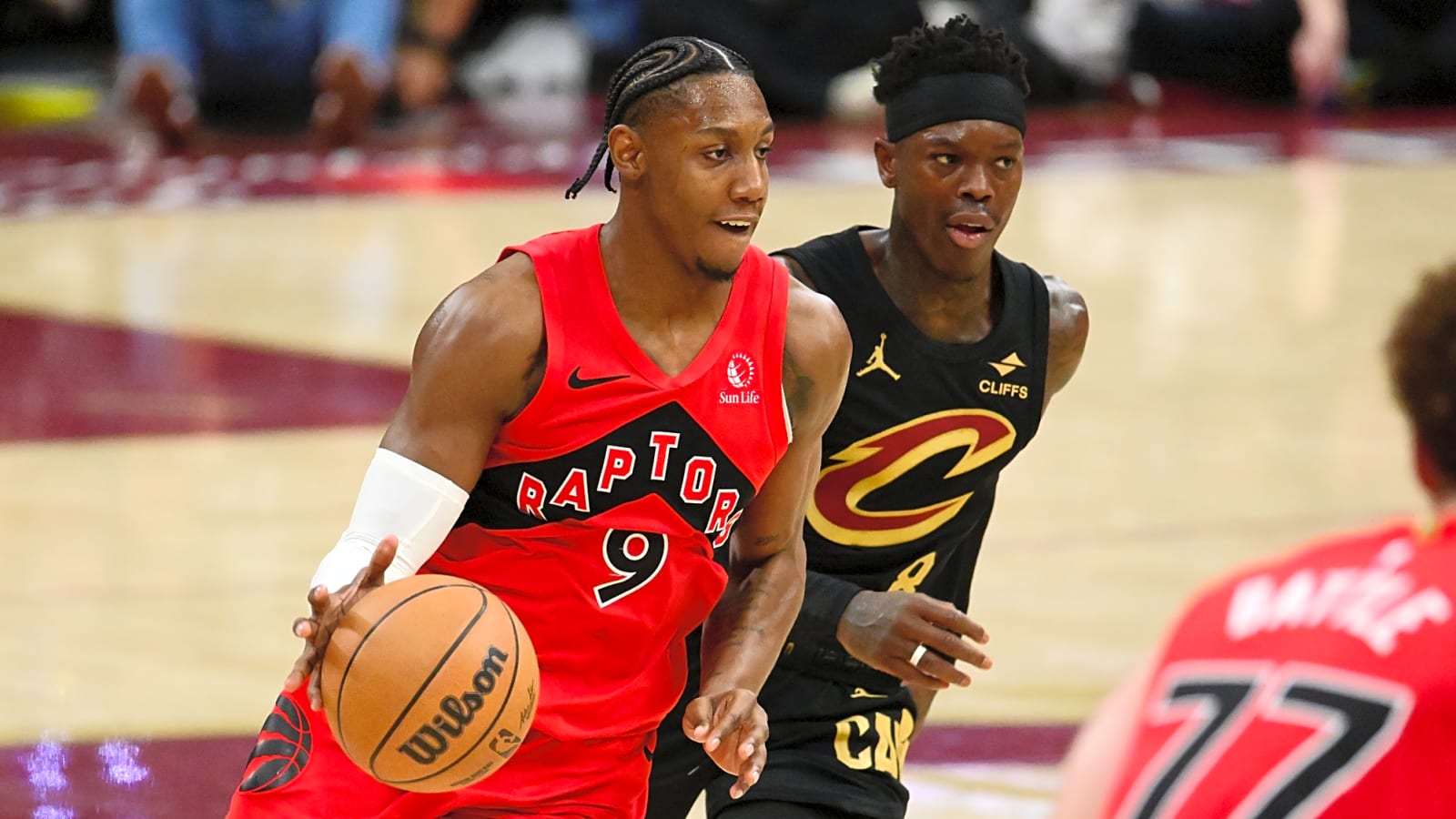
No matter which way you slice it, the Raptors are primed to be defined, mostly, by two things in this upcoming season:
- The duo of Kawhi Leonard & Scottie Barnes
- What should be an elite defense
Outside of that, there is a whole lot of room for a number of players to prove, elevate, or damn themselves on the basketball court.
Immanuel Quickley was initially targeted by the Raptors with the hopes of being the heir apparent at point guard. A star guard hidden behind Jalen Brunson, ready to jump at an opportunity. The Raptors are still waiting for a more all encompassing performance from Quickley, but there are enough markers to expect good things going forward.
Before signing his big extension, Jakob Poeltl had launched himself firmly into the top half of starting centers in the NBA. He’s run into injury problems and his feet have clearly slowed some since then. There should be different expectations about how he’s used defensively, but his offensive game, size, and impact on the glass should allow him to provide healthy impact if his health holds at a decent place.
Among the guys who are not max players like Barnes & Leonard, but still paid well, RJ Barrett is the only guy coming off a successful regular and postseason performance. Health is obviously a factor in that, because it created the opportunity that Barrett seized. Among the high usage Raptors, he was the only one who came out positive in the on/offs (just barely). Whether it was regular or postseason, Barrett maintained an ability to improve the Raptors offense measurably. In football parlance, you can cast him as the 3rd down back, the slot receiver, or the quarterback squirting for a first – he moves the chains.
Barrett’s lack of prowess when it comes to the home run ball or a pull-up jumper in general allows people to cast his offensive game in a sort of archaic light. That the game has passed him by in some sense. In reality, he punches into the paint so often, and creates rim attempts for himself and others at such a high frequency that it’s been remarkably easy for him to help the Raptors score. You wanna shoot better? Get to the line more often? Allow fewer turnovers? Call on Barrett. There isn’t a season with the Raptors where Barrett hasn’t improved their ability to do these things. Last season, the Raptors half-court offense was +9.2 points per 100 possessions (per Cleaning the Glass) when he was on the court. Good for the 98th percentile. The team context changes, and Barrett adapts and moves ahead.
Well, guess what? Hello changing context. Hello Kawhi Leonard.
It’s not often that a player could co-lead his team in playoff points per game (24.1 alongside Barnes) like Barrett did and still have an expectation to see less of the ball in the following season, but that’s where Barrett likely is. The question is: what does Barrett’s usage look like with the Raptors swapping their All-Star forward for the Clippers All-NBA forward?
The unique thing about swapping Brandon Ingram out for Leonard is that they have heaps of overlap in usage. Leonard just happens to elevate everything by a meaningful amount. They were afforded basically the same amount of touches per game (53 vs 52), they both like to work in the mid-range (although Leonard gets to the short mid range far more often, and is by extension, far more efficient), and they both benefit hugely when supported by elite playmaking.
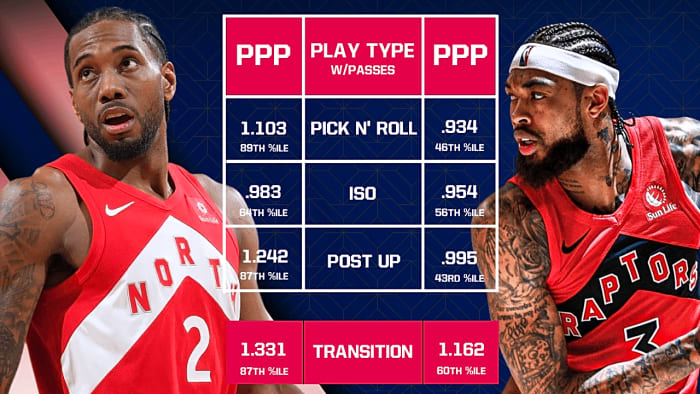
Barrett was a really important secondary player alongside Ingram. He cut well off of Ingram’s on-ball gravity; appearing at the point of highest leverage, palms turned up, ready to help. When Ingram needed possessions off, Barrett could step into an initiating role and comfortably allow the Raptors to churn through defenses. The expectation should be that Barrett will occupy a fairly similar role next Leonard. With small, but meaningful differences.
Barrett is an expert at absorbing usage on fewer touches because the way he plays leads him a lot closer to a used possession (shot attempt, assist, turnover) than it does to simply moving the ball on. As is Leonard. It’s how Leonard could turn only 1 more touch per game into nearly 7 more points and a much higher usage percentage than Ingram.
The Raptors offense struggled with a fair few things last season. They were bottom 10 in pull up points, dead last with a bullet in pull up 3’s, spent too much time in the mid-range, and were middle of the pack in C&S volume and efficiency. In terms of putting the ball on the floor, they were bottom half of the league in drives per game, top 7 in passing out of drives, bottom 5 in drive points per game, 5th in paint touch points, and top 10 in rim frequency.
Leonard obviously helps with a lot of this stuff, and most notably the pull up shooting, where he’s historically great. The question is, is Leonard expecting for his scoring to return somewhere closer to the 23ppg mark that he’s hung around the past few years? Would he welcome a player next to him like Barrett who wants to finish plays and has fewer qualms about deference to #1 options? Maybe so.
In that case, Barrett needs to continue to refine his pick n’ roll craft. He was the Raptors best high usage option in that play type during the playoffs. He has generally accumulated high efficiency touches there over his years as a Raptor. His team will rely on paint touches, rim pressure, and a healthy supply of passing to their bigs – Poeltl was near the top of the league in points off of cuts in the regular season, Collin Murray-Boyles during the postseason.
I think the easiest adaptation Barrett will make, is the one that asks him to score with and without Leonard (whether the Raptors star is on the bench or missing a game entirely). He’s quite adept at scaling his usage up or down and figuring out how to help offenses out.
The hardest adaptation that awaits Barrett is the one on the defensive side of the floor.
Barrett is set to be well protected in the Raptors defense, it’s true. However, when you’re kept out of the main action on these Raptors, the onus falls on you to create plays. Barrett has always struggled to create turnovers on defense. Historically, he’s tanked his teams ability to force them.
It’s two-fold, the trouble:
- Barrett doesn’t have the foot speed, quick hips, or the nimble movement style to stick with on-ball guards who are typically quick, agile, and use a lot of screens.
- Barrett can be entirely too passive as an off-ball defender (where the Raptors need help playmaking from) and can give up too much in the way of cuts and offensive rebounds when he gets lined up against opposing wings.
Considering Barrett has considerable size, and is very strong, the most natural defensive assignments for him are outside of the back court. Which means, I think, that Barrett’s path to improving on the defensive end are related to attentiveness and tenacity. Attentiveness is something that a lot of players improve during their career. Barrett can more than likely take that step. Tenacity is less of a guarantee. Tenacious defensive players are usually identified at the college level and bring it with them into the league. It’s pretty rare for a player to become a defensive playmaker mid career. However, it has happened before.
I make no guarantee that Barrett will be the player who does, but if there were a team that could draw that out of a player? The Raptors and their obsessive, grabby, harassing defense that bakes in playmaking reads at every turn seems like a good place for that to happen.
It’s easy to see how Barrett has become a strong offensive player, and a valuable player overall. He can be more, though. It’s up to him now, on what should be the best NBA team he’s ever been a part of, to create a new reputation on defense. One that his team needs.
More must-reads:
- Clippers owner Steve Ballmer expresses 'sincere regrets' in surprising statement
- NFL Week 1 lowlights: Worst lost, quarterback performance and more
- The 'Most points in a game by NBA team' quiz
Breaking News
Trending News




Customize Your Newsletter
 +
+




Get the latest news and rumors, customized to your favorite sports and teams. Emailed daily. Always free!
PRIVACY POLICY COOKIE POLICY CONTACT US
ABOUT YARDBARKER TERMS OF SERVICE


By using this site, you agree to our Terms of Service and Privacy Policy.
This site is for entertainment purposes only.
There is no gambling offered on this site.
Gambling Problem? Call 1-800-Gambler.
