
-

-


Follow Us
-

 On Facebook
 On Flipboard


Russell Westbrook made achieving a triple-double look incredibly easy. Even in the earlier years of his career, around 2013 and 2014, Westbrook was already joining the small group of guards capable of snatching rebounds, creating for teammates and scoring at a high level. But what happened during that breakout 2016-17 season, the one where he shattered Oscar Robertson’s record and then proceeded to lose in the first round? How did a walking triple-double eventually become a slandered Lakers player known by the moniker “Westbrick,” and how did what was once an amazing feat turn into something fans barely scoff at anymore? First, the different eras of the NBA have to be looked at.
The NBA Has Been Here Before
During the late 1950s and early 1960s, when Wilt Chamberlain and Bill Russell were dominating, the NBA was played at an incredibly fast pace. More possessions naturally meant more opportunities to score, rebound and assist, which is part of the reason the numbers from that era can look so ridiculous today.
The 1961-62 season is probably the perfect example. Wilt averaged 50.4 points and 25.7 rebounds, Oscar Robertson averaged 30.8 points, 12.5 rebounds and 11.4 assists, and that was also the season Wilt scored the infamous 100 points. Teams averaged almost 119 points per game, compared with only 105.6 during Westbrook’s 2016-17 MVP season.
Over the following decades, the game changed. Pace slowed, defenses became more structured and by the 1990s and early 2000s the league had become much more of a half-court game.
Modern basketball has started moving back in the opposite direction. More spacing, more three-pointers and faster offenses mean more possessions and more long rebounds. Players now have more chances to pile up box-score numbers than they did during some of the slower eras.
Bam Adebayo scoring 83 points in 2026, is probably the most ridiculous recent example. A player whose previous career high was 41 suddenly produced the second-highest scoring game in NBA history.
Then you get Westbrook.
Westbrook Made The Impossible Look Normal
The changing NBA environment helped create more statistical opportunities, but that does not suddenly make Westbrook’s 2017 season unimpressive.
The simple reason is that everyone else was playing in the same league.
Westbrook still became the first player since Oscar Robertson in 1962 to average a triple-double for an entire season, finishing at 31.6 points, 10.7 rebounds and 10.4 assists while breaking Robertson’s single-season record with 42 triple-doubles.
What made Westbrook special was the amount of offense he was creating while carrying that workload.
Kevin Durant had just left Oklahoma City, which essentially handed Westbrook complete control of the offense. Possessions ran through him, rebounds often started transition opportunities through him and almost every important decision belonged to him.
There were legitimate criticisms of stat-chasing. Research from Harvard later found that Westbrook became more likely to pursue rebounds and assists when he was close to completing a triple-double. A large portion of his defensive rebounds also came uncontested.
That does not erase the accomplishment. Plenty of players have been given massive usage and never came close to doing what Westbrook did.
He Destroyed The Novelty
The real effect Westbrook had was making the triple-double feel normal.
Before 2017, Oscar Robertson averaging one for an entire season felt like one of those untouchable NBA records. Robertson had done it in 1962, and then more than five decades passed through Magic Johnson, Larry Bird, Michael Jordan, Kobe Bryant and LeBron James without anybody repeating it.
Westbrook did it, then again, and again.
Westbrook eventually averaged a triple-double four different seasons and retired as the NBA’s all-time leader with 209 career triple-doubles.
No longer was the reaction, “A triple-double? That is insane.”
The reaction eventually became, “How many did Russ have tonight?”
That is where the Brando comparison works. Film students watching Marlon Brando decades later might wonder what was so revolutionary because the naturalistic acting style he helped popularize became normal afterward.
Westbrook did something similar to the triple-double.
The feat did not become less difficult overnight. Westbrook simply repeated it so frequently that fans became desensitized to it.
Then Everybody Started Getting Them

Westbrook was also arriving at exactly the moment league conditions became friendlier toward triple-doubles.
More three-point attempts created more long rebounds for guards. Faster pace produced more total possessions. Positionless basketball put the ball into the hands of larger playmakers, while heliocentric offenses increasingly allowed one star to control scoring and passing opportunities.
Triple-doubles started exploding across the league. One analysis found that the NBA went from 46 triple-doubles in 2014-15 to 75 the following season, with totals continuing to rise afterward. Increased pace was one of the contributing factors.
Then came Nikola Jokić, Luka Dončić, James Harden, Domantas Sabonis and other players who made filling every section of the box score look normal.
Jokić has pushed the idea even further, reaching 198 career triple-doubles by May 2026, only 11 behind Westbrook’s eventual record of 209.
Westbrook did not single-handedly cause the increase, but he became the face of it.
From Triple-Double King To “Westbrick”
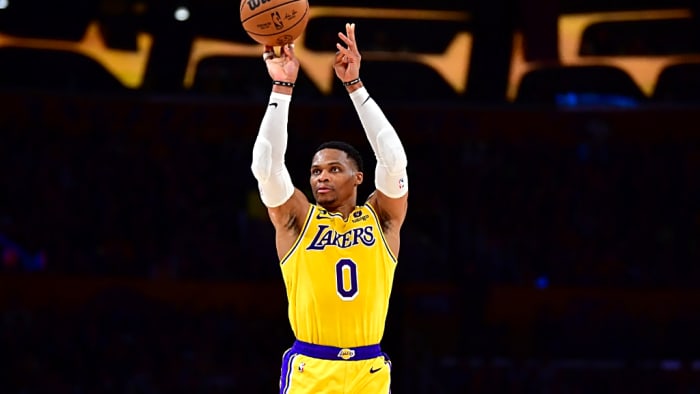
The other reason fans started disrespecting Westbrook’s numbers was that the winning did not always follow them.
Oklahoma City finished 47-35 during his MVP season but lost to Houston in five games in the first round. Westbrook had produced one of the greatest statistical seasons ever, but critics could immediately point toward the playoff exit.
That criticism became much louder later in his career.
By the time Westbrook reached the Lakers in 2021, declining athleticism and poor shooting made the flaws harder to hide. The “Westbrick” nickname became attached to his struggles, especially when missed jumpers and turnovers became social-media clips. Westbrook publicly pushed back against the nickname because of how it affected his family.
Suddenly the same player who had once made triple-doubles look superhuman was being criticized for producing empty statistics.
End Of My Westbrook Rant
Westbrook’s historic 2017 season should not be overshadowed. Averaging 31.6 points, 10.7 rebounds and 10.4 assists while breaking a record that had survived for 55 years was ridiculous.
The irony is that Westbrook may have damaged the reputation of his own greatest accomplishment simply by doing it too often.
Triple-doubles did not become useless because they stopped being difficult. The NBA became faster and more favorable toward all-around stat accumulation, while Westbrook repeated the feat so frequently that the novelty disappeared.
More must-reads:
- DeMar DeRozan's next team is obvious, but there's a holdup
- Did Lakers leave money on the table keeping Jeanie Buss in charge?
- The 'Last 200-yard rusher by team' quiz
Breaking News
Trending News






Customize Your Newsletter
 +
+




Get the latest news and rumors, customized to your favorite sports and teams. Emailed daily. Always free!
PRIVACY POLICY COOKIE POLICY CONTACT US
ABOUT YARDBARKER TERMS OF SERVICE


By using this site, you agree to our Terms of Service and Privacy Policy.
This site is for entertainment purposes only.
There is no gambling offered on this site.
Gambling Problem? Call 1-800-Gambler.
