
-

-


Follow Us
-

 On Facebook
 On Flipboard

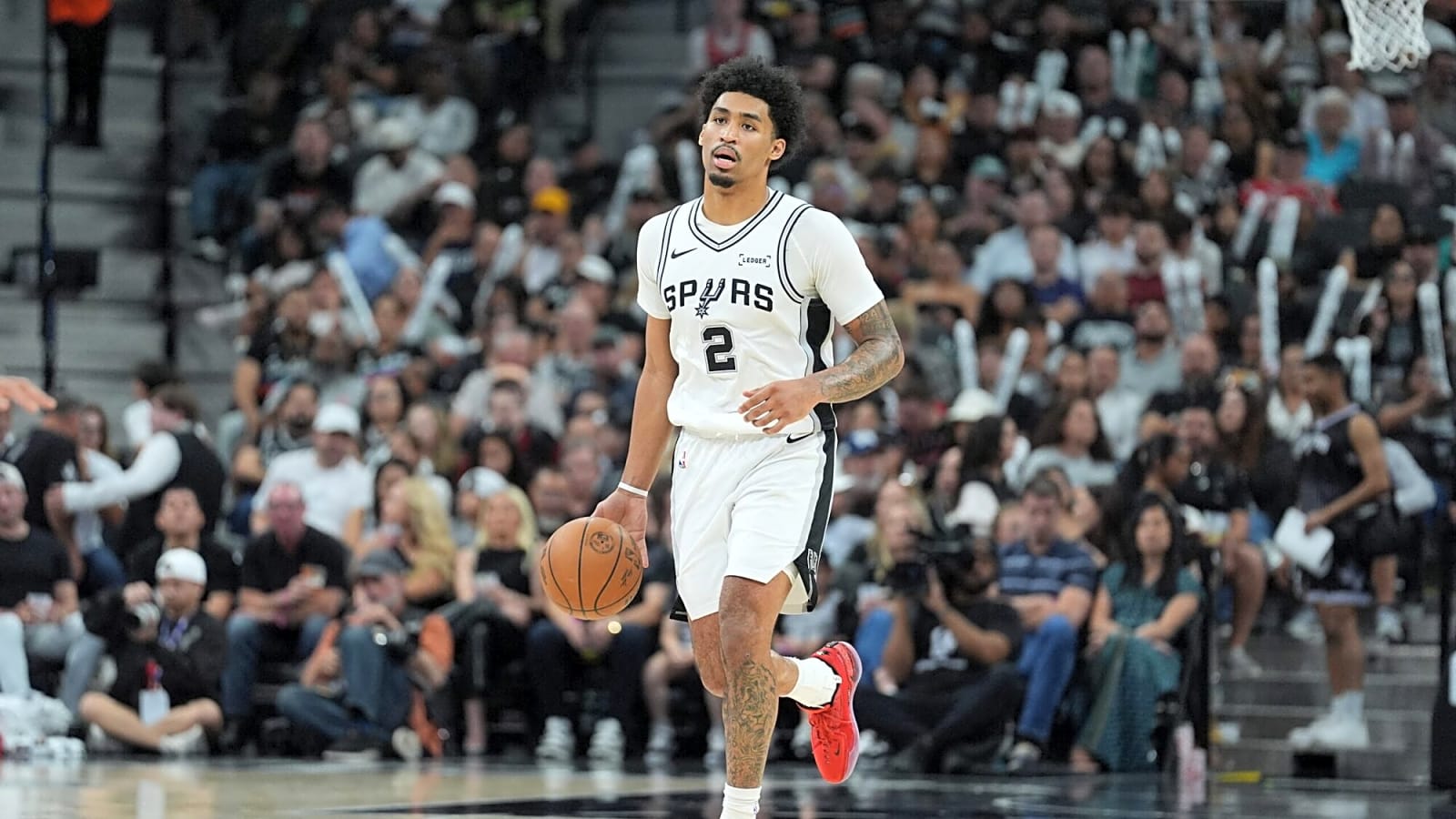
The San Antonio Spurs will be entering the 2026-27 season with one of the most promising young cores in the NBA. While Victor Wembanyama generates the most attention, players such as Stephon Castle, De’Aaron Fox, and Dylan Harper are hard to overlook. For all intents and purposes, the Spurs are geared to contend for the title. Still, assuming that there aren’t any problems is also unwise.
On paper, San Antonio features two stars, namely Victor Wembanyama and De’Aaron Fox. Theoretically, this makes for an impressive tandem. However, there appears to be an internal struggle in the guard rotation, especially with rookie phenom Dylan Harper vying for a larger role in the rotation this season.
Although Harper has joked about wanting a starting role in his sophomore year, his comments have caused a bit of a stir within the organization. While the rookie has certainly proven himself worthy, relegating De’Aaron Fox to the bench seems equally unreasonable. On that note, there has been speculation that Harper could be forcing San Antonio to embrace a 3-guard lineup.
Realistically, a 3-guard lineup isn’t an outrageous notion. When teams possess noteworthy guard depth, sacrificing some size for more efficiency and versatility isn’t the worst decision. But how exactly does this play out for the Spurs? To understand this better, we examine the pros and cons of a 3-guard lineup in the context of San Antonio’s active roster.
Spurs’ 3-Guard Lineup: De’Aaron Fox, Dylan Harper, Stephon Castle, Tobias Harris, Victor Wembanyama
Pros
To address the obvious, San Antonio boasts the luxury of playing with a 3-guard lineup. Even if Dylan Harper wasn’t the player in question, with another reliable guard in Devin Vassell on the roster, the Spurs have enough quality within their backcourt to deploy such a rotation. But what are the benefits of it?
For starters, the offensive flexibility is quite exciting. While Fox has established himself as a lethal scoring threat when attacking downhill, both Stephon Castle and Dylan Harper serve as ideal counterpoints capable of scoring from different spots on the floor, allowing the Spurs to explore more varied offensive sets.
Last season, the trio of Fox, Castle, and Harper was impressive in their own right. Fox, who was the team’s starting point guard, averaged 18.6 points, 3.2 rebounds, and 6.8 assists per game on 48.6% shooting from the field. Despite his shortcomings in the Finals, he was one of San Antonio’s most productive players.
Fox was joined by Castle in the starting backcourt. The 21-year-old guard out of UConn posted 16.7 points, 5.3 rebounds, and 7.4 assists per game on 47.1% shooting from the field, showcasing versatility in all departments as well as two-way upside.
While Castle and Fox thrived in the starting lineup, Harper served as a key player off the bench, posting 11.8 points, 3.4 rebounds, and 3.9 assists per game while shooting 50.5% from the field. Although it was his rookie campaign, the 20-year-old demonstrated incredible maturity and poise, earning himself praise from fans and players alike for his performances in the postseason.
In many ways, this is promising. But the biggest issue with 3-guard lineups involves sacrificing size for skill. So how would San Antonio compensate for this?
Honestly, the Spurs wouldn’t be compromising on size at all. Although all three players are guards, Fox (6’3″), Castle (6’6″), and Harper (6’5″) are all larger guards, with Fox surprisingly emerging as the shortest among the three. Some would argue that this would affect their defensive rotations, but when considering how reliable Harper and Castle are as wing defenders, San Antonio’s defensive structure may remain intact.
For the most part, playing with this trio of guards could transform the Spurs’ offense while maintaining the team’s defensive flexibility. In this regard, there is much to look forward to. However, the cons must also be considered before proceeding.
Cons
It is easy to get swayed by the overall promise of a 3-guard lineup, especially when considering the Spurs’ versatile backcourt. Still, one major flaw needs to be addressed before deploying such a rotation.
Although each of the three aforementioned players was individually spectacular last season, the trio barely spent time on the floor together.
The duo of De’Aaron Fox and Stephon Castle was quite impactful for the Spurs, combining for an average of 45.3 points, 17.3 rebounds, and 11.1 assists per game. Meanwhile, the Castle-Dylan Harper pairing posted 22.7 points, 8.9 rebounds, and 5.6 assists in only 9.2 minutes per game.
In comparison, the Fox-Harper pair was the backcourt duo the Spurs used with the least, averaging only 8.8 minutes per game. Although the production was notable, with 22.2 points, 8.6 rebounds, and 5.3 assists per game, San Antonio didn’t utilize this combo as often.
Much of this could be attributed to the similarities between Harper and Fox, particularly regarding scoring. Since both players are more comfortable attacking the rim, the spacing issues emerge as a minor concern for San Antonio, especially if Victor Wembanyama is operating in the post.
Thus, even though Castle has the potential to act as a solid connecting piece, his relatively average three-point shooting (33.2%) does not inspire much confidence in this approach.
Realistically, if both Harper and Castle demonstrate tangible improvement as perimeter shooters this season, embracing a 3-guard lineup isn’t out of the question. Still, building the chemistry among the three and ensuring it fits the team’s offensive schemes with Victor Wembanyama as the focal point will remain a priority.
Another issue is the overall squad depth. The distribution of talent will be vital for San Antonio as they prepare for another title push this season. Thus, even though promoting Dylan Harper to the starting lineup seems rational, the Spurs may need him to stabilize their bench and shore up the scoring in the second unit.
Overall, experimenting with the 3-guard lineup would be advised primarily to cultivate the chemistry and familiarity. But when it comes to making it their primary starting rotation, this may not be the best move.
More must-reads:
- Availability of LeBron James, Joel Embiid for 76ers' preseason opener revealed
- 76ers star LeBron James denies rumor about Joel Embiid: 'Stop the lies'
- The 'Most TD's through four games' quiz
Breaking News
Trending News


Customize Your Newsletter
 +
+




Get the latest news and rumors, customized to your favorite sports and teams. Emailed daily. Always free!
PRIVACY POLICY COOKIE POLICY CONTACT US
ABOUT YARDBARKER TERMS OF SERVICE


By using this site, you agree to our Terms of Service and Privacy Policy.
This site is for entertainment purposes only.
There is no gambling offered on this site.
Gambling Problem? Call 1-800-Gambler.
