
-

-


Follow Us
-

 On Facebook
 On Flipboard

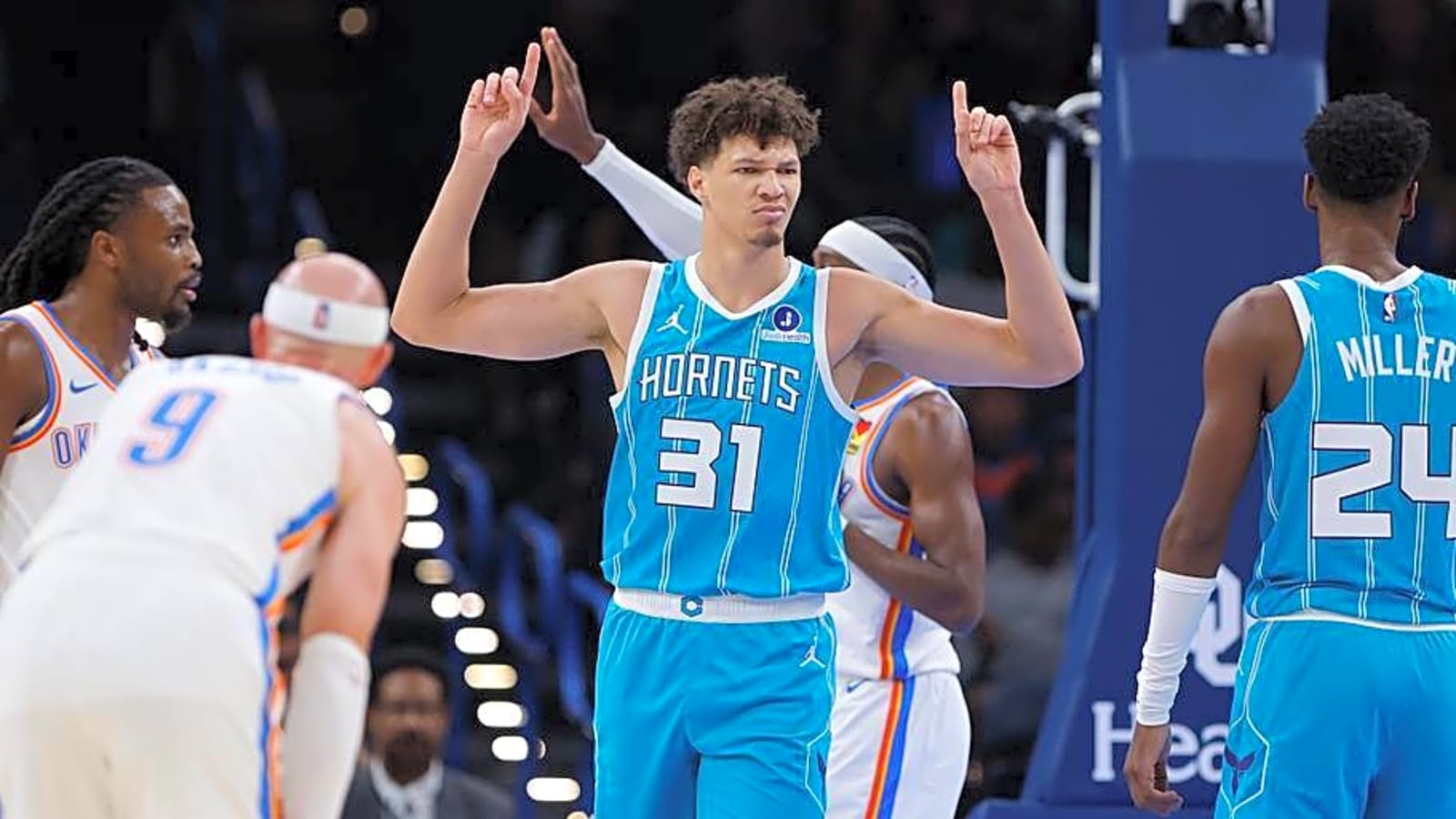
As Tidjane Salaün prepares to play in Summer League for the third time and enter his third NBA season with the Charlotte Hornets, the 20-year-old finds himself at an interesting crossroads with the organization that selected him with the No. 6 overall pick just over two years ago.
From a macro perspective, Salaün appears buried on Charlotte's forward depth chart. Over the past few weeks, the Hornets traded for Naz Reid and Dorian Finney-Smith, drafted Hannes Steinbach, who spent most of his time playing power forward at the University of Washington, and still have Grant Williams under contract, a player this front office clearly values.
As things stand in early July, Salaün's relevance to Charlotte's long-term future probably feels lower than it ever has, at least among the fan base. That had largely been my view as well. In late May, I even argued that Salaün's developmental timeline fundamentally did not fit where the franchise was headed.
Since then, though, Charlotte has undergone a pretty significant directional shift. The Hornets traded away their best player and one of their key starters from last season, making it clear the franchise is still very much in an asset-accumulation and rebuilding phase, at least for now.
Because of that, Salaün makes a lot more sense with Charlotte's current trajectory and, in theory, should have a better opportunity to carve out a legitimate role moving forward. So how does Salaün rise to the moment this summer? What growth does he need to show, and what does he already do well to make the possibility of him once again becoming a meaningful part of Charlotte's future plans a realistic one?
Defensive refinement
It has to start on the defensive end. If Tidjane wants to earn a spot in Charlotte's rotation, the growth has to be apparent, and it starts in Summer League.
For someone of Salaün's size and physical tools, he has not been much of an impact defender through two NBA seasons. His 0.6% block percentage is extremely low for a player with his frame, and his overall defensive analytical profile is not encouraging across the majority of impact metrics.
More than anything, Salaün has to do a better job of getting into his stance, moving his feet and hips laterally, and staying in front of ball handlers. If he wants to become a consistent rotation player in the NBA, that has to improve.
At his best defensively, Salaün can be effective using his long arms in passing lanes. But as a weak-side helper and rim protector, particularly for someone who stands 6-foot-10, I would really like to see him make a leap there.
One aspect of Salaün's game that is a real strength is his work on the defensive glass. He does a nice job of sticking his nose in, navigating traffic, and digging out rebounds off the rim. I would like to see more of that translate to the offensive glass, where his 4.7% offensive rebounding rate leaves plenty of room for growth.
Reasons for optimism
On the offensive end, to me, Salaün is a more polished player at the current moment, at least within the role he has been given.
An essential reason for Salaün's improvement from his rookie season was that Charlotte's coaching staff simplified what he was being asked to do offensively. Salaün was primarily deployed as a spot-up floor spacer or to attack closeouts when the ball was swung to him in the half-court. That was really the extent of his offensive role, and he was effective in that pocket.
Tidjane shot roughly 43% from 3-point range last season on a little more than two attempts per game. He also converted 70% of his attempts at the rim, a noticeable jump from his rookie season. His effective field goal percentage climbed from 41.7% to 62.6%. Within that limited role, Salaün developed into a low-usage, relatively high-efficiency offensive player.
The problematic part is still Salaün's decision-making. His 14.5% turnover percentage is fairly high for a player at his position, but he looked noticeably more confident and decisive with his reads during his time with the Greensboro Swarm and the Hornets last season.
As one of the best players on Charlotte's Summer League roster, Salaün should have more opportunities to create with the ball in his hands. I would like to see whether that part of his game has continued to develop.
What has always intrigued me about Salaün is his combination of youth, size, an excellent motor, and the competitiveness he brings every night. If he continues to shoot the ball the way he did last season, I have little doubt he will stick around the NBA for a long time.
The question is whether that future will ultimately be in Charlotte.
More must-reads:
- Thunder rookie's 2026-27 season wiped out by devastating injury
- Pablo Torre is now planning to investigate LeBron James' situation
- The '35-TD, 10-INT NFL seasons' quiz
Breaking News
Trending News


Customize Your Newsletter
 +
+




Get the latest news and rumors, customized to your favorite sports and teams. Emailed daily. Always free!
PRIVACY POLICY COOKIE POLICY CONTACT US
ABOUT YARDBARKER TERMS OF SERVICE


By using this site, you agree to our Terms of Service and Privacy Policy.
This site is for entertainment purposes only.
There is no gambling offered on this site.
Gambling Problem? Call 1-800-Gambler.
