
-

-


Follow Us
-

 On Facebook
 On Flipboard

One of the first things that happens when you sign with the Miami Heat is that somebody takes your shirt off and photographs your before picture.
Those photos live on an iPad, and the Heat pull them out for incoming players. Here’s what this man looked like when he walked in. Here’s what he looked like a year later. Here’s the contract he signed after that. James Johnson’s before-and-after became one of the franchise’s favorite exhibits, and you can understand why. It’s a strange sales pitch for a basketball team but an honest one. The Pitch? We are going to change your body, and your body is going to change your life.
I’ve spent my career doing a version of that job. I’ve run the assessments and pinched the skinfolds while sitting across from athletes and telling them a number they didn’t want to hear. What happens inside that building is a serious applied-physiology program, run with an almost unreasonable consistency.
Here are just a few of the players who arrived in Miami as question marks and left as much richer men:
• Hassan Whiteside 4 years, $98.4 million
• Duncan Robinson 5 years, $90 million
• James Johnson 4 years, $60 million
• Dion Waiters 4 years, $52 million
• Max Strus 4 years, $62.2 million
That is more than $360 million in guaranteed money paid to five men who before they arrived in Miami, were either a minimum-salary flier, a two-way project, a journeyman on a one-year deal, or a backup nobody was building around. Nobody in the NBA converts fringe rotation players into contracts at that rate. One can even argue that nobody else maximizes the physical performance peak of their players in general as well either. It’s all part of their method, and it started on day one.
Bill Foran joined the Heat in 1988, the franchise’s first season, and stayed until 2021. His son Eric, who as a small boy was photographed standing next to Miami’s first head coach, and who grew up inside the weight room, came up through the program and now runs its day-to-day operation. Two generations of the same family for nearly four decades.
One of Foran’s first case studies was the franchise’s first draft pick. Rony Seikaly came in 9th overall in 1988, a 6-foot-11 center who weighed 230 pounds and, in Foran’s own blunt telling, “got ate up” as a rookie. Seikaly spent that summer in the program and didn’t miss a workout.
He came back at 252 pounds with his body fat still sitting at 8 percent, and his vertical jump had gone up three inches. He was voted the most improved player in the league the following year. I want to sit on those numbers for a second, because they’re easy to skim past yet people don’t understand how difficult it is to gain that much weight without gaining fat.
Adding 22 pounds while holding single-digit body fat means almost every ounce of it was lean tissue. And gaining that much mass while increasing your vertical is genuinely difficult as power-to-weight normally moves in the wrong direction when a big man bulks up.
James Johnson arrived in 2016 on a one-year, $4 million contract, which was, at that point, the most money he had ever made. He was 29 years old, 7 seasons and 5 franchises deep into a career that had settled comfortably into the word journeyman. He shed roughly 40 pounds that year and got his body fat down to 6.75 percent.
In my professional experience, most NBA forwards live somewhere in the 8-to-12 percent range, and that’s already lean by any normal standard. Under 7 percent on a 6-foot-9 frame, while playing 28 minutes a night through an 82-game season, is a number you’d expect to see on a physique competitor the morning of a show. You get there through a supervised and monitored, year-round program with someone checking your work.
What came out the other side were career highs in points, rebounds, assists and three-point percentage, a sixth-place finish in Most Improved Player voting, and a four-year deal worth $60 million. He went from $4 million a season to roughly $15 million a season in 12 months. When the Heat announced the re-signing, Pat Riley said something that I think is the most revealing sentence any executive has ever said about Miami’s conditioning program:
“James Johnson epitomizes everything that the Miami Heat is about. He came in, made a promise to us and then fulfilled that promise by becoming a world class athlete thus leading to the best season he has had in the NBA.”Pat Riley
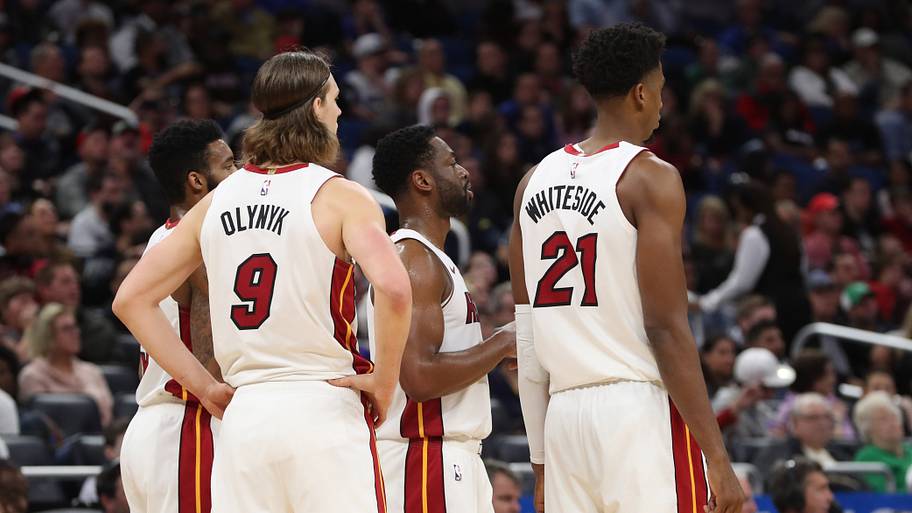
The same summer they paid Johnson, the Heat also gave Kelly Olynyk four years and $50 million. Olynyk had walked in at 258 pounds and 12.75 percent body fat which is respectable for any average person. Eventually, he got down to 232 lbs and 6% body fat. Twenty-six pounds and more than half his body fat gone. This transformation led to Olynyk averaging a career high in minutes which earned him a $1 million bonus incentive for reaching an agreed-upon minute mark.
Probably the most extreme example belongs to Hassan Whiteside, who was not in the NBA at all before Miami found him. Whiteside had been bouncing through the D-League and overseas, and by his own account had gone cold on interest from teams around the world. The Heat signed him in November 2014 for two years and $1.75 million, on the kind of contract a team can walk away from without a second thought.
Nineteen months later he signed a max contract of $98.4 million!!!
In between, he led the entire NBA in blocked shots, put up a player efficiency rating of 25 in 2015-16 — a figure that placed him in the neighborhood of David Robinson, Kareem Abdul-Jabbar, Hakeem Olajuwon, Patrick Ewing and Alonzo Mourning — and became one of only a handful of players in the league averaging a double-double. Hassan underwent a stunning physical transformation under the strict system, as he dropped to 5% body fat while weighing in at 265 lbs after years of being close to 300 lbs.
Udonis Haslem on Hassan Whiteside’s triple-doubles with blocks back in the 2015-2017 seasons:
— Hot Hot Hoops (@hothothoops) August 28, 2024
“I played around some of the greatest centers… but they couldn’t do what he did.” (via @theOGsShow)
I really thought a Bam/Whiteside frontcourt duo was the future… pic.twitter.com/XRnyIQ1yfX
Duncan Robinson came out of Division III basketball, went undrafted, and signed a two-way contract with Miami. In 2020-21 he was the only player on the Miami Heat to appear in all 72 regular-season games, while leading the team in three-point makes, attempts and percentage and ranking among the league leaders in minutes played. That summer he signed for five years and $90 million, the largest contract ever given to an undrafted player at that time.
His shooting is what made him famous but prepare his body and being consistently available is what made him rich. Nobody hands out that kind of money to a specialist who plays 55 games. Both in a HEAT jersey and now in Detroit, the job he was asked to do like sprinting off screens for 31 minutes a night, every night, is a conditioning job as much as a shooting one. He answered the bell time and time again.
He isn't alone either.
Gabe Vincent and Max Strus, both undrafted, developed in that same building and walked into significant free-agent money with the Lakers and Cavaliers. They haven't performed as they once did down in 601 Biscayne Blvd, but the pipeline made them bankable and heavily sought after post their 2023 Finals run.
So why does it work?
Well, let’s start with the fact that body composition is a mechanical input. Every pound of non-functional mass gets multiplied through the body on every deceleration, landing, and backdoor cut. The lower leg absorbs several times bodyweight with each stride at speed, we’re talking well over a thousand pounds of force, thousands of times a night. When you take 26 pounds of fat off a seven-footer like Whiteside, you’ve meaningfully lowered the cumulative load his tendons have to survive across 82 games.
The conditioning story and the availability story are undoubtedly linked.
Measurement is the main form of intervention. Every week, the strength and conditioning team delivers each player's weight and body-fat numbers directly to Erik Spoelstra. You would typically expect this to happen at the beginning of the season or even right before training camp. But this happens WEEKLY, and it is given to the man who decides your minutes.
The hips and glutes are the body's primary decelerators. When the body is strong, it can absorb force better. When they’re not, that force travels down the chain into smaller, more fragile tissue, which is how healthy athletes eventually become injured ones. A stable trunk also keeps force transferring cleanly instead of leaking into compensation patterns. Every one of those pillars is, functionally, an injury-prevention strategy wearing a strength-training costume.
Now I 'm not going to pretend a strength program is some kind of force field that protects these world-class athletes from going through injuries. Miami's system has never been an injury guarantee. The franchise has lost seasons to bad luck like everyone else, and no amount of work prevents an awkward landing or a collision. Not to mention, there have been the occasional scenarios where a player falls off after receiving their big pay day or simply gets tired of doing what is required to maximize their abilities out on the floor.
The best conditioning program on earth reduces the probability of a negative outcome but it doesn't eliminate these subpar events.
One thing is for certain in Miami, the standard is the standard . When the greatest player in franchise history, Dwyane Wade came back to Miami in 2018, a franchise legend with three championships, he’d had his body fat checked twice within weeks of walking in the door. “It’s part of what I need on this team,” he said.
No exemptions, not even for him.
More must-reads:
- Lakers are in 'advanced discussions' to trade for former lottery pick
- Celtics might pull off shocking Stephen Curry blockbuster trade
- The 'Most playoff games by NBA team' quiz
Breaking News
Trending News


Customize Your Newsletter
 +
+




Get the latest news and rumors, customized to your favorite sports and teams. Emailed daily. Always free!
PRIVACY POLICY COOKIE POLICY CONTACT US
ABOUT YARDBARKER TERMS OF SERVICE


By using this site, you agree to our Terms of Service and Privacy Policy.
This site is for entertainment purposes only.
There is no gambling offered on this site.
Gambling Problem? Call 1-800-Gambler.
