
-

-


Follow Us
-

 On Facebook
 On Flipboard

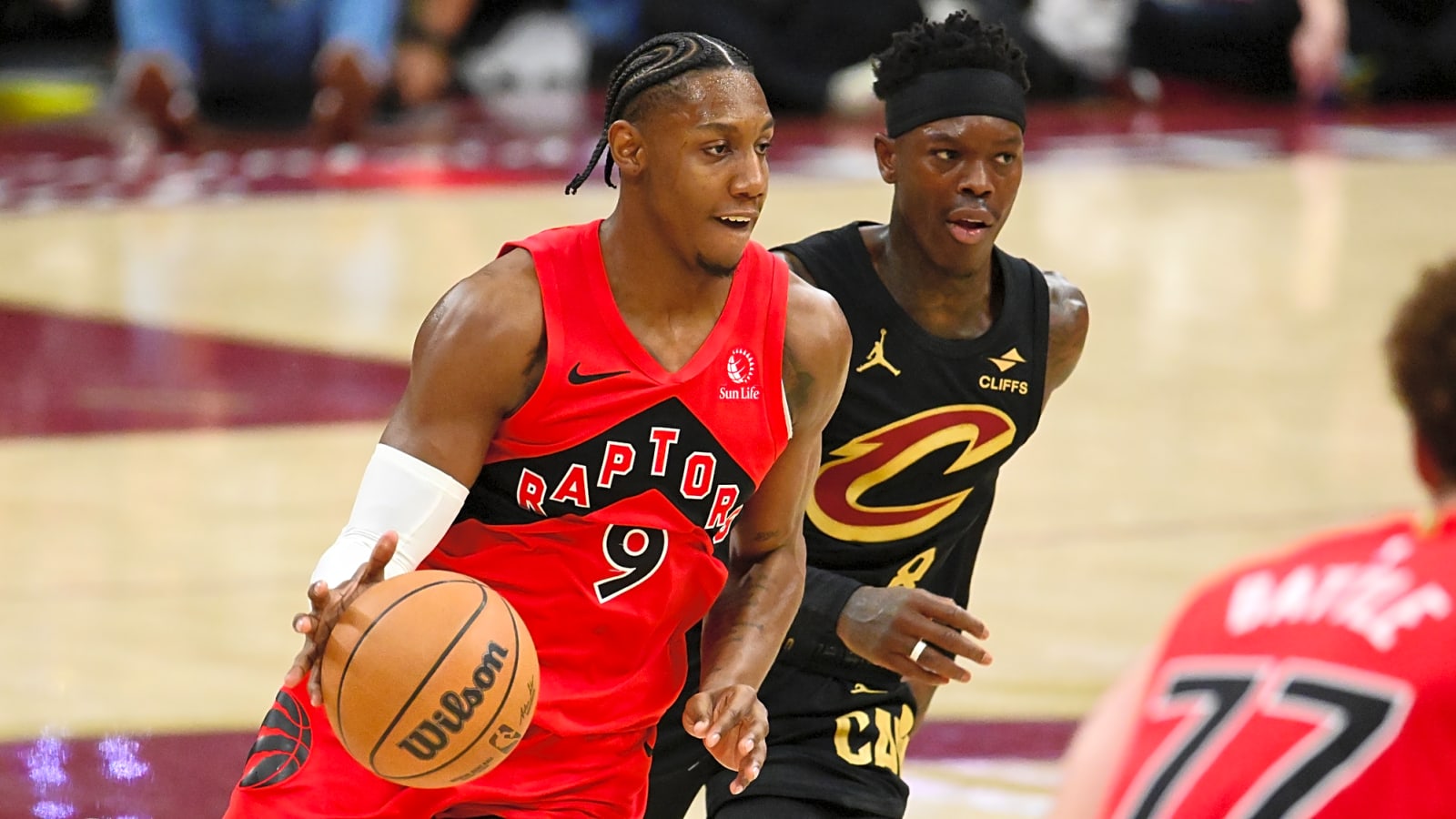
I don’t think it’s possible to describe the soul-baring trial that is the NBA playoffs better than Raptors Republic head honcho Louis Zatzman did ahead of Game 3 of the Toronto Raptors and Cleveland Cavaliers’ first-round playoff series:
“In a lot of ways, the playoffs are a crucible, where everything distills down to just your core.”
Over the course of a seven-game series, teams learn each other inside out. No tricks remain up sleeves. There’s no more beating around the bush. It’s your biggest and best gun against mine. May whoever has the most firepower win.
We didn’t see Gradey Dick running second-side actions (or see him much at all for that matter) or Ja’Kobe Walter handling in pick-n-roll. Instead, it was Scottie Barnes and RJ Barrett ramming it down the Cavs’ throats. Smashmouth basketball. Meanwhile James Harden and Donovan Mitchell powered Cleveland to the most prolific and prosperous pull-up shooting performance of the first round. The big guns came out.
Darko Rajaković gave me a straightforward answer on what the Raptors learned about themselves in the context of the playoffs at his season-end availability.
“It’s not about complicated plays, it’s about making simple plays, and it’s about execution of those simple plays,” the coach said. “… There’s going to be a lot of physicality. It’s not going to be easy just to come in pick-n-roll and create those gaps, to create those advantages. So just like really working on fundamentals of the game.”
Defences adjust and adjust in the playoffs until they reach the end of the rope. Teams are so keyed in on their opponent’s pet actions that it ultimately isn’t really the action creating the advantage anymore. It’s the players’ talent, physicality, and how that matches up with the man across from them.
So, what did the Raptors learn as they melted down to their essence in that seven-game crucible against the Cavs? Let’s dive in.
Their defence is built for the playoffs
On the surface, Toronto’s defensive performance in the first round doesn’t grade out particularly well statistically. We can throw that away.
Adjustments are paramount in the playoffs, and after getting torched through Game 1 and into Game 2 by Harden and Mitchell in ball screen actions, the Raptors made big changes, successfully tilting the dynamic into their arduous and chaotic wheelhouse.
They drastically switched up defensive matchups. Barnes left his patrol of the backline and guarded Harden to great success. Barrett first took Evan Mobley and then Jarrett Allen and did an extraordinary job both using his strength to bump them out and picking up pick-n-roll coverages as a screener-defender on the fly. Collin Murray-Boyles locked up a gauntlet of All-Stars and All-NBAers at age-20.
But most critical to their success was the versatility and ground coverage Barnes and Murray-Boyles provided. Their ability to recover one pass away out of switch-to-blitz coverages was uncanny. That pairing’s capacity to play stifling defence across the full spectrum of positions may be the single most promising aspect of the Raptors’ playoff performance and the team’s future. It provides them with unique and daunting defensive looks to throw at opposing offences, and the duos’ adaptability will allow them to continue finding distinctive playoff adjustments going forward.
Toronto proved its core has the makeup to win grindy, low-scoring basketball games. That the Raptors were able to win so many games while shooting poorly is a testament to them excelling in so many other areas of the floor – defensively, playing fast, playing up in the paint despite their lone seven-footer often appearing hobbled. Prepare for more horrifically beautiful showings like Game 4 in the future. That is unless the team can ameliorate some of their offensive woes – starting with pull up shooting.
Toronto is now 8-4 when they shoot below 26% from three this season. https://t.co/ZU6tdu4iW3
— Keerthika Uthayakumar (@keerthikau) April 26, 2026
They need more pull-up shooting
Zatzman wrote a piece after last season’s playoffs that made a compelling case for both winning the possession battle and pull-up shooting being the two foremost factors driving playoff success. It’s an excellent, extended look into playoff basketball and I recommend reading it if you haven’t.
As far as the Raptors are concerned, they do work to win the possession battle. Maybe not as hard as they once did under Nick Nurse, but hard enough. When it comes to the pull-up shooting half of the equation though, they are utterly bereft.
In their first-round series, the Raptors attempted only 3.9 pull-up 3s per game. It was a full 3.6 less than the second-ranked Houston Rockets, the same as the gap between the Rockets and the New York Knicks, who ranked ninth-last. Toronto didn’t even make one until the fourth quarter of Game 3 when RJ Barrett – a known non-pull-up threat – canned a pair. there were 12 players that averaged more pull-up 3s per game than Toronto did in the first round.
This number surely would’ve been higher had their most proficient long-range pull-up shooter, Immanuel Quickley, been available. But not significantly. This is not a new problem. The Raptors have ranked last in pull-up triples for consecutive seasons. Their 4.9 in the regular season met similar woeful criteria as their playoff number.
This is of particular concern as the playoff win correlation of pull-up effective field goal percentage has increased from 10 percentage points last year to 20 so far this postseason – teams win 61 percent of the time when shooting better on pull ups in the regular season and win 81 percent of the time in the playoffs.
There was a time at the start of the season where I thought the Raptors newfound pull-up shooting prowess was propelling them into a new age. That was fool’s gold. They may need to actually add or develop more players that can take and make difficult shots to attain greater success in the future though.
Darko is adept at making adjustments
Rajaković thoroughly outfoxed reigning Coach of the Year Kenny Atkinson. Both in the aforementioned defensive adjustments and in how he maximized his ailing roster.
The Raptors didn’t have the threat of Quickley’s deep ball to stretch the floor. Brandon Ingram was putrid and then unavailable as he struggled through a heel injury that would eventually require surgery.
Still Toronto, led by Rajaković, was one step ahead at every turn. He pulled the help from unorthodox places lever – which in turn sparked Toronto’s much-needed transition game. He pushed the force-Cleveland-to-use-Mobley (their non-preferred screening parter) in-actions button, testing the viability of Cleveland’s two-big lineups, which were so vital for their rim defence and offensive rebounding, two series-defining factors. He even broke the glass to use Toronto’s emergency Jamison Battle.
More, his pen was deft. Those simple actions he spoke of came in droves of hot-stove screens, ghosts and ghosts into flares, and Gut DHO’s. His willingness to ramp up Toronto’s guard-screen usage was crucial.
There was plenty of healthy (and surely also unhealthy) debate around if Rajaković had chops as a playoff coach entering this postseason. It’s safe to say he put those questions to bed after guiding the Raptors to Game 7 against a more talented Cleveland squad with aplomb.
Now that Rajaković is expected to get an extension – according to a report from Sportsnet’s Michael Grange – we may well get to see him lead this team with their fearsome defensive identity and fledgling offence into another playoff crucible.
More must-reads:
- Five huge questions after the wild NBA Draft Lottery
- 13-year NBA veteran Jason Collins dies at 47
- The 'Active NBA double-double leaders' quiz
Breaking News
Trending News





Customize Your Newsletter
 +
+




Get the latest news and rumors, customized to your favorite sports and teams. Emailed daily. Always free!
PRIVACY POLICY COOKIE POLICY CONTACT US
ABOUT YARDBARKER TERMS OF SERVICE


By using this site, you agree to our Terms of Service and Privacy Policy.
This site is for entertainment purposes only.
There is no gambling offered on this site.
Gambling Problem? Call 1-800-Gambler.
