
-

-


Follow Us
-

 On Facebook
 On Flipboard

The phone kept ringing, but not from NFL front offices. Russell Wilson sat in free agency limbo, 37 years old, a Super Bowl ring on his finger and 121 career wins on his résumé. CBS Sports wanted him behind a desk. The New York Jets dangled a contract. And former All-Pro Aqib Talib went on air and told him, flat out, to stop fighting it. Fourteen seasons, 353 touchdown passes, and the loudest voice in the room belonged to a television network, not a head coach.
From $245 Million to the Vet Minimum
The fall started in Denver. The Broncos traded multiple first-round picks for Wilson in 2022 and immediately handed him a five-year, $245 million extension. Two years later, they released him and absorbed an $85 million dead-cap hit, the largest in NFL history. Denver paid more to get rid of him than most franchises spend to build a roster. Wilson landed in Pittsburgh on a veteran-minimum deal worth roughly $1.2 million. That pay cut, from approximately $49 million a year to $1.2 million, tells you everything the league thought about his trajectory.
The Giants Gave Him One More Shot

New York signed Wilson to start in 2025, and for a moment, the narrative looked salvageable. Then head coach Brian Daboll benched him after three games in favor of rookie Jaxson Dart. It marked the first time in Wilson’s 14-year career he lost a starting job. The demotion kept going. Third string. Then a healthy scratch, not even dressing on game day. The quarterback with one of the strongest passer-rating marks in MetLife Stadium history couldn’t get on the field in that same building.
“I’m Not Blinking”
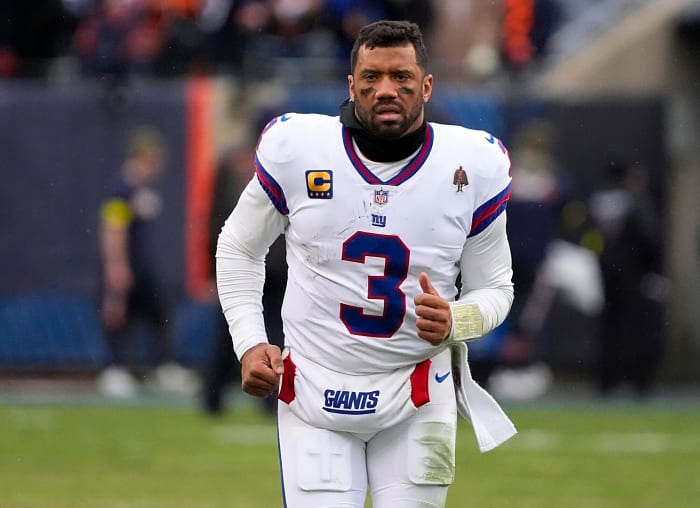
Wilson refused to accept it. “I’m not blinking,” he told reporters. “I know what I’m capable of.” He revealed he played through an undisclosed grade-two hamstring tear before Week 2, sneaking off to the Dallas Mavericks’ facility for treatment because he “couldn’t tell anybody.” Grit like that used to earn standing ovations. Now it raised questions about judgment. The league once prized his mobility. It watched him cite a hidden injury as proof of toughness while his declining physical tools told a different story entirely.
The Conveyor Belt Nobody Talks About

Here is the mechanism underneath all of it. The modern NFL runs an implicit pipeline: franchise centerpiece to cap liability to television asset. Salary-cap math, analytics-driven roster building, and a media ecosystem hungry for ex-quarterbacks combine to push aging stars off the field faster than they can emotionally process. Wilson went from a $245 million investment to an $85 million write-off to a valuable TV brand in three years. The calls for retirement aren’t personal judgments. They’re the final step in an institutional process designed to extract value at every stage.
The Numbers That Haunt the Debate

Wilson’s career stats belong in Canton. A winning record well above .600. Nine playoff victories. Ten Pro Bowl selections, with his 10th coming as a replacement during his 2024 season in Pittsburgh. He ranks among the greatest dual-threat quarterbacks ever, with more than 5,000 career rushing yards and 31 rushing touchdowns. Every eligible passer with more than 121 career wins is already in the Hall of Fame. And yet CBS Sports, not an NFL franchise, made the most aggressive pitch for his services this offseason. The résumé screams legend. The market whispers something else entirely, and that gap is widening by the week.
Who Pays the Price Next

Denver’s willingness to eat a record dead-cap charge to reset at quarterback sent a signal to every front office in football. If a team will absorb $85 million to escape a bad extension for a Super Bowl champion, no aging passer’s contract is safe. Other veteran quarterbacks nearing the back end of their primes should be watching closely. Wilson’s saga is becoming the cautionary tale general managers cite when they refuse to hand long, expensive deals to players over 30. The ripple effect has already started reshaping how teams think about commitment.
Seattle Won Again Without Him

Wilson led the Seahawks to their first Super Bowl title in February 2014, capping the 2013 season with a 43-8 rout of Denver. Seattle won another one in February 2026, beating New England 29-13 in Super Bowl LX, years after trading him away. That second championship decoupled the franchise’s identity from its former star and proved organizations can thrive after moving on. CBS Sports is reportedly in “deep discussions” to place Wilson on The NFL Today, replacing Matt Ryan. The precedent is stark: the league doesn’t just move past aging quarterbacks. It builds a comfortable television chair for them on the way out, whether they’re ready to sit down or not.
The Jets Offer and the Closing Window

Wilson visited the Jets and received a contract offer. “They offered me, and I’m trying to figure out what the next best thing is for me to do,” he said. He acknowledged the TV opportunity directly: “I still know I can play ball at a high level, but also I have an opportunity to do TV analysis, so we’ll see what happens.” Another year of clipboard duty or poor play could permanently cement the “tarnished legacy” narrative that CBS Sports and former teammate Richard Sherman have already started writing.
The Choice That Defines the Legacy

Talib told Wilson to “do your TV thing” and declared, “It’s over with, man.” That bluntness stings because it echoes what the market already decided. Players and agents watching this may start negotiating TV deals and exit clauses earlier in their contracts, treating post-playing careers as strategy rather than afterthought. Wilson’s choice before the 2026 season will shape how a generation of aging stars manages the end. Walk into the Jets’ huddle or sit in the CBS chair. Either way, the league, not the legend, picked the menu. Would you rather see Russell Wilson take one more shot with the Jets or trade the huddle for a CBS studio chair? Tell us in the comments — and which veteran QB do you think gets the same phone call next?
More must-reads:
- Notre Dame HC Marcus Freeman already being linked with one NFL team
- Update shares if NFL is on track to expand to 18-game regular season for 2027
- The '3 3-pointer, 3-block Playoff games' quiz
Breaking News
Trending News


Customize Your Newsletter
 +
+




Get the latest news and rumors, customized to your favorite sports and teams. Emailed daily. Always free!
PRIVACY POLICY COOKIE POLICY CONTACT US
ABOUT YARDBARKER TERMS OF SERVICE


By using this site, you agree to our Terms of Service and Privacy Policy.
This site is for entertainment purposes only.
There is no gambling offered on this site.
Gambling Problem? Call 1-800-Gambler.
