
-

-


Follow Us
-

 On Facebook
 On Flipboard


The engagement post read like a joke between homeroom teachers: “Your English teacher and your gym teacher are getting married.” Cute. Casual. The kind of caption that makes you forget one half of this couple anchors a business empire valued at roughly $12.2 billion and the other catches footballs for a living. Travis Kelce and Taylor Swift announced their engagement on August 26, 2025, and reports indicate Kelce had asked Scott Swift for his blessing in the weeks leading up to the proposal. Everything about it felt warm, easy, uncomplicated. But one detail behind the scenes told a different story entirely.
A Name Worth More Than Rings
Before any venue was finalized, before guest lists circulated, Taylor Swift had reportedly already settled the biggest off-paper question of the marriage. Not the date. Not the dress. The name. Sources close to Swift told outlets she has “pretty strong opinions” about keeping her surname. That might sound like standard celebrity posturing until you see the number underneath it: 438 trademark listings worldwide, spread across at least 16 jurisdictions, all built on five letters. Bookmakers have priced the odds of no name change at an overwhelming 83.3%.
What 80% of Women Still Do
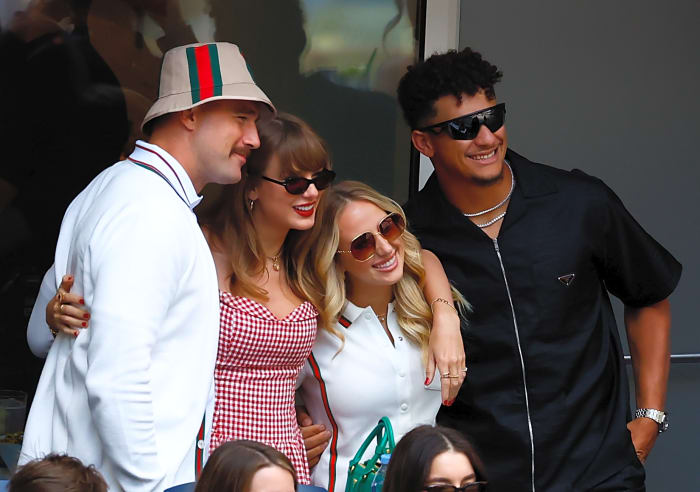
Here is the assumption most people carry into this story: even powerful women eventually take their husband’s name. The data backs that up. More than 80% of women still adopt their husband’s surname after marriage, a tradition rooted in historical laws that literally made women into men’s property. Lucy Stone challenged that norm back in 1855, and the number has barely budged in the centuries since. So the expectation around Swift felt automatic. She’d keep it professionally, maybe, but legally? Tradition usually wins. Except tradition had never run into 300 trademark applications.
Not Even for Travis

A source close to Swift put it bluntly: “When she gets married, it’s on her terms. And that Swift name’s not changing.” Another went further. “She’s not giving that up. Not even for Travis.” That phrase lands differently when you understand what “that” refers to. Over 300 US trademark applications filed through TAS Rights Management, LLC. An enterprise valued at $12.2 billion. Trademarks covering song titles, tour names, even her three cats. Changing the name would mean unwinding a legal empire. Five words. Twelve billion dollars. Done.
The Machine Behind the Name

Think of it like a Fortune 500 company being asked to rebrand after a merger. No board would approve it. Swift’s operation functions the same way. Analysts describe “Taylor Swift, Inc.” as a “trophy asset” with value anchored in catalogue ownership, repeatable touring economics, and direct-to-consumer sales. The estimated EBITDA sits around $804 million, carrying a 15.0x multiple. Her brand represents consistent storytelling, premium value creation, and community engagement that extends far beyond music. Changing the name on that asset would be like Coca-Cola rebranding because the CEO got married.
The Numbers That Killed the Debate

Swift trademarked her cats’ names. Meredith, Olivia, and Benjamin Swift all have filings. She trademarked phrases, tour titles, and signature sayings across 16 jurisdictions globally. Then, in April 2026, TAS Rights Management filed new applications with the US Patent and Trademark Office to protect her voice and likeness from AI-generated mimicry. A woman protecting her voice from digital theft while people debated whether she’d surrender her actual name to a marriage certificate. That contrast tells you everything about where her priorities sit, and where the tradition of automatic name changes stands in 2026.
The Ripple Beyond the Wedding
Swift’s decision doesn’t stay inside her marriage. It radiates outward. The wedding industry may need to adapt its language and services for brides who keep their names. Trademark protection for personal names could become standard among high-earning professionals who realize their identity carries financial weight. Their mothers, Andrea Swift and Donna Kelce, have made joint public appearances signaling the families have already absorbed this. The personal choice becomes an industry precedent the moment someone tied to a $12.2 billion empire makes it publicly.
Every Marriage Is Now a Merger

Once you see it, you cannot unsee it: every high-profile marriage has become a branding decision with financial and cultural implications. The surname question stopped being about romance the moment celebrity identities became registered assets. Swift didn’t invent this reality, but she made it impossible to ignore. The precedent now sits in plain view. When your name underpins an estimated $804 million in annual EBITDA, “taking his name” stops being a gesture of love and starts being a corporate restructuring. That reframe changes the conversation for every professional woman watching.
The Wedding Clock Is Ticking
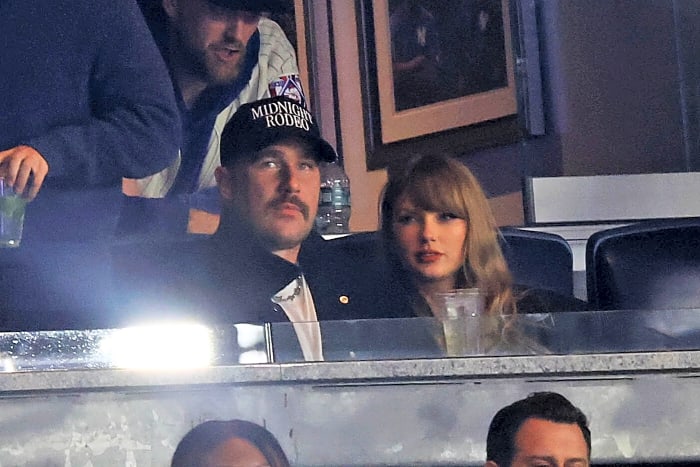
Page Six first reported in December 2025 that Swift and Kelce plan to marry on Saturday, June 13, 2026 — a date tied to Swift’s lucky number 13. Reporting placed the venue at the Ocean House resort in Watch Hill, Rhode Island, just steps from Swift’s roughly $17.75 million seaside estate. House-hunting rumors near an $18 million mansion in Hunting Valley, Ohio have also surfaced. Every detail gets dissected. But the name question is already answered, and the wedding hasn’t even happened yet.
The Battle He Never Needed to Fight

For all his rings and records, this is the rare matchup where the Chiefs’ tight end quietly takes the L, not because he fought and lost, but because the rules changed before he suited up. The tradition that once gave husbands automatic claim to the family name now runs headfirst into trademark law and billion-dollar balance sheets. Some men in future celebrity relationships may consider taking their wife’s name as a status symbol. Kelce doesn’t need to. He already won the bigger prize. He just won’t see his surname on the marquee. So here’s the question worth fighting about: if your name was worth $12.2 billion, would you change it for love — or would you make your partner take yours instead? Tell us where you land in the comments.
More must-reads:
- What Eagles reportedly will get from Patriots for A.J. Brown
- Packers have one obvious replacement for Josh Jacobs
- The 'Active playoff double-doubles' quiz
Breaking News
Trending News







Customize Your Newsletter
 +
+




Get the latest news and rumors, customized to your favorite sports and teams. Emailed daily. Always free!
PRIVACY POLICY COOKIE POLICY CONTACT US
ABOUT YARDBARKER TERMS OF SERVICE


By using this site, you agree to our Terms of Service and Privacy Policy.
This site is for entertainment purposes only.
There is no gambling offered on this site.
Gambling Problem? Call 1-800-Gambler.
