
-

-


Follow Us
-

 On Facebook
 On Flipboard

New England just committed $68 million in base value, potentially $80 million with incentives, to Romeo Doubs. A four-year deal for a receiver who caught 55 passes and posted 724 yards last season in Green Bay. The man he replaces, Stefon Diggs, caught 85 balls for 1,013 yards before the Patriots cut him loose. More money. Fewer catches. And anonymous NFL executives are already torching the move publicly. The obvious reaction is sticker shock. The real story is where this ripple travels next.
Why Desperation Sets the Price
Diggs’ salary cap charge was ballooning from $10.5 million to $26.5 million. That forced the release. But releasing a productive receiver mid-contract creates a desperation window, and the NFL’s free agency market prices panic, not talent. Doubs ranked just 28th among 2026 free agents despite that massive contract. The Packers accepted a 2027 fourth-round compensatory pick without counter-bidding. Green Bay knew the Patriots were overpaying. They let it happen. That pricing mechanism now ripples through New England’s entire roster construction.
The Grocery Bill Gets Worse
At roughly $17 million per year, Doubs costs Patriots fans a WR1 budget for WR2 production. Diggs delivered 85 receptions at a lower annual rate. Doubs delivered 55. That production gap means Drake Maye loses approximately 30 targets worth of proven reliability per season. For a quarterback who absorbed 21 playoff sacks across the Super Bowl LX run, the most in a single postseason in NFL history, fewer reliable targets compounds an already brutal pressure problem. The on-field downgrade hits Maye hardest.
The Roster Domino Effect

While locking in Doubs at $70 million, the Patriots let K’Lavon Chaisson walk to Washington for a one-year, $12 million deal. A proven pass rusher, gone for a fraction of the receiver’s cost. New England then signed Dre’Mont Jones for three years and $39.5 million, plus Alijah Vera-Tucker at three years and $42 million with unusual $250,000 per-game roster bonuses. The spending spree looks aggressive until you map the departures against the arrivals. Chaisson’s edge production left town, and nobody replaced it.
The System That Can’t Fix the Flaw
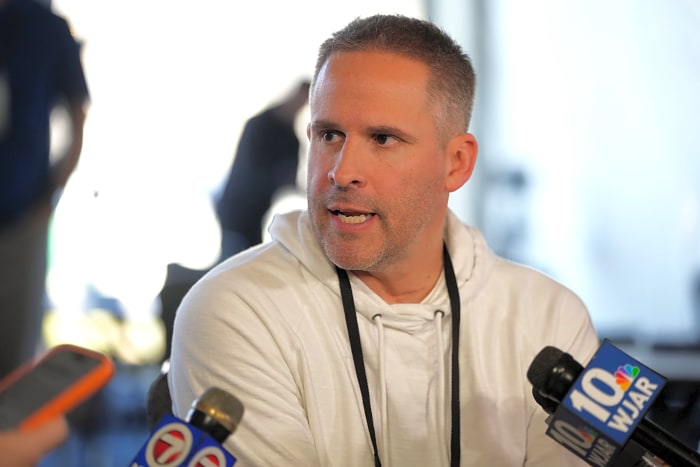
Here is where it crosses into territory nobody expected. Josh McDaniels’ offense requires receivers who read coverages and adjust routes after the snap. Doubs ran just 17.9 percent of his routes from the slot in Green Bay. The Patriots plan to increase that number. But executives specifically cited “inconsistent concentration” as his core weakness. That flaw is manageable in Green Bay’s spread-the-wealth scheme. In a system demanding heightened cognitive processing on every snap, concentration lapses become drive-killers. The Patriots bet $70 million that coaching fixes a brain problem.
Same Budget Problem, Different Name

Follow the money backward. Patriots released Diggs because his cap charge was unsustainable. Then signed Doubs to a nearly identical total commitment. Diggs: $69 million over three years. Doubs: $68 million base over four. The cap problem transferred. It never solved. One receiver contract replaced another, stretching the obligation an extra year through 2029. That timeline collides directly with Drake Maye’s rookie deal expiration and extension window. Cap dollars spent on Doubs are cap dollars unavailable for Maye’s next contract. Same trap, longer sentence.
The Executive Verdict
One unnamed NFL executive put it plainly: “I was not high on Doubs. They did not improve on the field from (Stefon) Diggs.” A second cited the need for “maybe slightly more consistency and concentration.” Two independent voices. Same conclusion. The industry consensus formed fast and landed hard. When every evaluator outside Foxborough sees the same flaw, the flaw tends to be real.
The Precedent Nobody Wants

Mike Vrabel and Eliot Wolf just created a case study every front office will reference. If Doubs thrives, internal conviction beat peer consensus. If he falters, the narrative becomes a franchise that ignored industry wisdom for system faith. Either way, opposing general managers now understand something valuable: the Patriots overpay when filling gaps under pressure. Future trade partners will exploit that. Draft-pick negotiations get more expensive. Free agent prices inflate when New England comes calling. The desperation-window bias is now public knowledge across 31 other front offices.
Winners, Losers, and the Math

Green Bay won cleanly. Let a mid-tier receiver walk, collected a 2027 fourth-round pick, and watched someone else absorb the risk. Washington won too, grabbing Chaisson’s proven edge production for $12 million. The Patriots? They hold a four-year commitment to a player who posted a career-low 3.5 percent drop rate only after struggling with drops for three straight seasons. Improvement, sure. But Doubs accumulated 202 receptions, 2,424 yards, and 21 touchdowns across four full years. Solid. Not $70 million solid.
The Cascade Keeps Moving

If Doubs drops below 50 catches or 600 yards in 2026, the trade market evaporates and dead money accumulates through 2029. That dead money lands precisely when Maye’s extension negotiations begin. The Patriots would face an impossible choice: pay the quarterback or eat the receiver’s ghost contract. Meanwhile, every team watching just learned the real lesson. The NFL’s free agency market rewards patience and punishes panic. Green Bay understood that. New England paid $70 million to prove it.
Sources:
“NFL Execs Question Patriots’ Decision to Sign Their Top Free Agent.” MusketFire, 5 Apr. 2026.
“Patriots Notebook: What to Expect from Newest WR Romeo Doubs.” ESPN, 28 Mar. 2026.
“Stefon Diggs Turns Down Patriots’ Contract Restructure as $26.5M Cap Hit Sparks Release.” Times of India, 4 Mar. 2026.
“Maye Sets Postseason Record for Most Sacks Taken in Super Bowl Loss.” The Score, 19 Feb. 2026.
More must-reads:
- Former NFL executive sounds alarms about Ravens, Lamar Jackson situation
- New Browns HC Todd Monken addresses Myles Garrett decision amid trade rumors
- The 'Rushing-TD leaders by NFL team' quiz
Breaking News
Trending News



Customize Your Newsletter
 +
+




Get the latest news and rumors, customized to your favorite sports and teams. Emailed daily. Always free!
PRIVACY POLICY COOKIE POLICY CONTACT US
ABOUT YARDBARKER TERMS OF SERVICE


By using this site, you agree to our Terms of Service and Privacy Policy.
This site is for entertainment purposes only.
There is no gambling offered on this site.
Gambling Problem? Call 1-800-Gambler.
