
-

-


Follow Us
-

 On Facebook
 On Flipboard


From holdouts to murder charges, Foxboro has seen some summers
Every NFL training camp brings optimism, and the New England Patriots — more than almost any franchise — have spent the last two decades manufacturing it. Bill Belichick’s program was built on a culture of discipline and preparation that made other organizations look disorganized by comparison. Most summers, it held. Some summers, it didn’t.
What follows are the six worst training camp periods in Patriots history since 2005: the summers that exposed cracks in the foundation, imploded high-profile signings, turned the practice field into a circus, or — in one case — shattered the illusion of the Patriot Way entirely.
6. Randy Moss Demands Out, 2010
Randy Moss arrived in New England via trade in 2007 and immediately became one of the most electric players in franchise history, setting the all-time single-season touchdown reception record alongside Tom Brady during the 16-0 regular season. By 2010, that version of Moss was gone, and so was his relationship with the organization.
The fracture began before camp opened. Belichick told Moss in February that the team had no plans to extend his contract beyond the 2010 season. Moss showed up to camp that July but told his agent to ask the Patriots for a trade — a request that became an open secret in Foxborough. Belichick, characteristically, tried to manage the situation publicly by approaching Moss about extension talks at camp. Moss reportedly rebuffed him.
The situation never recovered once the season began. Four weeks into the regular season, during halftime of a Monday Night Football win over Miami, Moss confronted quarterbacks coach Bill O’Brien over play-calling — arguing that he wasn’t getting enough targets. O’Brien didn’t take kindly to it. The exchange escalated, and reports of a separate practice altercation between Moss and Brady followed days later. The Patriots dealt Moss to the Vikings two days after the O’Brien blowup, on October 6, for a third-round pick. What had started as a quiet trade demand at training camp ended in one of the more combustible exits in franchise history.
5. Cam Newton’s Three Missing Practices, 2021
Cam Newton entered the 2021 training camp as the incumbent starter after leading the Patriots to an unusual 7-9 season in 2020 — the first losing record for the franchise in 20 years, though COVID protocols and a roster stripped of veterans made context essential. Newton had held the job heading into that summer, and the expectation was that he and rookie first-round pick Mac Jones would compete through August.
What nobody expected was Newton to miss three consecutive practices in the middle of camp due to a COVID-19 protocol misunderstanding. Newton had traveled to an approved out-of-town medical appointment, but used a testing facility that was not certified by the NFL — triggering a mandatory five-day re-entry process under the 2021 NFL-NFLPA protocols. He tested negative for COVID throughout. The absence was avoidable and entirely procedural. It was also decisive. Those three missed days handed Jones extended first-team reps at the precise moment when the quarterback competition was most consequential. Jones seized them. He outperformed Newton in every preseason game, and by August 31 — final cutdown day — the Patriots released Newton and named the rookie starter without warning.
Newton later said he didn’t believe Jones had beaten him out and that he would have accepted a backup role if asked. He wasn’t asked. Three missed practices in July effectively ended his time in New England before September arrived.
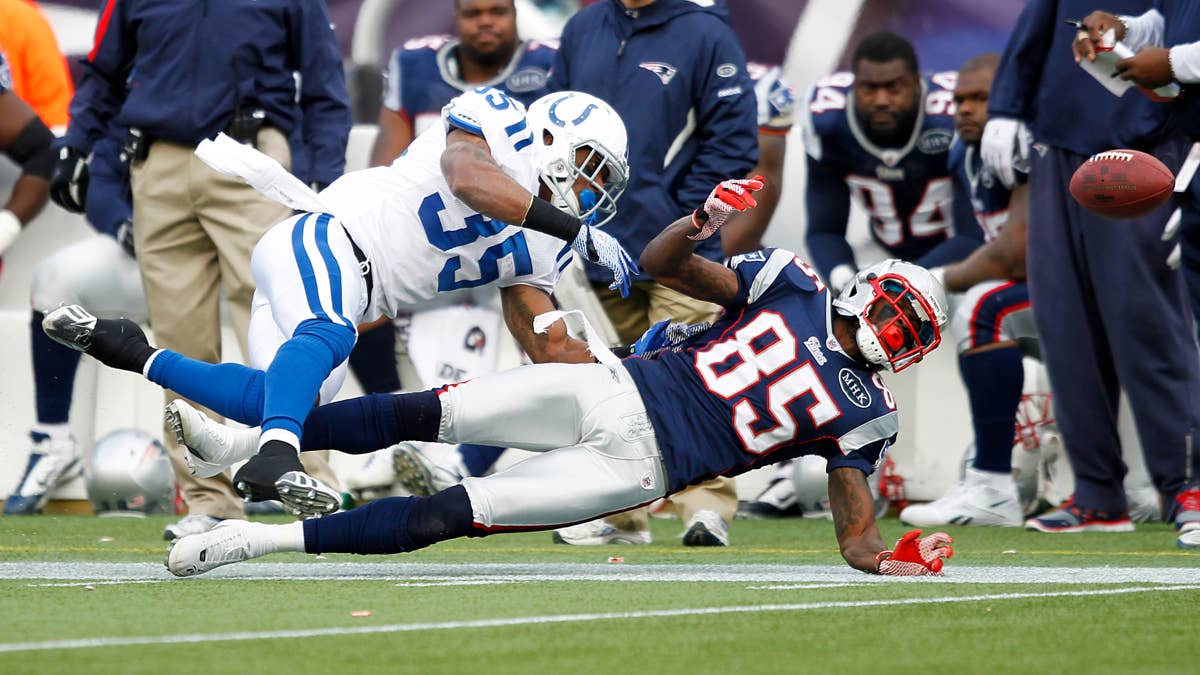
4. The Double Bust: Haynesworth and Ochocinco, 2011
The 2011 offseason looked like a statement from Belichick. The Patriots signed defensive tackle Albert Haynesworth from Washington — where he had been a spectacular failure on a $100 million deal — betting the Patriot Way could rehabilitate him. They also traded for wide receiver Chad Ochocinco from Cincinnati, pairing him with Tom Brady in what should have been a perfect scheme fit for a six-time Pro Bowl receiver.
Neither bet paid off.
Haynesworth showed up to camp out of shape and was held out of practice while working through conditioning requirements. A pending assault charge from Washington — involving an incident at a hotel bar — kept him off the field intermittently as the legal situation played out publicly. He never got into game shape, and by the time he was playing real snaps in November, he had three tackles in six games. The definitive end came during a Week 9 game against the Giants, when Haynesworth had a sideline shouting match with defensive line coach Pepper Johnson — with Belichick and defensive captain Jerod Mayo intervening on the sideline. He was released two days later.
Ochocinco’s failure was quieter but more complete. He couldn’t absorb the Patriots’ complex playbook, needed Brady to walk over and explain calls at the line of scrimmage, and caught 15 passes for 276 yards for the entire season — the worst totals of his career. He was inactive for the AFC Championship and released the following offseason.
Two high-profile acquisitions. One training camp. Zero return.
3. Deflategate and the Summer of Suspense, 2015
Tom Brady’s four-game suspension for the Deflategate ball-pressure controversy was announced in May 2015. He appealed immediately. The NFL’s appeal hearing was scheduled for June. The decision wasn’t upheld until July 28 — roughly the first day of Patriots training camp.
What followed was one of the most surreal training camp environments in NFL history. Brady was legally permitted to attend camp, practice, and play in the preseason — his suspension applied only to regular-season games — but the backdrop of the ongoing legal battle turned every practice into a media event.
The simultaneous drama included Belichick’s refusal to engage with any question about the investigation, Brady training with his legal team filing appeals in federal court, and the franchise losing a first-round pick and a fourth-round pick as organizational penalties.
Brady ultimately had his suspension vacated by a federal court in early September — two weeks before the season opened — only for an appeals court to reinstate it the following spring for the start of 2016. The summer of 2015 was six weeks of practiced denial in Foxborough while one of the most significant legal battles in NFL history unfolded in parallel.
2. The Offensive Coordinator Void, 2022
When Josh McDaniels left for the Las Vegas Raiders head coaching job after the 2021 season, he took with him the institutional knowledge of the Patriots’ offensive system he had spent two decades building. The question heading into 2022 training camp was: who runs the offense?
The answer, it turned out, was unclear even to the players. Belichick assigned play-calling duties to Matt Patricia — a former defensive coordinator and Detroit Lions head coach — and Joe Judge, a special teams coach who had just been fired as the Giants’ head coach.
Neither had called offensive plays at the professional level. Mac Jones later revealed that Belichick had initially considered calling plays himself before delegating to the two coaches. “He took it over, and we kind of didn’t know where we were going,” Jones said in subsequent interviews.
The confusion was visible from the first padded practice. Late play communications, unclear personnel groupings, and a chain of command that ran from the offensive coaches through the defensive-minded head coach to the players with no clear structure — all of it showed up in camp and never improved.
The Patriots finished 8-9 in 2022, Jones went backward as a quarterback, and the offensive disaster that began in that training camp ultimately contributed to the conditions that ended Belichick’s two-decade run in New England.
1. Aaron Hernandez, June 2013
There is no comparison. Nothing that has happened in or around a Patriots training camp in the Belichick era — or arguably in modern NFL history — approaches what unfolded in June 2013.
On June 17, the body of semi-pro football player Odin Lloyd was found in an industrial park one mile from Aaron Hernandez’s home in North Attleborough, Massachusetts. Nine days later, on June 26, Hernandez was arrested at his home and charged with first-degree murder and five weapons-related charges. The Patriots released him less than two hours later, before training camp was scheduled to open the following month.
The catastrophe was compounded by the timing of one specific decision: just one year earlier, in August 2012, the Patriots had signed Hernandez to a five-year, $40 million contract extension — making him one of the highest-paid tight ends in the league at the time.
Hernandez had been a first-team All-Pro caliber player, statistically elite, and 22 years old. The extension looked like forward-thinking roster management. Twelve months later, it was a symbol of an organization’s failure to see past a performance that was hiding something far darker.
Training camp that summer opened with Hernandez’s No. 81 jersey already pulled from circulation and a franchise trying to move forward from a story that was not going to move. He was convicted of first-degree murder in April 2015 and died in prison in 2017. No entry on this list is close.
More must-reads:
- Lions' Jahmyr Gibbs gets historic extension after Falcons pay Bijan Robinson
- Michael Penix Jr. makes honest admission about QB competition vs. Tua Tagovailoa
- The 'Most TDs by NFL franchise' quiz
Breaking News
Trending News


Customize Your Newsletter
 +
+




Get the latest news and rumors, customized to your favorite sports and teams. Emailed daily. Always free!
PRIVACY POLICY COOKIE POLICY CONTACT US
ABOUT YARDBARKER TERMS OF SERVICE


By using this site, you agree to our Terms of Service and Privacy Policy.
This site is for entertainment purposes only.
There is no gambling offered on this site.
Gambling Problem? Call 1-800-Gambler.
