
-

-


Follow Us
-

 On Facebook
 On Flipboard

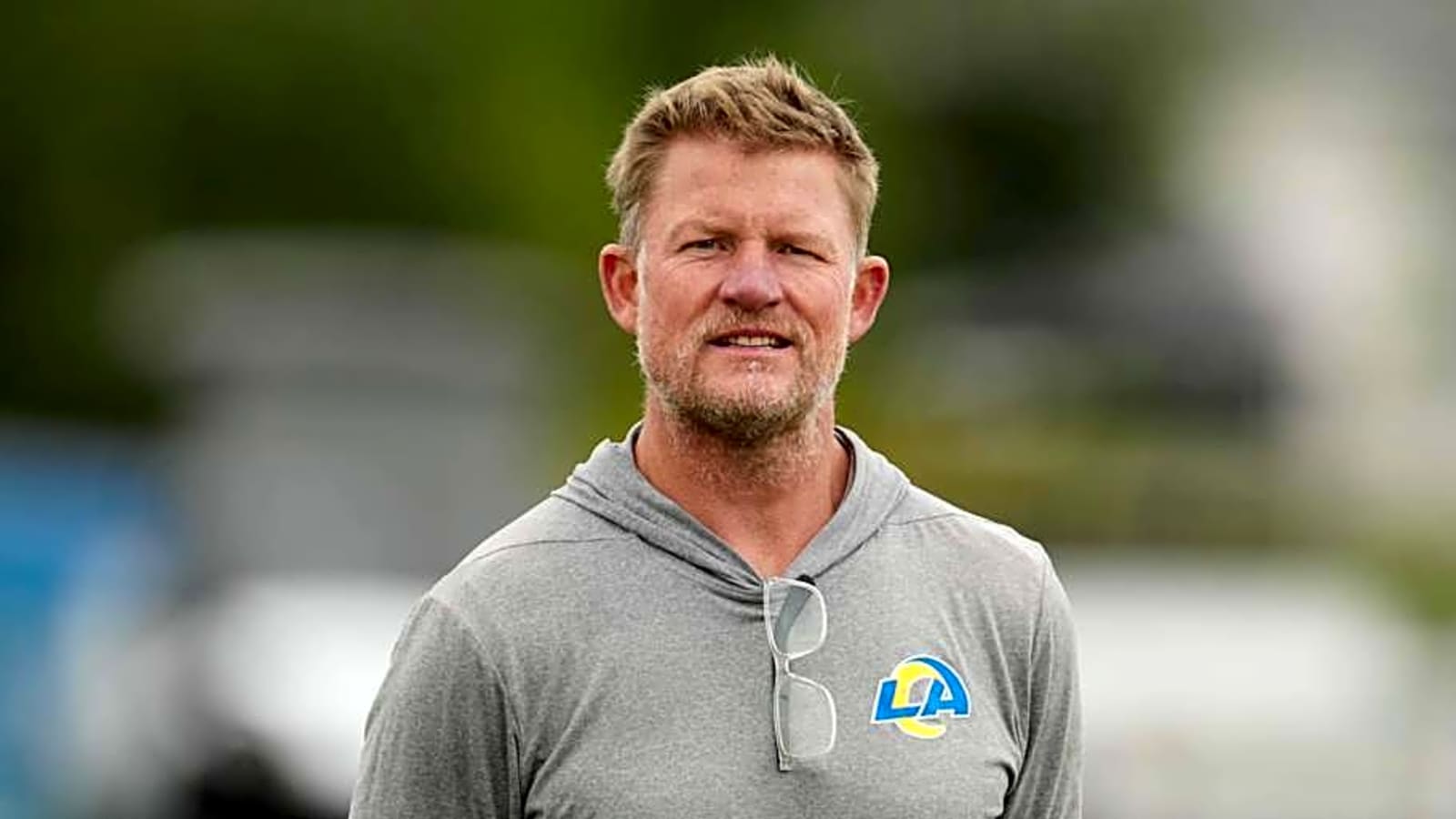
When it came to the 2026 NFL Draft, there was this idea that the Los Angeles Rams needed to make picks with the idea of “win now” and “all in” in mind. While it makes sense on the surface given how close the Rams are to a Super Bowl, it was also always unrealistic.
The ideas of ‘win now’ and ‘all in’ cannot coexist when it comes to the draft. That’s especially the case with this roster in particular.
This Rams Roster Changes the Equation
Could Les Snead have taken wide receiver Makai Lemon instead of Ty Simpson or a different wide receiver in the second round? Absolutely. That player was, at best, going to be WR3. Given that the Rams seem to be leaning towards running more 12 and 13 personnel, the third wide receiver in the offense becomes significantly less valuable. It doesn’t mean the Rams have had a disappointing draft.
“Drafting Ty Simpson) while Matthew Stafford is still in an MVP and Super Bowl window was enough to place them on this list. The Rams should have utilized that selection on an immediate contributor,” said Sports Illustrated’s Justin Melo. “In the second round, Sean McVay couldn't help himself with tight end Max Klare. Klare's selection is about securing the future, but McVay's infatuation with 13 personnel is bordering on obsession.”
It can certainly be argued that there were better picks to be made, but that’s also entirely subjective. If the issue isn’t with the players that were taken, but where they were taken, it’s an empty argument. While we can speculate whether or not a player will be available, the boards NFL teams use are different from the consensus board put together by the media. It’s not a direct reflection of how teams value certain players or how their player buckets stack up.
Why Consensus Boards Don’t Matter
The idea of a consensus board is simply to stack players based on raw talent for a theoretical team that doesn’t exist. However, that team doesn’t have needs or a specific team build plan in mind. When you’re watching a game, your mind doesn’t go to, “Well, ‘X’ team could have taken that player 14 picks later.” When Blake Corum rushed for 750 yards last year, nobody was thinking how the Rams possibly could have gotten Corum in the fourth round.
At the end of the day, the goal of the draft is to take good players. If a team likes a player and he’s at the top of or the only player left in a certain bucket, they are better off taking that player than not. General managers get one shot at the draft. They don’t have the benefit of trading down eight times and then clicking restart on the mock draft simulator when the player they wanted went off the board.
Teams can't draft a player specifically for the upcoming season. Team builds are much more complicated than that. Rookie contracts last four years. It’s hard to care about 2028 in 2026, but teams have to have that long-term vision. Team needs are much better looked at from a ‘future depth chart’ perspective than an immediate one. If a team is relying on the draft for the upcoming season, it’s already over. Rookies only make instant impacts on bad teams or at positions with a glaring hole.
When you look at the Rams, they fit neither of those categories. This is a team with a top-three roster at minimum. Looking at the depth chart, they have needs, but they are all at depth spots. Again, a wide receiver was always going to be the WR3 in the offense. A tackle or guard would have been a depth piece. A tight end will enter as the TE4 at best.
Les Snead’s Long-Term Approach Isn’t New
Over the past few seasons, the Rams have gotten immediate contributions from their rookie classes. When the Rams were drafting in 2023 with the idea of ‘retooling’ the roster, they needed high floor players that could be relied on to start. It’s why drafting Steve Avila, Byron Young, and Kobie Turner made sense. Jared Verse was drafted in the first round as the Rams had an immediate hole at edge rusher with Michael Hoecht as the No. 2 pass rusher across from Young.
The Rams roster is simply in a different place and that’s not a bad thing. In fact, it’s a testament to how good this roster has been put together. It also speaks to how well Snead has drafted in recent years. Finding a crack in this roster to carve out a significant role was going to be difficult for any rookie.
Team needs are ever-changing. A general manager can’t simply draft for need because what a team needs now might be different than what they need in four months. It’s why the next time the Rams are ‘all in’ will be closer to the trade deadline. The front office will have a better idea of what the team actually needs to make a Super Bowl push.
By taking a quarterback in this year’s draft given the flexibility of the roster, there’s no pressure to have to take one in the 2027 draft. Snead can sit at the trade deadline and evaluate the roster. If they need a pass rusher or wide receiver to make a Super Bowl push, the Rams can use their 2027 first-round pick for a proven player that can help immediately.
Rams Didn't Need Immediate Impact Players
From 2018 to 2022, it was normal for the Rams to draft with future years in mind. Joe Noteboom and Brian Allen were drafted in 2018 with the thought that John Sullivan and Andrew Whitworth were near the end of their careers. Darrell Henderson was taken in 2019, knowing that Todd Gurley’s knee had a shelf life.
There are a number of examples of the Rams drafting with that mindset during those years. The roster as currently constructed is much closer to that than the 2023 and 2024 versions where the Rams were searching to fill immediate starting roles.
When the Rams won the Super Bowl in 2021, Snead arguably had his biggest draft blunder, taking Tutu Atwell over Creed Humphrey. Ernest Jones was the best player of that class and he had minimal impact on the Rams hoisting the Lombardi.
Between nine players, the 2021 rookie class saw 689 snaps on offense and defense. Only Jones and Ben Skowronek had more than 25. Jones’ 440 snaps accounted for 43.1 percent of the defensive snaps while Skoworonek’s 179 snaps on offense accounted for 19.4 percent.
The Rams’ Draft Strategy Prioritizes Sustainability
This draft for the Rams was never about 2026. You may agree or disagree with how they’ve approached it. However, this draft was always about filling future needs and looking at where the roster lacked depth.
That’s not to say that a rookie can’t contribute on a Super Bowl roster or have an impact. However, on this roster in particular, that impact is minimal. Snead addressed the immediate needs in free agency and via the Trent McDuffie trade to provide flexibility in the draft. The Rams didn’t have to take so-called impact players because there were no immediate holes on the roster.
What the Rams did this weekend will have minimal impact on what happens in February. They didn’t sacrifice or put their Super Bowl window at risk. The Rams already had the roster to compete for a Super Bowl in 2026 and nothing they’ve done this weekend has changed that. Labeling this a ‘loser draft’ or disappointment misses how the Rams have operated. Snead’s approach is to ensure that the window doesn’t slam shut after this season. When the Rams are playing deep in January, how the Rams approached the draft won’t be the focus.
Sign up to our free newsletter and follow us on Facebook, X and Instagram for the latest news.
More must-reads:
- True-or-false for Rounds 2-3 of 2026 NFL Draft: Did Cardinals, Steelers realistically find franchise QBs?
- Winners, losers from Day 2 of 2026 NFL Draft: Browns keep adding playmakers
- The 'No.2-overall NFL Draft picks' quiz
Breaking News
Trending News




Customize Your Newsletter
 +
+




Get the latest news and rumors, customized to your favorite sports and teams. Emailed daily. Always free!
PRIVACY POLICY COOKIE POLICY CONTACT US
ABOUT YARDBARKER TERMS OF SERVICE


By using this site, you agree to our Terms of Service and Privacy Policy.
This site is for entertainment purposes only.
There is no gambling offered on this site.
Gambling Problem? Call 1-800-Gambler.
