
-

-


Follow Us
-

 On Facebook
 On Flipboard

The name came through the speakers late on a Saturday afternoon, deep into the seventh round, when the 176,000 fans who packed Pittsburgh on Day 3 of the draft had already spent their loudest moments on earlier picks. Nobody screams for pick 230. Nobody stands. Nobody holds applause for a player every scouting service in America rated at zero stars. But the crowd in Pittsburgh rose anyway, and they did not sit back down quickly. The kid walking to the stage was shaking.
The Hometown Ghost
Eli Heidenreich grew up in Mt. Lebanon, a Pittsburgh suburb, watching Steelers games with his family. He grabbed a Steelers cap, saluted the camera, and walked out swinging a Terrible Towel. The crowd recognized him before the broadcast could explain him. A local kid, drafted by his local team, in his local city, at pick 230. Steelers GM Omar Khan admitted afterward: “I wasn’t expecting to see that on TV. You can’t help but get emotional.” Even the front office got caught off guard by what that sustained roar felt like.
Zero Stars, Maximum Blind Spot

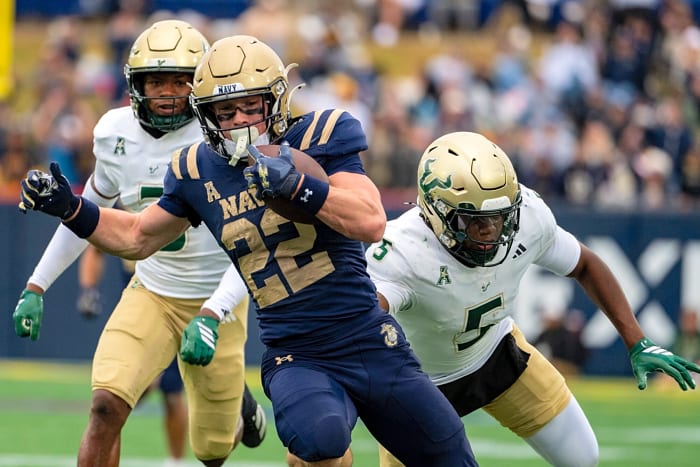
Coming out of high school, Heidenreich carried a zero-star recruiting rating. The lowest tier. The kind of grade that says: nobody is watching. Most people assume that rating sticks, that the system catches talent early and sorts it correctly. Heidenreich went to the Naval Academy, played in a triple-option offense that barely throws the ball, and quietly became Navy’s all-time receiving yards leader with 1,994 career yards. The scouting industry graded him invisible. He responded with 109 receptions and 3,206 all-purpose yards.
What the Ovation Actually Meant

Seventh-round picks usually get polite claps. Maybe a few seconds. Heidenreich got a sustained, minutes-long roar from a record-setting draft crowd. That disproportion tells the whole story. Pittsburgh wasn’t cheering draft value. They were cheering a zero-star kid from their own backyard who broke receiving records at a military academy, then heard his name called by his childhood team. Heidenreich said it himself: “I was thinking about all the time and effort. Things most people don’t know. The unseen hours. It all hit me at once.” The 10-year Marine Corps obligation waiting after his NFL career made every second heavier.
The System Nobody Scouts
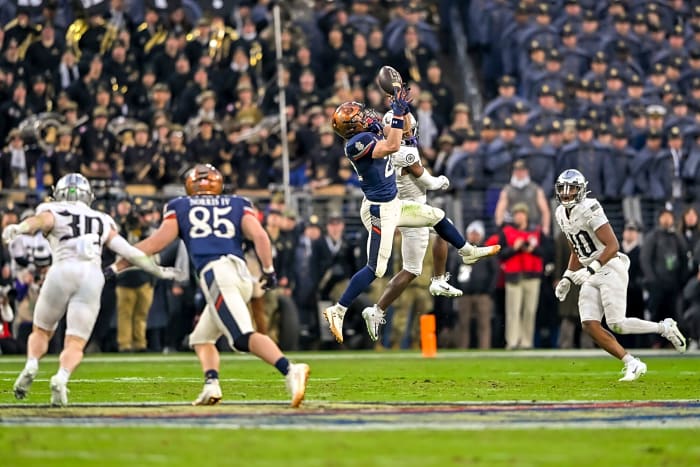
Navy runs a triple-option offense. Receivers in that scheme barely touch the ball by NFL standards. Heidenreich still posted 243 receiving yards in a single game against Air Force, setting a Navy single-game record and becoming the first Navy player to surpass 200 receiving yards in a game. He finished his career with 3,206 all-purpose yards split across rushing, receiving, and punt returns. The scouting models that rated him zero stars were built for pro-style offenses. They had no framework for what Navy’s scheme was hiding.
Numbers That Rewrite the Record Book

In his final season, Heidenreich posted 51 receptions for 941 yards and six touchdowns through the air, plus 77 carries for 499 yards and three scores on the ground. His 16 career receiving touchdowns are the most in Navy history, and his 109 career receptions rank second all-time at the school. Navy finished the season ranked and produced one of the most successful stretches in recent program history. One player. Zero recruiting stars. A stack of major program records.
The Navy Pipeline Reopens
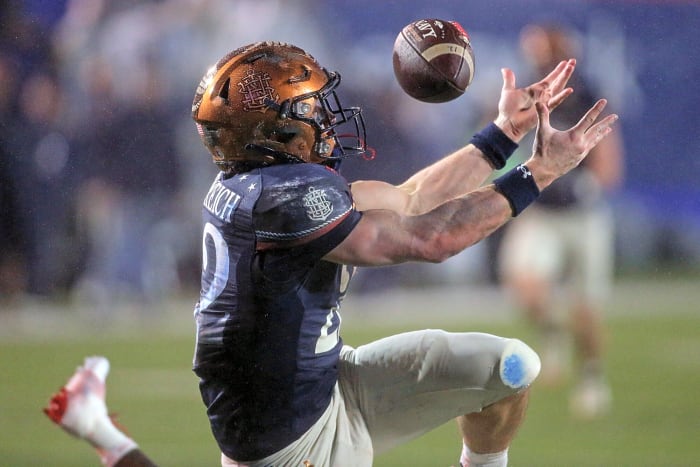
Four picks before Heidenreich, the Bengals selected his Navy teammate Landon Robinson at 226th overall. Robinson was a 2025 first-team AP All-American, a rarity for a Navy defender in the modern era. Together, according to Navy Athletics, they became the first Navy duo selected in the same NFL Draft since 1956. Seventy years between pairs. The deferment program that allows military academy athletes to pursue pro careers has also expanded in recent years, giving more Midshipmen a realistic path to the league.
Annapolis Gets Noticed Again
Navy players have been drafted only a handful of times in the last decade-plus. Two came in a single class this April. That trajectory changes how NFL front offices view Annapolis. Navy’s recent bowl success, a Commander-in-Chief’s Trophy win over Army, and a quarterback in Blake Horvath who has produced at a high level all point to a program operating at a level the scouting industry still hasn’t fully priced in. The zero-star label wasn’t a fluke. It was a systemic blind spot.
The Clock That Starts After Football
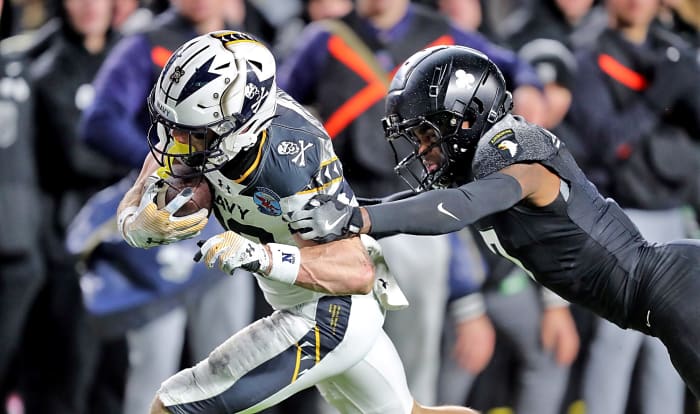
Every NFL career has a shelf life. Heidenreich’s has a second one. After football ends, a Marine Corps service obligation begins. He majored in Cyber Operations at the Naval Academy and plans to commission as a Marine officer. Most rookies worry about making the roster. Heidenreich carries the weight of a military commitment that outlasts any contract an NFL team will offer him. “It was awesome,” he said. “I had the whole spectrum of emotions. I was born and raised a Steelers fan.”
What Pittsburgh Already Knew
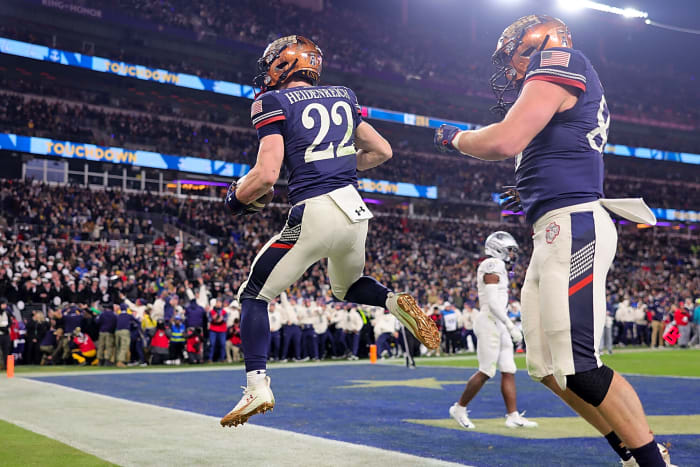
The scouting consensus missed him. The star-rating system ignored him. The draft let him fall 229 spots. And when his name finally came through the speakers in his own city, a record-setting Pittsburgh draft crowd stood and roared because they understood something the recruiting databases never captured: merit doesn’t always arrive through the front door. Heidenreich still owes the Marine Corps after his last snap. The Steelers got a football player. The crowd recognized something rarer than that.
Sources:
Navy Athletics, “Landon Robinson and Eli Heidenreich Become First Navy Duo to be Selected in the NFL Draft Since 1956,” April 25, 2026.
Pittsburgh Steelers, “Pittsburgh Sets NFL Draft Attendance Record,” Steelers.com, April 26, 2026.
ESPN, “Pittsburgh Steelers 2026 NFL Draft Picks: Full List, Analysis,” April 25, 2026.
CBS News Pittsburgh, “Pittsburgh Breaks All-Time Attendance Record for NFL Draft,” April 25, 2026.
Military.com, “Steelers Select Navy Star and Pittsburgh Native in NFL Draft,” April 26, 2026.
The Athletic (The New York Times), “Steelers Pick Pittsburgh Native Navy RB Eli Heidenreich in Draft’s Seventh Round,” April 25, 2026.
More must-reads:
- NFL Week 6 prime-time predictions: Will Broncos QB Bo Nix get back on track vs. Seahawks?
- Packers' Micah Parsons explains why he won't return from injury to play against Cowboys
- The '100-yard, 1-rushing TD games' quiz
Breaking News
Trending News


Customize Your Newsletter
 +
+




Get the latest news and rumors, customized to your favorite sports and teams. Emailed daily. Always free!
PRIVACY POLICY COOKIE POLICY CONTACT US
ABOUT YARDBARKER TERMS OF SERVICE


By using this site, you agree to our Terms of Service and Privacy Policy.
This site is for entertainment purposes only.
There is no gambling offered on this site.
Gambling Problem? Call 1-800-Gambler.
