
-

-


Follow Us
-

 On Facebook
 On Flipboard
 On Twitter
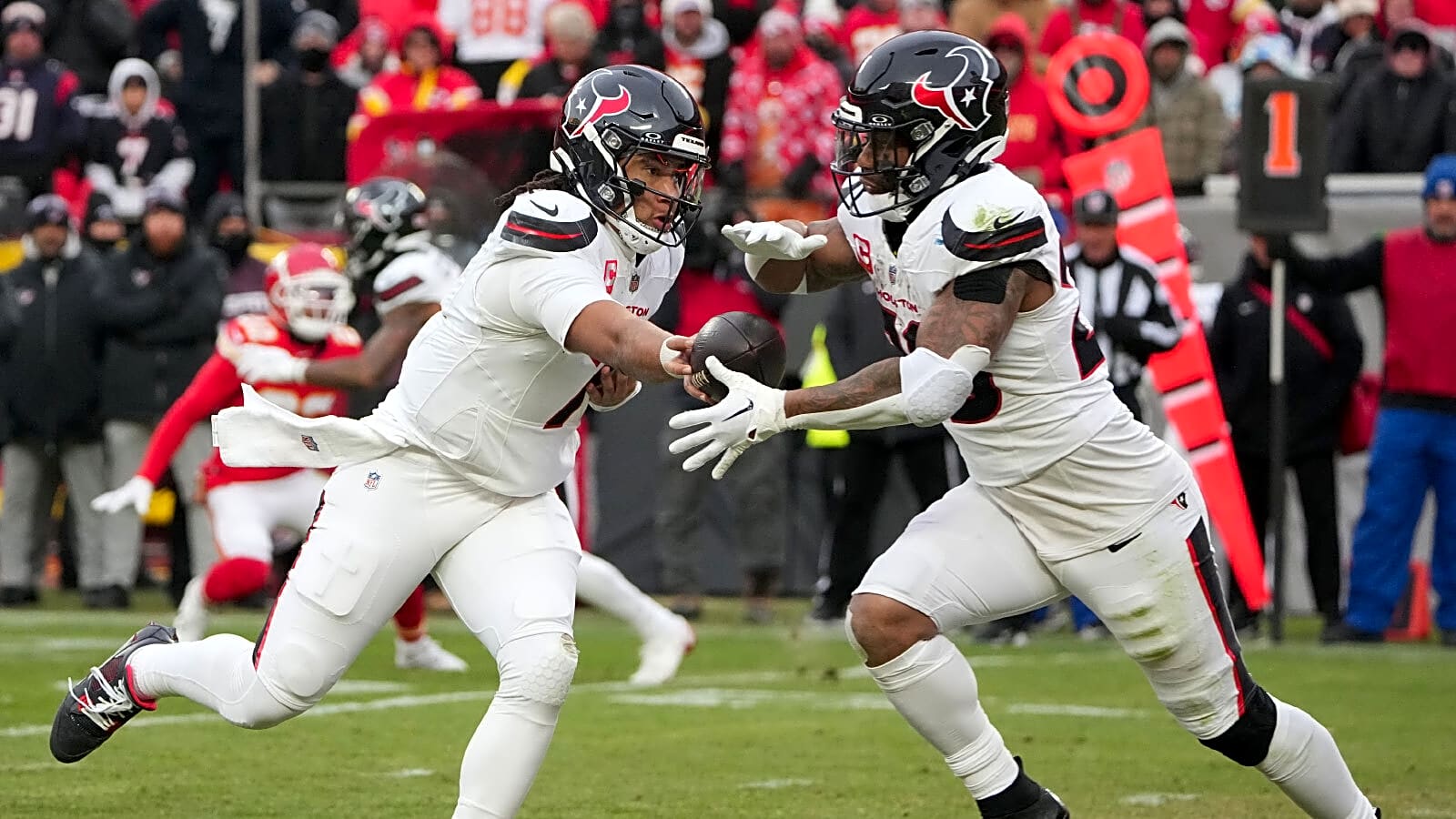
The Texans have spent the opening stretch of the offseason reinforcing the parts of the roster they already trust. Houston gave kicker Ka’imi Fairbairn a two-year, $13 million extension that made him the league’s highest-paid kicker on a per-year basis, and then added safety Reed Blankenship on a three-year, $24.75 million contract after he helped anchor Philadelphia’s defense.
Those are not draft picks, but they tell you something about how Houston is operating, and that is why this post-Combine mock-draft picture is so narrow compared with some other teams. The Texans are picking at No. 28, and most of the serious projections coming out of Indianapolis are not sending them receivers, corners, or splashy toys.
Let’s see them right now.
OT Kadyn Proctor, Alabama
Tim Crean sends Kadyn Proctor to Houston at No. 28, and he connects the pick directly to the Texans’ shift toward a heavier offensive identity.
His point is that after drafting a massive tackle in Aireontae Ersery a year ago and trading out a more conventional body type in Tytus Howard, Houston looks like a team leaning toward size and power to take some of the burden off C.J. Stroud. Proctor, at 6-foot-7 and well over 350 pounds, fits that picture in a hurry.
There is also another football reason for this, as Houston does not just need line help in the abstract.
Proctor is not a finesse projection, and he is definitely the type of blocker who can alter the edge of a run play just by arriving with mass and length, and he gives a coaching staff room to decide whether he is best outside or whether he eventually grows into an inside role if needed.
The argument against Proctor is the usual one with large-framed linemen.
You are betting on consistency as much as on talent, but at No. 28, that kind of bet makes more sense for Houston than it would for a team with no structure around it.
The Texans already have a real quarterback, a serious defense, and enough stability that they do not need every rookie to be polished on arrival.
Proctor, in that sense, feels like the kind of pick a playoff team makes when it wants to become more difficult to push around.
OT Caleb Lomu, Utah
Danny Kelly also sends Houston toward the offensive line, but he does it with a different style of tackle. In Kelly’s updated mock, the Texans take Utah’s Caleb Lomu at 28, and the write-up frames it as part of an ongoing rebuild up front after multiple starter-level changes over the past two years.
Kelly points to Lomu’s feet and natural movement skills as the appeal, especially for a team that still needs a long-term answer on the blind side.
Proctor looks like the choice for a team wanting to get bigger and meaner, but Lomu looks like the choice for a team wanting the edge of the line to feel calmer.
Houston’s offensive line has not just been a strength-versus-weakness problem, but has been a comfort problem.
He playing for the Texans also works because the team is not drafting in a spot that forces them to chase flash.
At the back end of the first round, a steady tackle prospect can be more useful than a more glamorous player at a less urgent position, and that is especially true for Houston, because it already made one major backfield move by trading for David Montgomery.
Once you add a back like that and extend a kicker like Fairbairn, you are making it obvious that you want the offense to function with more control and fewer wasted possessions.
A tackle who can protect the edge of that plan has real value.
DT Peter Woods, Clemson
In a break from the offensive line trend, Greg Auman selects Clemson defensive tackle Peter Woods for the Texans.
He reasons that while Houston should ideally focus on offense, if six offensive linemen are already off the board, a disruptive tackle becomes hard to overlook, especially if Sheldon Rankins is not re-signed. Auman describes it as a “rich-get-richer” situation, which seems accurate.
This selection reflects a front office that believes the roster is strong enough to prioritize quality over immediate needs.
Woods is particularly appealing because he doesn’t fit the traditional mold of a plug-style nose tackle.
Instead, he is an interior defender capable of making guards uncomfortable, succeeding with quickness, and altering the offensive play before the quarterback even reaches his second read.
This type of player influences a defense differently than an edge rusher, because he shortens the middle of the pocket, disrupts quarterback movements, and turns clean throwing lanes into crowded spaces.
With Danielle Hunter and Will Anderson Jr. already on the edges, adding an impactful interior player makes the defense even more formidable.
What makes this projection credible is Houston’s history of addressing the offensive line through various means.
They extended Ed Ingram, re-signed Trent Brown, and have made additional moves, indicating that the line will continue to be a priority outside the draft.
If the board at pick 28 favors defense, and Woods is still available, the Texans would be wise to select a defender who could make an already strong front even more aggressive.
DT Kayden McDonald, Ohio State
In another mock draft, Ryan Wilson selects Ohio State’s Kayden McDonald, another defensive tackle, for Houston. He believes the Texans would likely prefer an interior offensive lineman at this position, but if the options there are limited, McDonald would make sense as the best run-stuffing tackle available.
McDonald offers a different type of fit compared to Woods, and while Woods is focused on disruption and movement, McDonald emphasizes weight and ensuring the run game doesn’t gain easy yards inside.
This ability is crucial for them; although Houston has notable edge talent, the defense must also be proficient during fundamental downs.
They need to effectively manage first-and-10 situations and aim for second-and-8 instead of second-and-4. McDonald can contribute to that effort, a valuable trait, especially in late-season games when these moments matter most.
What should the Texans do in the NFL Draft?
This selection would also signal a level of trust for them, of course. If the Texans opt for a defensive tackle instead of the remaining offensive options, it indicates they are confident in their offseason offensive plan and willing to choose the stronger player.
While this may not be the decision fans want to hear, it aligns with how teams drafting in the 20s often operate when they believe their window for success is open.
The latest mock draft insights from Houston are intriguing in a recurring debate.
Some evaluators argue that the Texans must prioritize finishing the offensive line rebuild, while others believe the roster’s strength allows for selecting a high-end defensive tackle if one becomes available, trusting that offensive fixes can happen elsewhere.
Both viewpoints are defensible since Houston is no longer drafting from the league’s bottom and is now in a position where good teams must decide whether to play it safe or take risks.
This first-round pick, therefore, feels more significant than the position itself indicates.
The draft will ultimately reveal whether the Texans aim to simplify things for Stroud or complicate matters for their opponents.
More must-reads:
- NFL Draft intel: Jeremiyah Love destinations, O-line help for Raiders and Ty Simpson-Cardinals buzz
- Patriots set to pay former Packers WR Romeo Doubs handsomely to replace Stefon Diggs
- The '4,500-yard NFL passers' quiz
Breaking News
Trending News





Customize Your Newsletter
 +
+




Get the latest news and rumors, customized to your favorite sports and teams. Emailed daily. Always free!
PRIVACY POLICY COOKIE POLICY CONTACT US
ABOUT YARDBARKER TERMS OF SERVICE


By using this site, you agree to our Terms of Service and Privacy Policy.
This site is for entertainment purposes only.
There is no gambling offered on this site.
Gambling Problem? Call 1-800-Gambler.
