
-

-


Follow Us
-

 On Facebook
 On Flipboard


Montreal Canadiens fans have heard it all offseason, how the team has improved this summer, despite general manager Kent Hughes not having done anything to add to his roster. The implication is clear, in that the Habs, in becoming the youngest team to advance to Round 3 since the 1993 Stanley Cup-winning team, have a bright future ahead.
My annual offseason look at which NHL teams improved the most this summer.https://t.co/tsLFu2ijMM pic.twitter.com/UOhR53Pb14
— dom(@domluszczyszyn) July 16, 2026
The Canadiens might have fallen short, succumbing to the championship Carolina Hurricanes in a mere five games. However, as the Habs’ core enters its prime, through sheer organic growth, the team should improve all on its own. At least, that’s what most people believe, but how specifically will they be better in 2026-27? Here are the top three ways:
3. A Deadly Second Line if Canadiens Want It
After benefitting from a full season of rookie Ivan Demidov, it became clear the Canadiens have the beginnings of a team with two high-powered offensive lines, when, in the recent past, they had to make do with only one: Nick Suzuki, Cole Caufield and Juraj Slafkovsky.
Granted, it took a few injuries early on for the Canadiens, namely to Alex Newhook, to drop Slafkovsky down to the second line and settle on a unit of Oliver Kapanen between him and Demidov, but two things:
- Once they did, Slafkovsky found his game after starting off the season with just nine points (six goals) in his first 20 games, ending with a career-high 30 goals and 73 points.
- Before getting injured, Newhook had gotten off to the best start in his career playing with Demidov, with six goals and 12 points in his first 15 games.
When Newhook returned from his broken ankle in early March, he technically picked up where he left off, with two goals and four points in his first three games, but playing with Jake Evans. He eventually returned to the Demidov line, ultimately totalling a relatively modest 25 points (13 goals) in 42 games before coming alive in the postseason with seven markers and nine points through the first two rounds.
Based on that level of success, which most notably saw him score the Game 7-winning goal in each case, Newhook has earned another shot on that second line. However, it should be a comfort to know that Slafkovsky remains an option, if the Canadiens ever feel a need to spread the proverbial wealth around. It’s also a comfort it’s not just the Demidov effect, in that Slafkovsky took his and the games of Suzuki and Caufield up another notch upon returning to the top line, scoring 26 points (nine goals) in his final 22 games.
The bottom line is, not only has Demidov altered the makeup of the team. Slafkovsky has also added another dimension to the top six as well, giving the Canadiens the option of rolling two lines (if not more) with two players capable of driving the play on each, which contributed to the seventh-ranked offense in the league. Entering last season, that really wasn’t necessarily foreseen. Now it most definitely should be (if not more so).
2. Dobes in Net
Last year at around this time, the offseason acquisition of Noah Dobson was seen as a catalyst to more of a refined defense, which ended up coming to fruition, at least somewhat. The Canadiens gave up an 18th-ranked 27.8 shots per game, down significantly from earlier on in the rebuild. However, it was only after the Habs began riding rookie Jakub Dobes down the stretch that goals allowed per game (3.06), which ranked 16th overall to end the season, began to reflect the team’s improved outlook in their own end of the ice.
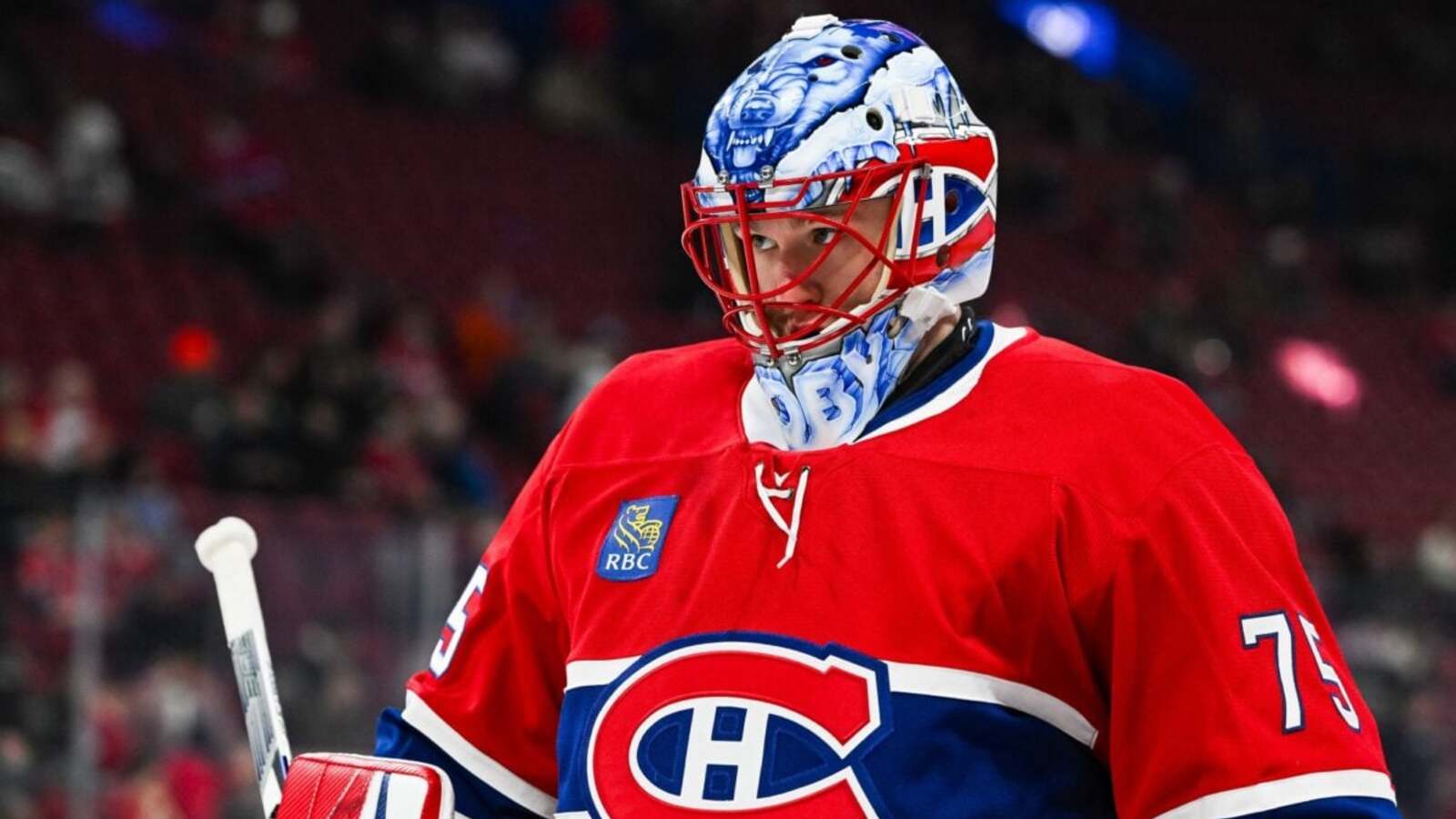
It was coincidentally Slafkovsky’s first game back on the top line against the Anaheim Ducks on March 6 in which it became clear then-starter Sam Montembeault, who went 10-8-4 with a 3.43 goals-against average (GAA) and .872 save percentage (SV%), had run out of leash. He gave up one goal seconds into the contest that got called back, but then gave up another right after play resumed and ultimately five total, including not only the game-tying marker in the final minute, but also several of the soft, long-distance variety. He never saw the net again.
After yo-yoing between him and Dobes up to that point (and at times Jacob Fowler in an ill-advised three-goalie rotation), the Canadiens then gave the net to Dobes, who proceeded to go on a 10-4 run with .924 save percentage (SV%). He was arguably even better in the postseason, when he posted a 2.66 GAA and .908 SV%, but also a league-leading 13.3 goals saved above expected (per MoneyPuck.com).
Canadiens fans can admittedly claim to have seen this same story unfold before. Montembeault captured their hearts the previous season, when he was among the league leaders in that same statistical category, leading many analysts to suggest goaltending would be a strength for the team in 2025-26, when it ended up being their greatest weakness in the regular season. So, why does it feel different now?
Montembeault will be 30 in October. When he had been acquired at Age 25, he wasn’t really acknowledged as a legitimate NHL goalie. To his credit, he grew into the role, but, as a third-stringer at the time, he had been unlikely to ever develop into a consistent NHLer, let alone starter. In Dobes, who is now 25, it appears they’ve found a goalie on the rise, who has seemingly reached a level of consistency that Montembeault really only enjoyed over the course of a single season in 2024-25, before he fell back to Earth.
In Montembeault’s defense, he didn’t exactly have the benefit of playing behind the same calibre of team that Dobes does. In the early going of his Canadiens tenure, he seemed to serve the role of fodder in net and little more. However, when the team in front of him finally reached his level of play, he undeniably struggled, whether as a result of him starting to decline, previous injuries catching up to him or simply an inability to meet heightened expectations. Whatever the reason, it paved the way for Dobes, who did.
1. Salary Cap Structure
Dobes is one of several Canadiens players who have recently signed relatively sweetheart extensions with the team, contributing to a fairly rosy outlook from a salary-cap perspective. Whereas entering last season, the team was seen as being in just decent shape in that regard, they’re now considered one of the darlings of the league, especially after having traded Brendan Gallagher and with Patrik Laine having hit unrestricted free agency.
For context, Gallagher had had what was generally considered the worst contract on the team going on a few seasons, with a cap hit of $6.5 million. While the Canadiens are admittedly retaining half of that, their worst contract is now arguably Montembeault’s with a $3.15 million hit. Both contracts also come off the books at the end of the season, making them far from albatrosses, based on how the Habs were even able to offload Gallagher’s at all.
Whether or not Montembeault’s follows, the Canadiens find themselves in an enviable position. They have $9.78 million in cap space currently, just defenseman Arber Xhekaj and forward Zachary Bolduc to re-sign and the flexibility to pull off several big moves, if the situation calls for it. Based on the lack of high-impact options available in free agency this summer, it’s understandable that Hughes held off on signing anyone. However, in the future, it’s good to know the Habs can, but won’t necessarily have to add to their team via free agency to contend. After having just reached Round 3, it looks like they’re already there.
More must-reads:
- Michael Wilbon tears into Connor Hellebuyck after goalie’s trade request
- Clemson officially announces starting quarterback ahead of LSU matchup
- The 'Last 3-HR game by MLB team' quiz
Breaking News
Trending News






Customize Your Newsletter
 +
+




Get the latest news and rumors, customized to your favorite sports and teams. Emailed daily. Always free!
PRIVACY POLICY COOKIE POLICY CONTACT US
ABOUT YARDBARKER TERMS OF SERVICE


By using this site, you agree to our Terms of Service and Privacy Policy.
This site is for entertainment purposes only.
There is no gambling offered on this site.
Gambling Problem? Call 1-800-Gambler.
