
-

-


Follow Us
-

 On Facebook
 On Flipboard

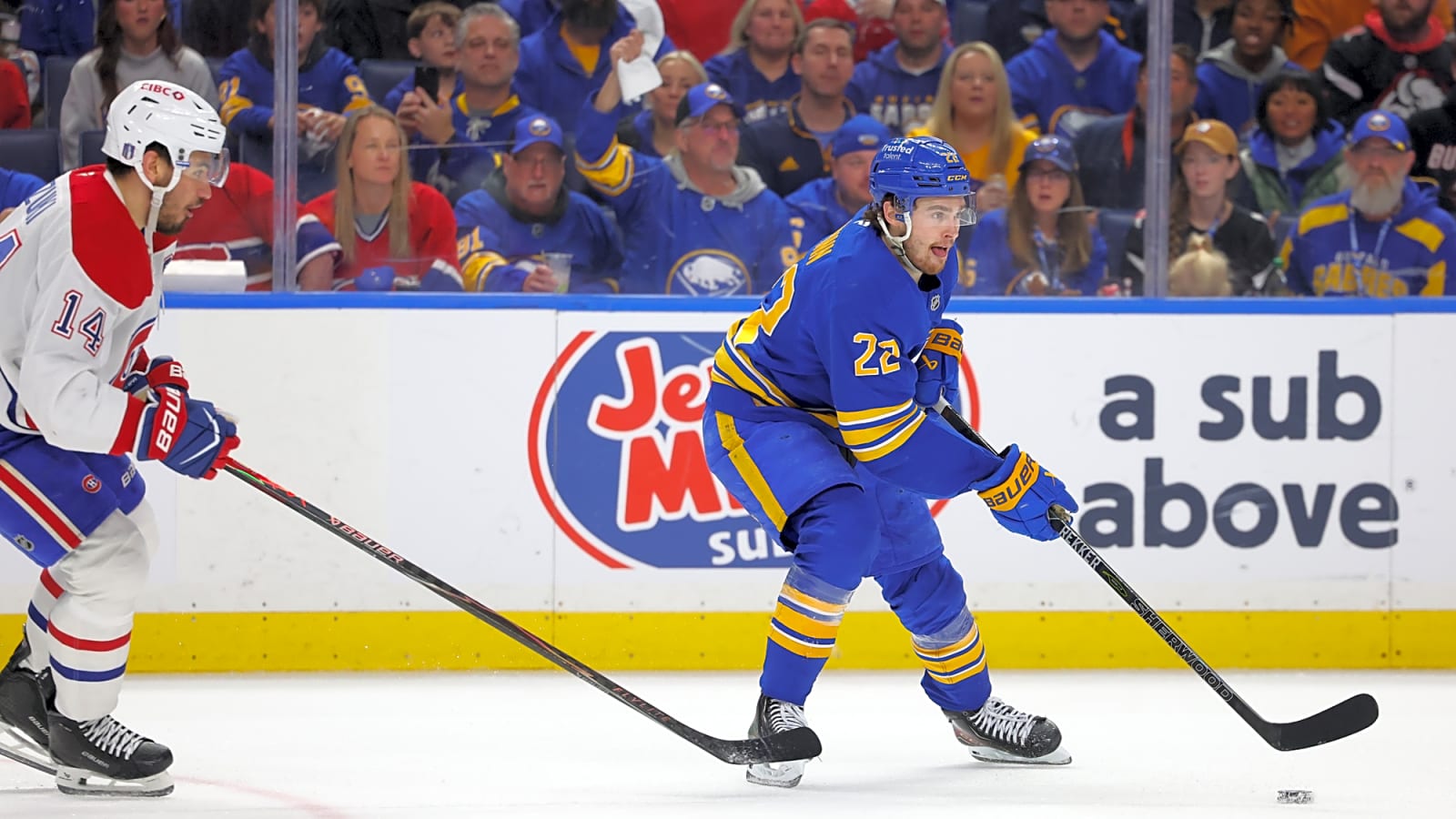
The Buffalo Sabres have effectively locked up their entire young core for the foreseeable future, with one glaring omission: forward Jack Quinn. Louis Crevier is also unsigned beyond this year, but given that he was recently acquired in the Bowen Byram trade, it would make sense that Buffalo wants to see how he fits and what his potential is with the Sabres before locking him up to an extension. But Quinn has now been in Buffalo for four full NHL seasons, and with Noah Ostlund’s extension, he remains the sole member of the young core without the security of years on his contract. Now, there are many reasons why Quinn could be the odd man out at the moment, with one key factor being that he only became eligible to sign an extension two months ago. With Ostlund, Zach Benson, Josh Doan, and Peyton Krebs all signing extensions in the past year, it’s fair to wonder when Quinn will get his deal.
Quinn is heading into the final season of a two-year $6.75MM contract and will be an RFA on July 1st, 2027. This past season, he finally had the kind of year that showed his true offensive potential, notching 20 goals and 31 assists in 82 games, all of which were career highs. That kind of improvement can’t be overlooked, but it’s fair to wonder whether that is his ceiling, a mirage, or if he has more to give. Obviously, if Buffalo were to ink Quinn right now, he’d be looking at a sizeable raise on his next deal, but question marks remain, and that could be part of the internal discussion around Sabres management.
One of the key questions entering last season was Quinn’s health, but he proved he can play an entire season, dressing for all 82 games. Prior to that, the Cobden, Ontario, native had played only 176 games over his first three NHL seasons, averaging fewer than 60 games per season. Realistically, though, he played at least 74 games in two of those seasons, except in 2023-24, when injuries limited him to just 27. Those injuries are a concern and part of the overall assessment Buffalo will need to complete as it decides how to proceed with Quinn’s contract. Ultimately, the Sabres will need to determine whether Quinn is on track to realize his full offensive potential or whether the 50–60-point range is his ceiling in the NHL.
It is interesting to compare Quinn to Benson, whose recent seven-year, $7.5MM deal came after a 43-point season and a fantastic playoff appearance, in which Benson posted nine points in 13 games. For comparison, Quinn is 24, just had a 51-point season, and was an eighth-overall pick (2020), while Benson is 21, just had a 43-point season, and was the 13th overall pick in 2023. Quinn has shown himself to be a better offensive contributor, but so far the Sabres may see more stability in Benson’s two-way game, playoff performance, and potential. Could Quinn top Benson’s AAV on his next deal? What about Östlund?
Östlund just signed an eight-year deal worth $6.6MM annually after posting 11 goals and 27 points in 60 games at age 22. There is no comparison to last year offensively, yet Buffalo hasn’t jumped on a long-term deal with Quinn. Is it possible the Sabres want to be prudent and make sure Quinn is what they hope he is? Or maybe they want to buy low or see Quinn as a potential trade chip. Either way, it’s a gamble, but maybe it’s one the Sabres need to make to be sure of what Quinn will give them. If he scores 70+ points next year, his number will obviously go up, but if he hovers around 50 points again, they may be able to get him at a lower number than they would right now.
The downside to waiting is obvious, though. If Quinn has a breakout into another tier, something along the lines of 30 goals and 70 points, sprinkled in with a solid playoff performance, it’s entirely possible he starts to thrust himself into an entirely different stratosphere when it comes to AAV. Suddenly, $8MM-$9MM could be on the table, which would further strain the Sabres’ long-term cap-space flexibility.
The Sabres could also bridge Quinn next summer, as he isn’t eligible to be a UFA until 2027. They have done a lot in the past year to change the perception of the organization by locking up their young pieces long term. For years, the Sabres were criticized for having no direction and failing to retain young players, but that narrative is shifting as the team builds a long-term salary structure that they will need to fit Quinn into if they plan to keep him long term.
Buffalo doesn’t have much pressure to extend Quinn right now, and it’s likely they will let it play out a bit longer before committing. With a three-year window and plenty of uncertainty around the player, the Sabres have no reason to rush. They could always move him down the line if he prices himself out of Buffalo, or they could let him walk as a UFA if he doesn’t become the player they wanted. Waiting carries a great deal of risk, but so does extending a young player with an injury history who just had a career year.
The Sabres have spent years trying to find the right mix to finally emerge as a contender, and it’s starting to look like they have. They’ve been very assertive about locking them up and keeping them in Buffalo, and as more young players come into the fold, they can also use some of them as trade capital to fill holes in the roster. It’s entirely possible that Quinn becomes the player to trade or the player to keep in the fold, but one thing is for sure: the Sabres have time on their side and no reason to panic. Quinn has a chance to prove himself once again and make a lot of money on his next deal if he can.
More must-reads:
- Extending Ryan Warsofsky makes sense for Sharks early in Macklin Celebrini era
- Red Wings' Dylan Larkin breaks silence after trade request, but says little
- The 'Most lefty-homers in a season' quiz
Breaking News
Trending News







Customize Your Newsletter
 +
+




Get the latest news and rumors, customized to your favorite sports and teams. Emailed daily. Always free!
PRIVACY POLICY COOKIE POLICY CONTACT US
ABOUT YARDBARKER TERMS OF SERVICE


By using this site, you agree to our Terms of Service and Privacy Policy.
This site is for entertainment purposes only.
There is no gambling offered on this site.
Gambling Problem? Call 1-800-Gambler.
