
-

-


Follow Us
-

 On Facebook
 On Flipboard


The Toronto Maple Leafs already know what William Nylander can do with the puck. He has spent years proving that. Even in a season when almost everything around him seemed to go sideways, Nylander scored 30 goals and 79 points in just 65 games. That works out to a 100-point pace over a full season, and he led the Maple Leafs in scoring by eight points despite playing 17 fewer games than John Tavares. There really isn’t much left to prove about his offensive ability.
The more interesting question heading into 2026-27 is what else the Maple Leafs can reasonably expect from him. Nylander is no longer the young, immensely talented player whose occasional lapses could be explained away as part of growing up. He turned 30 in May, is entering the third year of his eight-year contract and is now one of the senior players in the organization. Meanwhile, Auston Matthews is coming off a difficult season of his own. For Toronto, the challenge isn’t simply getting their stars to produce. It’s about figuring out how to get the best versions of both on the ice.
William Nylander Has Nothing Left to Prove About Scoring
Nylander’s offensive season was excellent, even if it wasn’t always a comfortable one to watch. His 1.22 points per game was the best rate of his NHL career, and there were stretches when he looked almost impossible to defend. Coming off an 11-game goal drought, he erupted for four points against Pittsburgh and then put together a 16-point run over nine games. For a while, it looked as though the Maple Leafs might actually rescue their season, winning seven of nine games around that stretch.
But there were also too many nights when the player on the ice didn’t quite match the player in the statistics. His engagement came and went. There were casual plays with the puck, poor backchecks and stretches when it seemed as though another level was available. His minus-14 was the worst of his NHL career, although that number needs plenty of context because Toronto was a poor team. John Tavares was minus-28, and Matthew Knies was minus-30. Still, anybody who watched Nylander regularly knows the criticism wasn’t entirely made up.
Some of that may have been connected to the strange season happening around him. Nylander dealt with injuries, including a lower-body issue that sidelined him for an extended period. Even stranger, there appeared to be some tension between him and former coach Craig Berube. None of us knows what was happening behind closed doors, so it would be foolish to blame everything on that relationship. But new head coach Jim Hiller now gives Nylander a fresh start. Nylander’s ability to score isn’t the question. The bigger question is whether he can bring that same level of engagement more consistently and understand that, at 30, his actions carry more weight.
Auston Matthews Needs to Be Unleashed Again
Matthews has a different problem. He doesn’t need to prove that he can be responsible defensively or handle difficult minutes. In fact, there is an argument that Toronto asked him to do too much of exactly that last season. Matthews spent enormous amounts of time dealing with difficult matchups, often without anything resembling a high-end right winger beside him. The result was a season in which the team got plenty of work from their captain but not enough of the offensive dominance they have come to expect from him.
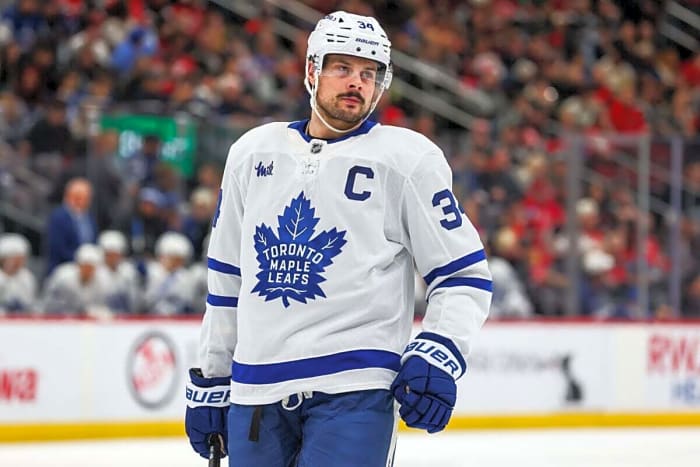
That is where Hiller’s arrival becomes interesting. The new coach has talked about getting Matthews back to having the puck more, attacking with it, playing creatively and, perhaps most importantly, celebrating offence again. The Maple Leafs also added Nick Paul, Colton Sissons, Teddy Blueger and Brandon Duhaime, giving Hiller more options for the difficult checking work that Matthews was frequently asked to absorb. If those players take some of that burden, Matthews can spend more of his time doing what he does best.
And then there is the possibility of putting Matthews and Nylander together again. During Hiller’s previous three seasons in Toronto, the two played 1,342 five-on-five minutes together and outscored opponents 76-47. That’s pretty persuasive evidence. It didn’t work nearly as well last season, when they finished 13-13 in five-on-five goals, but the team was also much different and much thinner. If Easton Cowan or Gavin McKenna emerges as a legitimate top-six player, Hiller may have enough depth to put his two best offensive players together without leaving the rest of the lineup exposed.
What’s Next for the Maple Leafs?
There is a temptation to focus on what players like Nylander and Matthews don’t do well. That can cause us to forget why the Maple Leafs committed so much money to them in the first place. Nylander can be one of the most dangerous wingers in the NHL, while Matthews remains one of the league’s premier goal scorers. The goal shouldn’t be to turn either player into something else.
For Nylander, that means maintaining the creativity and confidence that make him special while becoming more consistent in the details and the moments that require leadership. For Matthews, it may mean the opposite: taking away some of the responsibility that has consumed his game and giving him more freedom to attack. Hiller has the opportunity to make both changes at the same time.
The Maple Leafs have spent plenty of time talking about changing the culture, the roster, and the way they play. Perhaps one of the simplest changes is to let their two best offensive players be better versions of themselves. Nylander needs to grab the responsibility that comes with being a veteran star. Matthews needs to rediscover the freedom that made him one of the most dangerous scorers in hockey. If Hiller can find that balance, Toronto might have more offensive firepower than last season’s record suggested.
More must-reads:
- Michael Wilbon tears into Connor Hellebuyck after goalie’s trade request
- Clemson officially announces starting quarterback ahead of LSU matchup
- The 'Last 3-HR game by MLB team' quiz
Breaking News
Trending News






Customize Your Newsletter
 +
+




Get the latest news and rumors, customized to your favorite sports and teams. Emailed daily. Always free!
PRIVACY POLICY COOKIE POLICY CONTACT US
ABOUT YARDBARKER TERMS OF SERVICE


By using this site, you agree to our Terms of Service and Privacy Policy.
This site is for entertainment purposes only.
There is no gambling offered on this site.
Gambling Problem? Call 1-800-Gambler.
